What is Mindwalk?
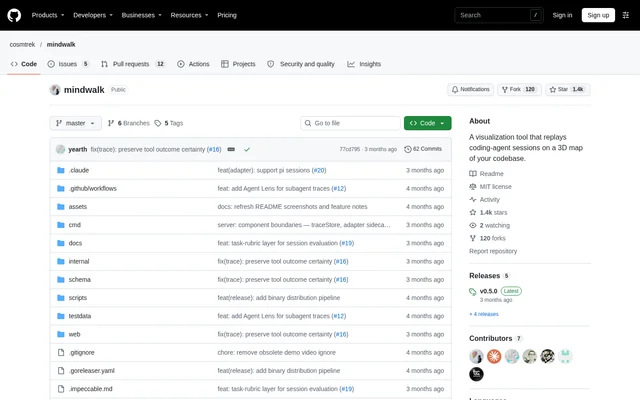
Mindwalk is an open-source visualization tool for replaying coding-agent sessions on a 3D map of a codebase. Mindwalk helps developers inspect which parts of a repository an agent treated as relevant, where exploration happened before edits, and whether the resulting footprint matched the intended scope. Supported session logs come from Claude Code, Codex, and pi.
Mindwalk represents repository activity through illuminated file locations rather than requiring reviewers to read raw JSONL logs line by line. A local Go server serves a React/Three.js interface in the browser. Session viewing stays on the user's machine; optional model-based evaluation follows a separate, explicitly requested workflow.
What Mindwalk can do
Mindwalk combines repository visualization with navigable session playback. Tree and terrain views show file activity, while touch states distinguish seen, read, edited, and unvisited files. Files touched during a session that no longer exist in the repository remain visible as wireframe ghosts, preserving context for the replay.
- Mindwalk replays session activity over a bucketed timeline histogram.
- Mindwalk opens file visit histories and jumps to selected events.
- Mindwalk switches between main-session and subagent traces.
- Mindwalk highlights error rate, churned files, and edits after the last verification.
- Mindwalk exports playback as a .webm video entirely client-side.
- Mindwalk generates repository maps and normalized trace JSON.
How Mindwalk works
Mindwalk starts from a local command and, without arguments, scans the default Claude Code, Codex, and pi session directories. Mindwalk serves the interface on a random local port and opens a browser. Commands can also open a specific session file, display a repository without a session, or write map and trace artifacts.
Mindwalk keeps normalized session traces, deterministic repository maps, and evaluation reports separate. Optional evaluation calls the user's Claude or Codex CLI with task wording, file paths, and event digests. The judge runs without tools, MCP servers, user or project settings, or session persistence. Cached reports become stale when session content changes and do not rerun automatically.
Who Mindwalk is for
Mindwalk serves developers who want to examine coding-agent behavior beyond a chronological log. Repository maps make exploration and editing footprints visible, while playback and file inspection support closer review. Mindwalk also supports evaluating whether an agent explored relevant areas, stayed within scope, wandered, or performed verification, with findings linked to session evidence.
- Mindwalk helps reviewers compare agent activity with the requested task scope.
- Mindwalk helps developers inspect subagent work within a larger session.
- Mindwalk supports repository exploration without an attached session.
Mindwalk licensing and installation
Mindwalk is an open-source project distributed under the MIT license. The repository provides an installation script that verifies the binary against checksums and installs locally. Windows archives are available through GitHub Releases. Developers can also build Mindwalk from source, and Nix users can obtain Mindwalk through the documented numtide/llm-agents flake.
Mindwalk strengths and limitations
Mindwalk combines local session viewing, comparable repository layouts, and evidence-linked evaluation. Evaluation reports distinguish fixed process dimensions from task-specific criteria, and verdicts are rolled up mechanically from finding severities. When a log cannot establish whether a criterion was met, the report marks the missing evidence as no signal rather than treating the gap as failure.
- Mindwalk requires local installation and command-line use.
- Mindwalk sends session summaries to the configured model only when evaluation is explicitly requested.
- Mindwalk skips task scorecards when sessions lack tool events or sufficient task text.
Mindwalk FAQ
What is Mindwalk?
Mindwalk is an open-source visualization tool that replays coding-agent sessions on a 3D repository map. Mindwalk shows where agents searched, read, and edited files, helping developers inspect the relationship between agent activity and the requested task.
Which coding agents does Mindwalk support?
Mindwalk reads session logs from Claude Code, Codex, and pi. Mindwalk can scan their default local session directories or open a specific session file, and Mindwalk can replay correlated subagent traces on the same repository map.
Does Mindwalk send session data to external services?
Mindwalk sends nothing while sessions are being viewed locally. Optional evaluation sends the selected session's task wording, file paths, and event digests through the user's Claude or Codex CLI to the model behind that account, only when explicitly requested.
How does Mindwalk evaluate coding-agent sessions?
Mindwalk uses a local agent CLI to evaluate exploration, scope, wandering, and verification, alongside criteria drafted from the user's task wording. Findings cite clickable timeline events, and verdicts are calculated from finding severities rather than directly chosen by the model.
How can developers install Mindwalk?
Mindwalk is available through an installation script, Windows release archives, or a source build. Mindwalk's installer verifies the binary against checksums before installation, and the repository also documents access through the numtide/llm-agents Nix flake.
From the community
No reviews yet
Be the first to review this tool. What you write helps the next person choose.