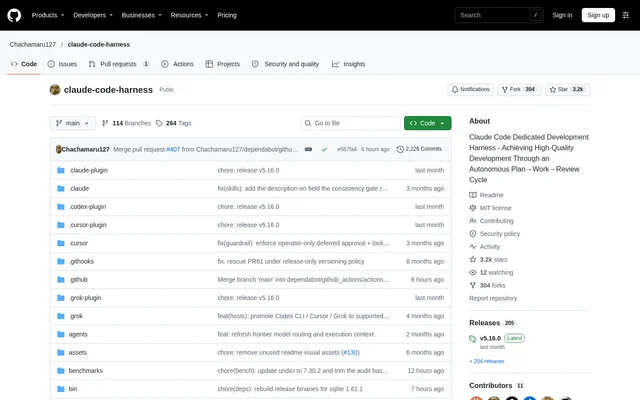
What is claude-code-harness?
claude-code-harness is an open-source development harness for organizing coding-assistant work through planning, implementation, and separate review. Developers delegate the preparation and execution of tasks while deciding the intended outcome, completion criteria, and permitted actions. The repository documents verified integration paths for Claude Code, Codex CLI, Cursor, and Grok, rather than promising identical behavior across every assistant.
claude-code-harness stores specifications in spec.md and tasks in Plans.md. These files act as a shared job sheet and checklist: the assistant drafts and updates the records, while the user approves the intended result. Recorded progress describes task completion, not proof that every feature works.
What claude-code-harness can do
claude-code-harness provides reusable instructions for planning, work, review, status checking, and release preparation. Approved tasks receive the checks specified in their plan. When test-first development is required, the assistant demonstrates a failing test before implementing the fix and runs the test again afterward. Failed checks remain unfinished work rather than being treated as successful completion.
- claude-code-harness drafts specifications, tasks, completion criteria, and unknowns.
- claude-code-harness works through approved tasks with checks and corrections.
- claude-code-harness requests review separate from implementation.
- claude-code-harness compares recorded plans with observed project state.
- claude-code-harness prepares release plans and publication checks.
- claude-code-harness recovers recorded work after interruptions.
How claude-code-harness works
claude-code-harness requires an installed, signed-in coding assistant and a project folder the user can write to. Claude Code users add the repository's marketplace, install the harness plugin, and run /harness-setup. Setup prepares project instructions and checks, and the documentation asks users to review proposed project changes before accepting them.
claude-code-harness starts a typical task with /harness-plan, which drafts the proposed behavior, implementation scope, tests, and unresolved questions. After approval, /harness-work all executes approved tasks and /harness-review requests separate review. Codex uses the corresponding dollar-prefixed commands. Other supported tools have setup scripts, and script-based installation begins by cloning the repository.
Who claude-code-harness is for
claude-code-harness serves developers who already use coding assistants and want explicit plans, visible task records, and separate review. The documented starting point is a small change with an observable result, such as preventing a contact form from sending duplicate messages. Larger approved jobs can be divided between agents, while the user remains responsible for judging the actual result.
- claude-code-harness supports bug fixes with explicit acceptance criteria.
- claude-code-harness supports checking test evidence before publication.
- claude-code-harness supports resuming interrupted development work.
- claude-code-harness supports preparing releases that require approval.
claude-code-harness pricing and plans
claude-code-harness is free to use and modify under the MIT license and is available through its public repository. Coding assistants, model providers, and connected services retain their own fees and terms. Additional workers, reviews, and repeated attempts can consume more of those services. The harness does not supply an account or a universal spending cap.
claude-code-harness strengths and limitations
claude-code-harness combines persistent project records, separate review, and execution-hook checks. Its bundled Go-native guardrail engine does not require Node.js to run. Permission rules cover operations such as external sends, secret reads, and production deployment, but the documentation explicitly warns that these checks do not guarantee containment of every command. Coverage depends on the tool and how an operation is launched.
- claude-code-harness does not give Cursor traditional filesystem isolation.
- claude-code-harness does not make model requests local or prevent provider-bound project content.
- claude-code-harness may require real service connections or user acceptance before publication.
- claude-code-harness documents limited or experimental integration paths beyond its supported tools.
claude-code-harness FAQ
What is claude-code-harness?
claude-code-harness is an open-source development harness that coordinates planning, implementation, checks, and separate review through an existing coding assistant. Specifications and task records stay in project files, while users approve scope, permissions, and completion criteria.
Is claude-code-harness free?
claude-code-harness is free to use and modify under the MIT license. Coding assistants, model providers, and connected services have their own fees and terms. Additional workers, reviews, and repeated attempts can increase consumption of those services.
Which coding assistants does claude-code-harness support?
claude-code-harness documents verified integration paths for Claude Code, Codex CLI, Cursor, and Grok. OpenCode is described as internal-compatible, while other listed tools have experimental or unsupported routes. Integration labels do not promise identical permissions or features across tools.
How do you start using claude-code-harness?
claude-code-harness requires an installed, signed-in coding assistant and a writable project folder. Claude Code users add the marketplace, install the harness plugin, and run /harness-setup. The documented workflow then starts with a small request, plan approval, task execution, and separate review.
Does claude-code-harness keep coding requests local?
claude-code-harness does not make model requests local or prevent a coding assistant from sending project content to its provider. Plans and task records are project files, but content read by the assistant remains subject to that assistant's data-handling practices.
Can claude-code-harness resume interrupted work?
claude-code-harness can recover the recorded plan, changes, check results, and remaining work with /harness-work --resume latest. The documentation advises asking the assistant to show what was recovered before relying on the resumed state.
From the community
No reviews yet
Be the first to review this tool. What you write helps the next person choose.