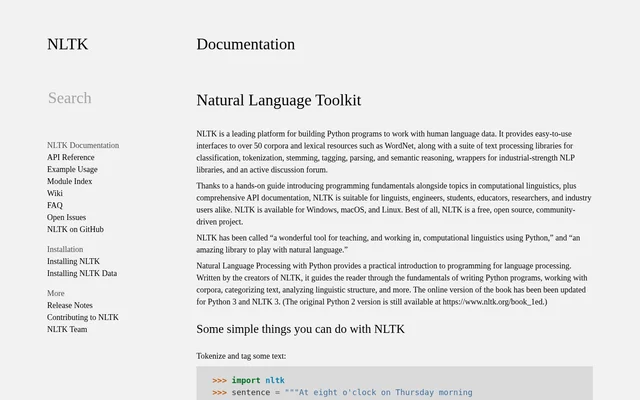
What is NLTK?
NLTK is a Python toolkit for building programs that work with human language data. The Natural Language Toolkit brings together text-processing libraries and interfaces to corpora and lexical resources such as WordNet. NLTK serves developers and researchers working with text as well as students and educators studying how programming applies to computational linguistics.
What NLTK can do
NLTK provides tools for working with text at different levels, from splitting a sentence into tokens to analyzing its grammatical structure. The documentation illustrates these tasks with a sentence that is tokenized, tagged, and examined for a named entity. A separate example displays the parse tree of a sentence from the Treebank corpus.
- NLTK splits sentences into tokens and provides stemming tools.
- NLTK classifies text.
- NLTK assigns part-of-speech tags to tokens.
- NLTK identifies named entities in tagged text.
- NLTK supports parsing and displays parse trees.
- NLTK provides tools for semantic reasoning.
- NLTK provides access to over 50 corpora and lexical resources, including WordNet.
How NLTK works
NLTK is imported into Python in the documentation examples. The tagging example passes a sentence to the word tokenizer and then passes the resulting tokens to the part-of-speech tagger. The named entity example uses those tagged tokens to identify a person's name. The Treebank example follows a different workflow: it retrieves an already parsed sentence from a corpus and draws its tree.
Who NLTK is for
NLTK is intended for linguists, engineers, researchers, students, educators, and industry users. The companion book starts with Python programming fundamentals and connects them to tasks such as categorizing text and analyzing linguistic structure. The API reference and examples serve readers looking for specific toolkit functions rather than a guided introduction to the subject.
- Students can practice Python through language-processing exercises.
- Educators can demonstrate computational linguistics tasks.
- Linguists and researchers can work with corpora and analyze sentence structure.
- Engineers can build Python programs that classify, tag, or parse text.
NLTK pricing and plans
NLTK is free and open source, and the website describes it as a community-driven project. NLTK is available for Windows, macOS, and Linux. The documentation links to instructions for installing the toolkit and its data, and the site also links to the project on GitHub.
NLTK strengths and limitations
NLTK combines text-processing functions, corpus access, and learning resources in one toolkit. The documented examples show how the output of one step can become the input to another, as when tokenization feeds part-of-speech tagging. The examples focus on writing Python code, and the documentation treats installing the toolkit and installing its data as separate topics.
Getting started with NLTK
NLTK provides installation instructions, example usage, and an API reference. The website's sample sentence offers a starting point for practicing tokenization and part-of-speech tagging before trying named entity recognition. For a more structured introduction, the online edition of Natural Language Processing with Python is updated for Python 3 and NLTK 3 and covers programming fundamentals, corpus work, and linguistic analysis.
NLTK FAQ
What is NLTK?
NLTK is the Natural Language Toolkit, an open-source toolkit for building Python programs that work with human language data. NLTK provides text-processing libraries and interfaces to over 50 corpora and lexical resources, including WordNet.
Is NLTK free to use?
NLTK is free and open source. NLTK is a community-driven project available for Windows, macOS, and Linux, and its website provides documentation for installing both the toolkit and its data.
What can you use NLTK for?
NLTK can be used to tokenize, classify, stem, tag, and parse text, as well as for semantic reasoning. The documentation also demonstrates how to identify a named entity in tagged text and display a parse tree from the Treebank corpus.
Who is NLTK for?
NLTK is for linguists, engineers, students, educators, researchers, and industry users working with human language data. The companion book introduces programming fundamentals alongside computational linguistics, and the API reference documents the toolkit's functions.
Does NLTK provide access to WordNet?
NLTK provides an interface to WordNet as part of its collection of over 50 corpora and lexical resources. The toolkit also includes text-processing libraries for tasks such as classification, tokenization, tagging, and parsing.
From the community
No reviews yet
Be the first to review this tool. What you write helps the next person choose.