What is nobodywho?
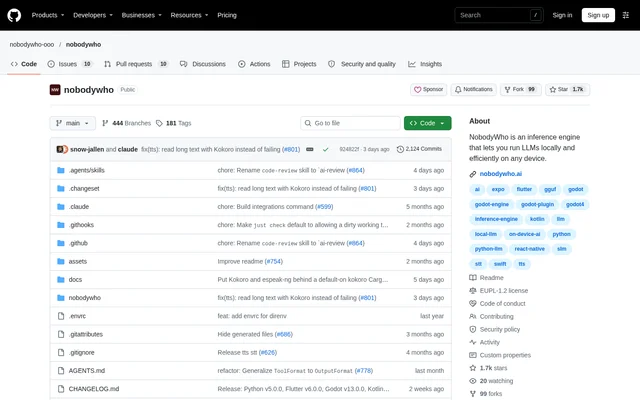
nobodywho is an open-source inference engine for running language models locally inside applications. The project serves developers working across desktop and mobile environments, with bindings for Python, Kotlin, Swift, React Native / Expo, Flutter and Godot. Local inference works offline without API keys.
nobodywho uses a Rust core for chat, templates, grammars, sampling and context shifting. The architecture connects llama.cpp for text, vision, embeddings and reranking with ONNX Runtime for speech recognition, speech synthesis and voice activity detection. Hardware acceleration and CPU execution support different deployment environments.
What nobodywho can do
nobodywho brings language model inference and audio processing into the same project. Developers can load GGUF models, provide image or audio information, and connect model output to application functions. The speech components cover transcription, local WAV generation and detecting when listening should stop before transcription begins.
- nobodywho runs GGUF chat models, including Gemma, Qwen and Mistral.
- nobodywho generates structured grammars from function signatures for type-safe tool calling.
- nobodywho accepts image and audio information as multimodal input.
- nobodywho synthesizes local WAV audio with Kokoro, Pocket TTS and Supertonic.
- nobodywho transcribes speech with Whisper and detects voice activity with Silero.
- nobodywho downloads models from Hugging Face or other URLs.
How nobodywho works
nobodywho is installed through the package source associated with each binding: PyPI, Maven Central, Swift Package Manager, npm, pub.dev or Godot AssetLib. The quick starts show developers creating a Chat instance with a model reference, asking a question and retrieving the completed response.
nobodywho accepts a Hugging Face reference, an HTTPS URL or a local model path. Remote models are downloaded and cached on first use, while the auto option selects a model to fit available memory. An experimental local server also implements the OpenAI Chat Completions API and exposes model-listing and chat-completion endpoints.
Who nobodywho is for
nobodywho is intended for developers embedding local AI into desktop and mobile software. Desktop support covers Linux, macOS and Windows, while mobile availability depends on the selected binding. Swift also supports visionOS and watchOS. Godot integration provides an installation path directly through the editor's AssetLib.
- Desktop application developers can add local language model chat.
- Mobile developers can integrate on-device inference through supported bindings.
- Godot developers can add language model functionality to projects.
- Voice application developers can combine transcription, voice activity detection and speech synthesis.
nobodywho pricing and licence
nobodywho is free of charge under the EUPL-1.2 licence, including use in proprietary and commercial projects. The repository distinguishes using the engine in proprietary software from distributing modified engine code: distributed modifications to code in the repository must be open sourced. Source code and installation instructions are available through GitHub.
nobodywho includes an additional dependency consideration for speech synthesis. The default Kokoro feature compiles in espeak-ng, which is licensed under GPL-3.0-or-later, and prebuilt packages include that dependency. Developers who do not need Kokoro can build without the feature; Supertonic and Pocket TTS remain available.
nobodywho strengths and limitations
nobodywho combines offline operation, multiple language bindings and local speech capabilities without requiring API keys. GPU acceleration uses available hardware, with CPU fallback when necessary. Model layers can be split between GPU memory and CPU execution, although models that exceed available GPU memory run more slowly.
- nobodywho has no web export.
- nobodywho does not yet support Windows ARM64.
- nobodywho does not provide iOS export through Godot.
- nobodywho requires sufficient available RAM for the selected model.
- nobodywho uses a single GPU, selecting the card with the most free memory.
nobodywho FAQ
What is nobodywho?
nobodywho is an open-source inference engine for running language models locally and offline. nobodywho supports GGUF models, type-safe tool calling, multimodal input and speech processing, with bindings for Python, Kotlin, Swift, React Native / Expo, Flutter and Godot.
Is nobodywho free for commercial use?
nobodywho is free of charge for proprietary and commercial projects under EUPL-1.2. Distributed modifications to the repository code must be open sourced. Prebuilt packages also include the GPL-3.0-or-later espeak-ng dependency through the default Kokoro speech synthesis feature.
Which platforms does nobodywho support?
nobodywho supports Linux, macOS and Windows desktop environments, plus mobile platforms through selected bindings. Swift supports macOS, iOS, visionOS and watchOS. Windows ARM64 and web export are not supported, and the Godot binding has no iOS export.
Which models can nobodywho run?
nobodywho supports models in GGUF format, including Gemma, Qwen and Mistral. Developers can supply a Hugging Face reference, an HTTPS URL or a local path. Remote models are downloaded and cached on first use, and available memory constrains model selection.
Does nobodywho have an OpenAI-compatible API?
nobodywho provides an experimental local server implementing the OpenAI Chat Completions API. The server exposes /v1/models and /v1/chat/completions endpoints. The repository includes a command for starting the server with a specified model and links to further documentation.
Can nobodywho handle speech recognition and text-to-speech?
nobodywho transcribes audio with Whisper and synthesizes local WAV audio using Kokoro, Pocket TTS and Supertonic backends. nobodywho also uses Silero for voice activity detection to determine when to stop listening and begin transcribing.
From the community
No reviews yet
Be the first to review this tool. What you write helps the next person choose.