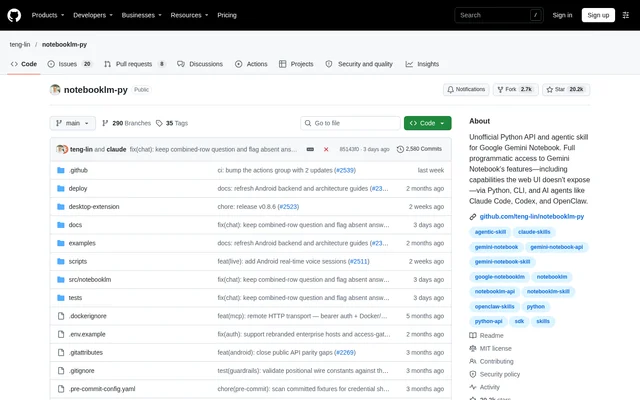
What is notebooklm-py?
notebooklm-py is an open-source Python library and agentic skill that provides unofficial programmatic access to Google Gemini Notebook, formerly NotebookLM. Developers and researchers can use notebooklm-py to manage sources, request cited answers, generate content, and retrieve artifacts without relying solely on the web interface.
notebooklm-py is a community project rather than an official Google integration. The package retains its name following the service's rebranding. The repository positions the library for prototypes, research, and personal projects, and provides Python, command-line, server, and agent-oriented ways to access the underlying service.
What notebooklm-py can do
notebooklm-py connects source ingestion, research, content generation, and export in scriptable workflows. The repository describes both ordinary NotebookLM operations and capabilities that the web interface does not expose, including batch downloads, quiz and flashcard exports in multiple formats, and extraction of mind maps as JSON.
- notebooklm-py imports sources from URLs, PDFs, YouTube, and Google Drive.
- notebooklm-py runs web and Drive research queries with automatic source import.
- notebooklm-py retrieves source-grounded answers with citations.
- notebooklm-py generates audio overviews, videos, slide decks, quizzes, and flashcards.
- notebooklm-py downloads artifacts locally and exports content to Google Docs and Sheets.
- notebooklm-py extracts mind maps as JSON and data tables as CSV.
How notebooklm-py works
notebooklm-py offers a Python API for application integration and asynchronous workflows, plus a CLI for scripts and automation. MCP access supports local stdio connections or a self-hosted remote connector behind a Cloudflare or Tailscale tunnel. A REST server provides guarded HTTP routes without launching a separate CLI process for each call.
notebooklm-py uses the Web transport by default and offers an optional Android backend that requires an explicit runtime installation. The Android backend uses the service's mobile gRPC interface and bearer authentication. Agent integrations include Claude Code, Codex, and OpenClaw, while REST and MCP servers support multiple profiles.
Who notebooklm-py is for
notebooklm-py serves developers building integrations, researchers assembling repeatable pipelines, and AI agent users coordinating source-based tasks. The repository describes workflows in which Gemini Notebook performs analysis while an agent handles orchestration and final outputs. Scheduling, skill composition, and knowledge-vault organization remain part of the user's own setup.
- Researchers can bulk-import documents and retrieve cited insights.
- Coding agents can consult internal documentation and preserve session notes.
- Study workflows can generate podcasts, quizzes, and flashcards from topic notebooks.
- Content workflows can turn a shared source collection into multiple media formats.
notebooklm-py pricing and access
notebooklm-py is available as an open-source project on GitHub under the MIT license. The supplied repository text does not list paid library plans or subscription prices. Access to the underlying Google service has separate operational constraints: source counts per notebook depend on the Google account tier, and rate limits apply.
Strengths and limitations of notebooklm-py
notebooklm-py combines multiple access methods with structured exports and agent integrations, making the library suitable for custom research and automation workflows. The main trade-off is dependence on undocumented Google APIs. Google can change internal endpoints without notice, and the repository explicitly warns that the library may break.
- notebooklm-py is not affiliated with Google.
- notebooklm-py workflows may be throttled during heavy usage.
- notebooklm-py requires user-managed glue for scheduling and related agent workflows.
- notebooklm-py advises using a dedicated account and protecting the Android backend's full-account credential.
notebooklm-py FAQ
What is notebooklm-py?
notebooklm-py is an unofficial, open-source Python API and agentic skill for Google Gemini Notebook. notebooklm-py provides Python, CLI, MCP, and REST access for source management, cited research, content generation, and artifact exports.
Is notebooklm-py free?
notebooklm-py is available as an open-source project under the MIT license. The repository does not list paid library plans. Google account tiers affect per-notebook source limits, and the underlying service applies rate limits.
Does notebooklm-py work with Claude Code and Codex?
notebooklm-py supports Claude Code, Codex, and other AI agents through agent skills and MCP access. notebooklm-py includes local skill installation support, repository-level Codex guidance, and local or self-hosted remote MCP connection options.
What can notebooklm-py generate and export?
notebooklm-py can generate audio overviews, videos, slide decks, quizzes, flashcards, infographics, data tables, mind maps, and study guides. notebooklm-py supports local artifact downloads, structured exports such as JSON and CSV, and exports to Google Docs and Sheets.
Is notebooklm-py an official Google API?
notebooklm-py is not an official Google API or a Google-affiliated project. notebooklm-py uses undocumented Google APIs that can change without notice, so the repository recommends the library for prototypes, research, and personal projects.
Can notebooklm-py run as a remote MCP server?
notebooklm-py supports a self-hosted remote MCP connector behind a Cloudflare or Tailscale tunnel. notebooklm-py can connect to claude.ai and ChatGPT through their connector options; the repository notes that ChatGPT MCP connectors are web-only.
From the community
No reviews yet
Be the first to review this tool. What you write helps the next person choose.