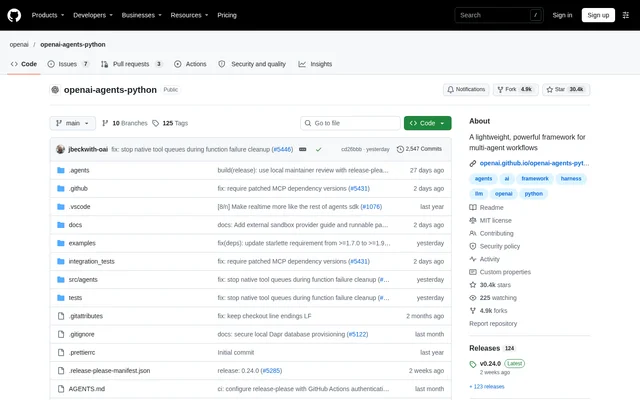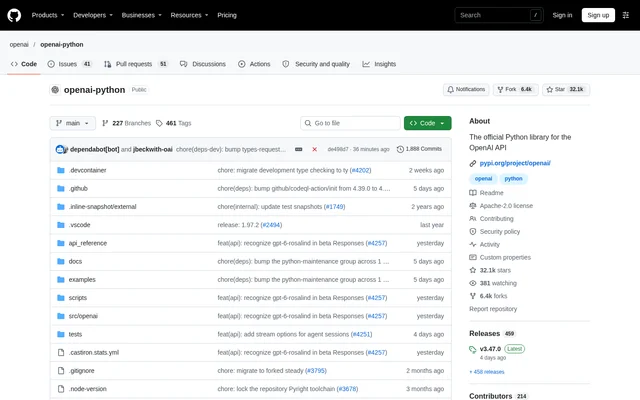
What is openai-python?
openai-python is the official Python library for accessing the OpenAI REST API from Python applications. The open-source project serves developers who want to call OpenAI models through Python code. Generated from OpenAI’s OpenAPI specification, openai-python includes type definitions for request parameters and response fields. The repository links to the REST API documentation, a library API reference, and examples, and publishes the source under the Apache-2.0 license.
What openai-python can do
openai-python exposes model interactions through synchronous and asynchronous clients powered by HTTPX2. The Responses API is identified as the primary interface for interacting with OpenAI models, while Chat Completions remains supported indefinitely. Beyond text generation, the documented examples cover image inputs, streamed output, and Realtime conversations. These capabilities let developers select an interaction pattern suited to their application.
- openai-python generates text through the Responses API and Chat Completions API.
- openai-python accepts image inputs as URLs or base64-encoded strings.
- openai-python streams responses through Server-Sent Events.
- openai-python supports Realtime text, audio, and function calling over WebSockets.
- openai-python supports optional aiohttp transport for asynchronous requests.
How openai-python works
openai-python is installed from PyPI with pip install openai and used by importing OpenAI or AsyncOpenAI. Developers configure authentication, create a client, and call an API method with a model and input. The asynchronous client uses await for API calls and otherwise provides the same functionality as the synchronous client. The usage examples retrieve generated text from the response’s output_text field.
openai-python supports API keys and workload identity authentication using short-lived tokens from cloud identity providers. Documented providers include Kubernetes service accounts, Azure managed identity, and Google Cloud Platform metadata, alongside custom subject token providers. The repository recommends storing API keys through python-dotenv rather than in source control. HTTPX2 is the default HTTP client, with a migration guide for custom transport configurations.
Who openai-python is for
openai-python is for developers integrating OpenAI API calls into Python 3.10+ applications. The documented workflows span text generation, image-based prompts, streaming interfaces, and conversational experiences with audio. For automated cloud environments, openai-python also offers workload identity authentication instead of relying exclusively on long-lived API keys. The library is used through Python code rather than a standalone graphical interface.
- Python application developers can add text generation to software.
- Developers can send image-and-text prompts through the Responses API.
- Conversational application developers can use Realtime text and audio.
- Cloud developers can configure authentication with short-lived workload identity tokens.
openai-python licensing and access
openai-python is an open-source project published under the Apache-2.0 license and distributed through PyPI. The repository provides the installation command, source code, API reference, and usage examples. The supplied page does not state OpenAI API pricing or usage allowances. Access to the library source and installation package should therefore be distinguished from the authentication needed to make API requests.
openai-python strengths and limitations
openai-python combines official API access, typed request and response definitions, and matching synchronous and asynchronous functionality. Streaming and Realtime support cover different interaction patterns, while workload identity options address automated deployment environments. The documented constraints concern runtime requirements and authentication compatibility: developers need a supported Python environment, and some identity methods do not extend to every connection type.
- openai-python requires Python 3.10 or later.
- openai-python X.509 workload identity supports HTTP APIs, not Realtime or WebSockets.
- openai-python Azure clients do not support X.509 workload identity.
- openai-python requires application-managed certificate files, private keys, server trust, and rotation for X.509 authentication.
openai-python FAQ
What is openai-python?
openai-python is the official Python library for the OpenAI REST API. The open-source library provides typed request and response definitions, synchronous and asynchronous clients, and access to text generation, image inputs, streaming, and Realtime interactions.
How do you install openai-python?
openai-python is installed from PyPI with pip install openai and requires Python 3.10 or later. Developers then import OpenAI or AsyncOpenAI, configure authentication, and use the client to make API requests.
Does openai-python support asynchronous requests and streaming?
openai-python supports asynchronous requests through AsyncOpenAI and streaming responses through Server-Sent Events. The asynchronous client uses await for API calls and otherwise offers the same functionality as the synchronous client. An optional aiohttp transport is also documented.
What authentication methods does openai-python support?
openai-python supports API-key authentication and workload identity authentication. Documented workload identity options include Kubernetes service account tokens, Azure managed identity, Google Cloud Platform metadata, custom subject token providers, and X.509 mutual TLS. X.509 support is limited to HTTP APIs.
Is openai-python open source?
openai-python is an open-source project distributed under the Apache-2.0 license, with source code available in the repository and installation available through PyPI. The supplied page does not state pricing or usage allowances for the OpenAI API.
From the community
No reviews yet
Be the first to review this tool. What you write helps the next person choose.