What is openmed?
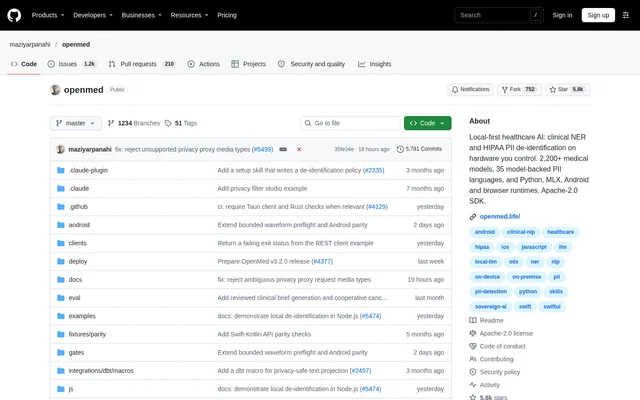
openmed is an open-source healthcare AI project for clinical named entity recognition and PII de-identification on hardware controlled by the deployment owner. The core runtime processes clinical text locally once the required model artifacts are available, producing medical entities, detected identifiers and de-identified text.
openmed targets developers building healthcare text workflows across desktop, mobile, browser and service environments. The repository provides SDK source, examples, documentation and a curated model catalog. Local execution is a defined runtime boundary rather than a guarantee that every download, adapter or configured integration operates without network access.
What openmed can do
openmed combines clinical information extraction with identifier detection and redaction. The supplied examples demonstrate disease and medication extraction, while supported privacy workflows identify sensitive details in clinical documents. The repository also includes callable interfaces and reusable agent procedures for incorporating these capabilities into applications and development workflows.
- openmed extracts clinical entities such as diseases and drugs.
- openmed detects PII and produces de-identified text.
- openmed supports model-backed PII detection across 35 languages.
- openmed exposes a Python API, CLI, MCP server and REST service.
- openmed provides agent skills for FHIR export and evaluation.
- openmed supports browser inference through Transformers.js.
How openmed works
openmed accepts clinical text and uses a selected model to return entity results or perform de-identification. The Python quick start installs the package with runtime-specific extras, including Hugging Face or MLX support. The Python example calls analyze_text with a model name and reads the resulting entity labels, text and confidence.
openmed offers Linux, macOS and Windows execution with CPU or CUDA, plus supported Apple, Android and browser paths. OpenMedKit integrates through Swift Package Manager on Apple and a Kotlin library on Android. Required artifacts must be acquired first; supported backends and model mappings depend on the environment and available artifacts.
Who openmed is for
openmed serves developers and deployment teams that need clinical text processing on hardware they control. The documented interfaces support application development, service deployment and agent-assisted pipeline creation. Mobile examples cover clinical document intake and local processing, while repository skills describe workflows around de-identification, clinical NER, evaluation and structured healthcare output.
- Developers can extract medication and disease mentions from clinical notes.
- Mobile application teams can build local document intake and PII redaction.
- Service developers can expose clinical analysis through REST endpoints.
- Coding-agent users can assemble pipelines using synthetic placeholders.
openmed pricing and source access
openmed is available as an open-source SDK under the Apache-2.0 licence. The source page provides a GitHub repository, a PyPI package and installation instructions for supported runtimes rather than a subscription pricing table. Model and dataset terms vary, so the SDK licence should not be treated as covering every downloaded artifact.
openmed strengths and deployment limitations
openmed combines local clinical extraction, de-identification and multiple deployment interfaces in an openly available SDK. The documented runtime choices allow developers to select supported execution paths for their hardware. Deployment owners must still validate model suitability, privacy behaviour and clinical fitness, rather than treating local processing as sufficient evidence of compliance.
- openmed requires the relevant model artifacts before local processing.
- openmed may use a network for downloads, remote adapters, telemetry-enabled paths and configured integrations.
- openmed does not itself establish HIPAA compliance.
- openmed's clinical brief demonstration uses synthetic test doubles rather than clinical validation.
openmed FAQ
What is openmed?
openmed is an open-source, local-first healthcare AI SDK for clinical named entity recognition and PII de-identification. openmed processes clinical text into medical entities, identifier findings and de-identified text on controlled hardware after the required model artifacts are available.
Is openmed free?
openmed is available as an open-source SDK under the Apache-2.0 licence, with source code on GitHub and a Python package on PyPI. Model and dataset terms vary and require separate review; the source page does not list subscription plans.
Does openmed work offline?
openmed's core runtime performs extraction and de-identification locally after required model artifacts are available. Model downloads, remote-provider adapters, telemetry-enabled paths and user-configured integrations may use a network, so deployment owners need to review the boundaries of their chosen configuration.
Does openmed support mobile and browser applications?
openmed supports Apple processing through OpenMedKit and MLX, Android inference through a Kotlin library and ONNX Runtime Mobile, and browser inference through Transformers.js. Runtime availability depends on supported hardware, model artifacts and environment-specific configuration.
Does openmed make a deployment HIPAA compliant?
openmed does not itself establish HIPAA compliance. openmed supports a Safe Harbor-aligned configuration targeting the 18 identifier categories, but expert deployment review remains required. Deployment owners must validate model and dataset terms, privacy behaviour and clinical fitness.
From the community
No reviews yet
Be the first to review this tool. What you write helps the next person choose.