What is OpenSRE?
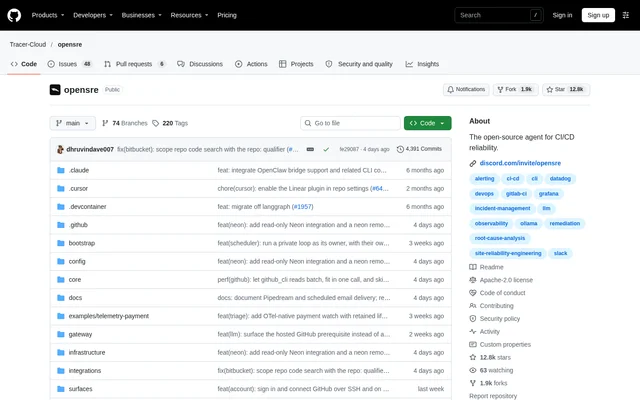
OpenSRE is an open-source agent for investigating CI/CD failures and preparing fixes for engineering review. OpenSRE gathers evidence from failed runs and connected systems, tests hypotheses, and distinguishes pipeline problems from code problems. The project targets the investigation work that follows a red build rather than simply rerunning failed checks.
OpenSRE is a community-built project hosted in the Tracer-Cloud GitHub repository. OpenSRE supports running on users’ own infrastructure with their own models. The repository describes the release as public alpha: core workflows support early exploration, but stability is incomplete and APIs and integrations may change during development.
What OpenSRE can do
OpenSRE combines CI investigation with operational context from connected tools. OpenSRE can respond to a failed run, an alert or a direct question, then gather evidence and reason through possible causes. Depending on the workflow, OpenSRE returns an explanation, prepares a code change or suggests and optionally executes remediation.
- OpenSRE retrieves failing checks, CI logs, recent commits and deployments.
- OpenSRE correlates logs, metrics and traces across connected systems.
- OpenSRE separates CI-caused failures from code-caused failures.
- OpenSRE produces evidence-linked responses in the conversation.
- OpenSRE pushes fixes to a pull request branch for review.
- OpenSRE posts investigation summaries to Slack, PagerDuty or Telegram.
How OpenSRE works
OpenSRE provides installation commands for macOS, Linux and Windows PowerShell. The installer retrieves the latest build from the main branch without requiring sudo. Running the opensre command starts authentication and setup; the first launch activates the hosted model. The interactive shell validates the account and requires a TTY.
OpenSRE also supports a headless command for a terminal, script or CI job, with documented stdin prompts, JSON output and tool approvals. OpenSRE can run inside Python code through an embedded session, although that route requires a source checkout. Deployment paths include a managed cloud gateway, an AWS server-image gateway and a self-hosted container.
Who OpenSRE is for
OpenSRE serves engineers responsible for build reliability and incident investigation. OpenSRE is relevant to teams that need to understand failing pull request checks, recurring pipeline problems or operational alerts. The documented Python workflow also supports teams that want incident-response assistance inside existing services and automations rather than only in a terminal.
- Engineering teams can use OpenSRE to analyze a repository’s CI reliability.
- Developers can use OpenSRE to investigate and fix failing pull request checks.
- Operations teams can use OpenSRE to investigate incidents using connected observability systems.
- Python developers can embed OpenSRE in team services and automations.
OpenSRE licensing and access
OpenSRE is distributed as an open-source project under the Apache 2.0 license. OpenSRE can be obtained through the documented installer or source repository, with self-hosted options for users who configure their own deployment and model provider. An organization administrator can provision the OpenSRE Cloud managed gateway through the web app.
OpenSRE strengths and limitations
OpenSRE combines investigation, evidence-linked explanations and reviewable code fixes in the same workflow. OpenSRE supports model choice, infrastructure control and connections to development, observability and incident-management tools. Security measures include optional identifier masking before external model calls, structured and auditable LLM prompts, and local transcript handling by default.
- OpenSRE remains in public alpha, with core workflows not yet fully stable.
- OpenSRE APIs and integrations may evolve during active development.
- OpenSRE requires an active account for the interactive shell.
- OpenSRE enables product analytics and Sentry error reporting on an opt-out basis.
OpenSRE FAQ
What is OpenSRE?
OpenSRE is an open-source CLI agent for CI/CD reliability. OpenSRE investigates failed runs, reads logs, tests hypotheses and distinguishes CI failures from code failures. OpenSRE can provide evidence-linked explanations and push fixes to a pull request branch for human review.
Can OpenSRE be self-hosted?
OpenSRE supports self-hosted deployment on users’ infrastructure with their own models. OpenSRE documents a container deployment using the repository Dockerfile, an AWS server-image gateway path and a managed cloud gateway alternative. Container configuration includes selecting a mode and setting the model provider and its API key.
Which tools does OpenSRE integrate with?
OpenSRE lists integrations across development, observability, infrastructure, databases and incident management. Examples include GitHub, GitLab, Jenkins, Grafana, Datadog, Kubernetes, Slack and PagerDuty. OpenSRE also supports model providers including Anthropic, OpenAI, Ollama and Google Gemini, and lists MCP among supported protocols.
Does OpenSRE have a Python API?
OpenSRE provides an embedded Python API for running agent sessions inside existing code. OpenSRE documents sessions, conversations and custom output sinks, and suggests embedding the agent in team services and automations. Using the in-process Python workflow requires a source checkout.
Is OpenSRE ready for production?
OpenSRE is in public alpha, and the repository says core workflows are usable for early exploration but are not yet fully stable. OpenSRE remains under active development, so APIs and integrations may evolve. The repository also documents security measures and deployment prerequisites.
What license does OpenSRE use?
OpenSRE uses the Apache 2.0 license and publishes its source code in a public GitHub repository. OpenSRE provides installer instructions, source-development documentation and self-hosted deployment guidance, alongside a managed cloud gateway option.
From the community
No reviews yet
Be the first to review this tool. What you write helps the next person choose.