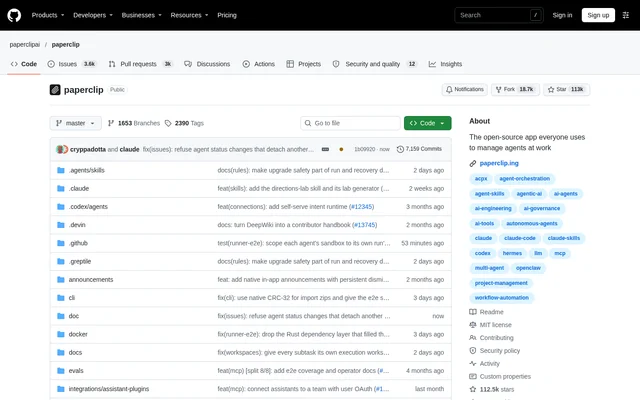
What is paperclip?
paperclip is an open-source application for coordinating teams of AI agents at work. A Node.js server and React interface connect task management with organizational goals, reporting lines, permissions, and budgets. paperclip is designed for people who want autonomous agents to work toward common business objectives while retaining human review and oversight.
paperclip keeps tasks, skills, permissions, and work history together rather than treating each agent as an isolated session. Users bring their own agents and choose models and harnesses per agent. The repository describes a management layer for agent organizations, including mixed human and agent teams.
What paperclip can do
paperclip combines agent execution with the records and controls needed to supervise ongoing work. Tasks retain conversations, plans, blockers, files, and run histories, while project and company links provide goal context. Managers can delegate through reporting lines, review outputs, and intervene by pausing, reassigning, or stopping work.
- paperclip links tasks and projects to organization goals.
- paperclip wakes agents for assigned work, messages, or configured schedules.
- paperclip tracks reported spending and pauses work at configured budget limits.
- paperclip applies review stages, approval gates, and agent permissions.
- paperclip supports shared skills, saved test inputs, and version restoration.
- paperclip creates recurring tasks through schedules, an API, or webhooks.
- paperclip previews supported artifacts and accepts comments on document passages.
How paperclip works
paperclip follows a workflow of defining a goal, assembling an agent team, reviewing strategy, setting budgets, and monitoring execution from the dashboard. Supported agents include OpenClaw, Claude Code, Codex, Cursor, and Gemini CLI. Custom processes, HTTP endpoints, and external adapter packages extend the available agent connections.
paperclip supports trusted local and authenticated deployment modes. Connections can include GitHub, Notion, Railway, and a user's own MCP server, with gateway actions configured as Allowed, Ask first, or Off. Human connection access and agent eligibility are separate controls, and supported managed connections can attribute operations to the person directing the work.
Who paperclip is for
paperclip serves people coordinating multiple agents, managers defining responsibilities and approval boundaries, and technical operators maintaining agent infrastructure. The source also describes skill development and evaluation workflows for people training agent teams. Mobile access supports users who need to monitor and manage autonomous work away from their primary computer.
- paperclip coordinates coding agents working toward shared project goals.
- paperclip schedules recurring customer support, social, and reporting work.
- paperclip helps managers review agent outputs and approve delegated work.
- paperclip separates organizations, agents, tasks, permissions, and activity histories within a deployment.
paperclip licensing and availability
paperclip is available through a public source repository under the MIT license. The supplied page links to a quickstart, documentation, and the project website, and also invites users to join the paperclip Cloud waitlist. The page does not state subscription prices, cloud plan details, or hosted service allowances.
paperclip strengths and limitations
paperclip combines task coordination, goal context, spending controls, and governance in a shared management interface. Atomic task checkout and execution locks prevent competing runs from claiming the same task. Persistent task records and revisioned configuration changes support inspection and rollback, while organization-scoped checks separate work across companies within a deployment.
- paperclip requires users to supply and configure agent runtimes.
- paperclip resumes saved sessions only through supporting adapters.
- paperclip labels agent chat and chat/email connectors as experimental.
- paperclip requires relevant instance settings to enable experimental conversations.
- paperclip Cloud access is described through a waitlist.
paperclip FAQ
What is paperclip?
paperclip is an open-source application for managing teams of AI agents at work. paperclip uses a Node.js server and React interface to coordinate tasks, goals, org charts, permissions, skills, budgets, and work histories.
Is paperclip open source?
paperclip is an open-source project available in a public repository under the MIT license. The source page also links to documentation, a quickstart, and a cloud waitlist, but does not state cloud subscription prices or plan details.
Which AI agents does paperclip support?
paperclip lists support for OpenClaw, Claude Code, Codex, Cursor, Gemini CLI, OpenCode, Pi, Hermes, Grok Build, and Kimi Code. Custom processes, HTTP endpoints, and external adapter packages can extend the available agent connections.
Can paperclip control AI agent spending?
paperclip provides company, agent, and project budgets to track reported spending, issue threshold alerts, and pause work at configured limits. These controls are designed to help users oversee the costs of ongoing agent work.
Does paperclip support integrations and MCP servers?
paperclip connects services such as GitHub, Notion, and Railway, as well as a user's own MCP server. Connection controls distinguish human access, agent eligibility, and gateway action permissions, including Allowed, Ask first, and Off settings.
Can paperclip schedule recurring agent tasks?
paperclip supports scheduled routines and work triggered through an API or webhook. Each routine run has a task, an owner, and a history, allowing users to inspect recurring outputs for work such as customer support, social tasks, and reports.
From the community
No reviews yet
Be the first to review this tool. What you write helps the next person choose.