What is Paragraphica?
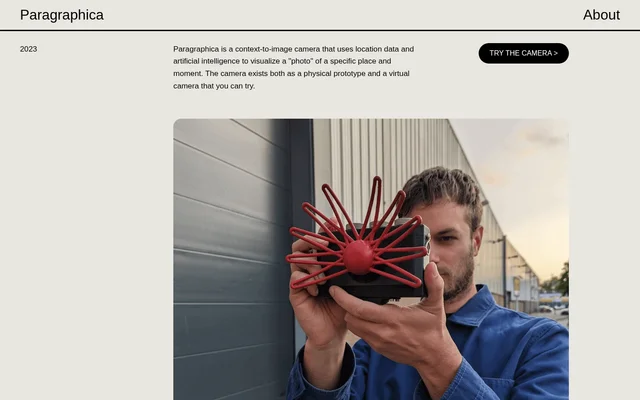
Paragraphica is a context-to-image camera that generates images from location information rather than reproducing the visible scene. Paragraphica uses artificial intelligence to represent a specific place and moment, combining contextual data with text-to-image generation. The project exists as both a physical camera prototype and a virtual camera that visitors can try through the project page.
Paragraphica explores how a place might be represented through information beyond visual perception. The project cites the star-nosed mole, which perceives its surroundings through finger-like antennae, as an inspiration. This framing makes Paragraphica an experiment in alternative perception as well as an image-generation tool: the output reflects an AI interpretation of contextual information, not an exact view of the surroundings.
What Paragraphica can do
Paragraphica turns several kinds of local information into a paragraph that becomes the basis for an AI-generated image. The viewfinder presents the current location description in real time. The physical camera also includes dials that influence both the information gathered and the image-generation process, using controls compared on the project page to focal length, film grain, and focus.
- Paragraphica gathers address, weather, time of day, and nearby-place information through open APIs.
- Paragraphica composes a paragraph describing the current place and moment.
- Paragraphica converts the description into an image using text-to-image AI.
- Paragraphica adjusts the radius used to search for places and data.
- Paragraphica controls the diffusion noise seed and guidance scale.
How Paragraphica works
Paragraphica starts by collecting contextual information from its location using open APIs. The camera combines those details into a written description, which appears in the viewfinder. Pressing the trigger generates an image from that description. Increasing the guidance scale makes the AI follow the paragraph more closely, while the other physical controls change the data-search radius and diffusion noise seed.
Paragraphica uses a Noodl web app to communicate between the camera and the APIs that generate the location-based prompt and image. The listed software includes Python code and the Stable Diffusion API. The physical prototype uses a Raspberry Pi 4, a 15-inch touchscreen, a 3D printed housing, and custom electronics. The page also links to a virtual camera for trying the concept.
Who Paragraphica is for
Paragraphica is relevant to people interested in location-based image generation and experiments with AI perception. The project offers a way to explore how contextual information can stand in for direct visual observation. The virtual camera provides a route to trying that idea, while the physical prototype demonstrates how familiar camera controls can be adapted to data gathering and image synthesis.
- Paragraphica can generate a visual interpretation of a current place and moment.
- Paragraphica can explore the relationship between local context and AI-generated imagery.
- Paragraphica can demonstrate a camera workflow based on descriptive data rather than an optical view.
Paragraphica strengths and limitations
Paragraphica combines location context, a readable intermediate description, and adjustable generation parameters in a camera-like workflow. The physical controls make the relationship between gathered data and generated imagery explicit. However, the project notes that the images never look exactly like the actual location, even when they evoke aspects of its mood. Paragraphica is therefore an interpretive image-making project rather than a method for faithful visual documentation.
- Paragraphica produces interpretations rather than exact depictions of a location.
- Paragraphica’s physical hardware is presented as a prototype.
- Paragraphica relies on location information and external APIs to generate its descriptions and images.
Paragraphica FAQ
What is Paragraphica?
Paragraphica is a context-to-image camera that uses location data and artificial intelligence to generate an image of a specific place and moment. Paragraphica exists as a physical prototype and a virtual camera, representing surroundings through contextual information rather than an exact visual capture.
How does Paragraphica generate images?
Paragraphica collects an address, weather, time of day, and nearby places through open APIs, then combines that information into a descriptive paragraph. Paragraphica displays the description in the viewfinder and uses text-to-image AI to generate an image when the trigger is pressed.
What do the Paragraphica camera dials control?
Paragraphica has physical dials for the search radius, diffusion noise seed, and guidance scale. Paragraphica uses the radius to determine the area searched for places and data, while increasing guidance makes the generated image follow the descriptive paragraph more closely.
Can you try Paragraphica without the physical camera?
Paragraphica is available as a virtual camera linked from the project page, alongside the physical prototype. Paragraphica’s page invites visitors to try the camera and generate their own location-based image through the virtual version.
Does Paragraphica produce accurate photos of a location?
Paragraphica does not produce an exact depiction of the actual location. Paragraphica generates an AI interpretation from contextual data, and the project notes that the results can evoke moods and emotions associated with a place without looking exactly like the surroundings.
What software and hardware does Paragraphica use?
Paragraphica uses Noodl, Python code, and the Stable Diffusion API for its software workflow. Paragraphica’s physical prototype includes a Raspberry Pi 4, a 15-inch touchscreen, a 3D printed housing, and custom electronics.
From the community
No reviews yet
Be the first to review this tool. What you write helps the next person choose.