What is plano?
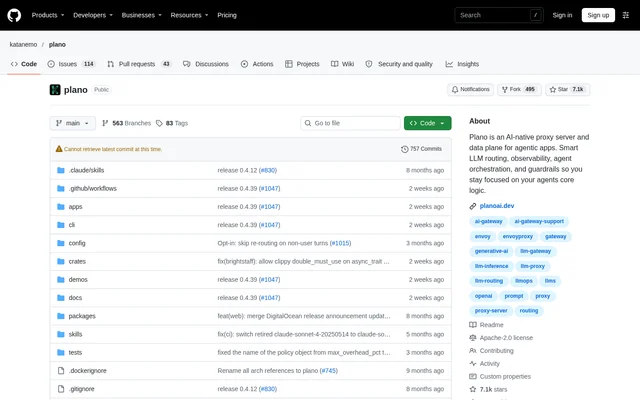
plano is an open-source AI-native proxy server and data plane for agentic applications. plano centralizes agent orchestration, model routing, observability, and guardrail hooks outside application code. The project targets developers who need to move agent-based applications beyond demonstrations without building separate middleware for each delivery concern.
plano is built on Envoy and is designed to work with any programming language or AI framework. The repository describes a modular approach: developers can configure edge proxying for orchestration and guardrails, LLM routing from services, or both together. This allows plano to fit into existing application architectures.
What plano can do
plano combines agent-level routing with model management and request visibility. Agent descriptions guide orchestration, while the LLM gateway provides a common interface for model access. Filter chains provide a place to add safety policies and memory hooks, and automatic signal capture supports evaluation and continuous improvement without custom tracing instrumentation.
- plano orchestrates requests between agents using configured descriptions.
- plano routes LLM requests by model name, alias, or preferences.
- plano captures agentic signals without instrumentation code.
- plano records OpenTelemetry traces, metrics, and logs.
- plano supports filter chains for moderation, jailbreak protection, and memory hooks.
- plano provides unified LLM APIs with state management.
How plano works
plano uses YAML configuration to declare agent URLs, natural-language descriptions, model providers, listeners, and tracing settings. Agents run as HTTP servers implementing the OpenAI-compatible chat completions endpoint. Agent code can direct model requests through the plano LLM gateway rather than handling provider-specific API behavior separately inside each service.
plano starts from the configured file using the planoai up command. Clients then send chat completion requests to the configured listener, which routes requests to the relevant agents. The repository's travel example combines weather and flight agents in a conversation. Adding an agent involves updating the configuration and restarting rather than modifying application routing code.
Who plano is for
plano serves developers building agentic applications who need shared infrastructure for routing, safety, and observability. The repository emphasizes production delivery concerns rather than agent business logic. The included travel assistant demonstrates how separate specialist agents can participate in a conversation while keeping weather and flight functionality in their own services.
- plano can coordinate weather and flight agents for travel planning.
- plano can centralize model-provider access for application services.
- plano can capture traces and signals for agent evaluation.
- plano can apply moderation and memory hooks across agent workflows.
plano pricing and access
plano is available as an open-source project under the Apache-2.0 license. The repository states that plano and its family of LLMs are hosted free of charge in the US-central region to support an initial developer experience. For scaling and production use, developers can run these LLMs locally or contact the project on Discord for API keys.
plano strengths and limitations
plano separates delivery infrastructure from core agent logic and supports language- and framework-independent agent implementations. Automatic tracing reduces the need to instrument individual services, while declarative configuration keeps routing outside application code. These benefits still require developers to set up the environment, expose compatible agent endpoints, and choose how to access the routing LLMs for production.
- plano requires prerequisite installation and environment setup.
- plano expects agents to implement an OpenAI-compatible chat completions endpoint.
- plano hosts its free initial-development service in the US-central region.
- plano directs production users to local LLM deployment or Discord-based API key access.
plano FAQ
What is plano?
plano is an open-source AI-native proxy server and data plane for agentic applications. plano handles agent orchestration, LLM routing, observability, and guardrail hooks outside application code, helping developers centralize infrastructure concerns while keeping agent logic in their preferred language or framework.
Is plano free?
plano is open source under Apache-2.0, and the repository states that plano and its family of LLMs are hosted free of charge in the US-central region for initial development. For production scaling, developers can run the LLMs locally or contact the project on Discord for API keys.
How do developers configure plano agents?
plano agents are declared in YAML using agent URLs and natural-language descriptions. Agent services implement the OpenAI-compatible chat completions endpoint, and developers start plano with the configuration file. The repository demonstrates routing a conversation between separate weather and flight agents.
Does plano support OpenTelemetry?
plano supports automatic OpenTelemetry traces and metrics across agents, alongside zero-code capture of agentic signals. The repository describes end-to-end request tracing without instrumentation code and lists traces, metrics, and logs among its observability capabilities.
What guardrails does plano support?
plano supports filter chains for adding jailbreak protection, moderation policies, and memory hooks. These hooks let developers configure safety and memory behavior consistently outside individual agent implementations, alongside agent orchestration and LLM routing.
Can plano work with different AI frameworks and model providers?
plano supports agents written in any language or AI framework and provides unified LLM APIs for model access. The repository demonstrates OpenAI and Anthropic provider configuration and describes model routing by name, alias, or preferences.
From the community
No reviews yet
Be the first to review this tool. What you write helps the next person choose.