What is Latitude?
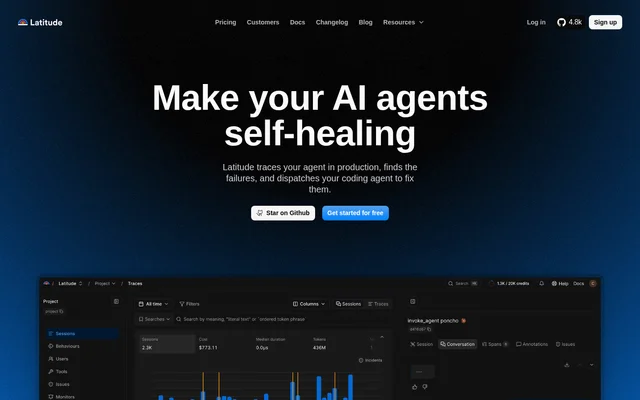
Latitude is an open-source observability and monitoring platform for AI agents running in production. Latitude helps developers and AI product teams understand agent conversations, identify recurring failures, and connect detected problems to coding-agent fixes. The project is released under the MIT license and combines production tracing, session search, conversation intelligence, and automatic issue discovery.
Latitude analyzes completed sessions to identify what conversations concerned and what happened during them. The analysis covers escalations, resolutions, abandonments, trust breaks, retries, and tool failures. Rather than leaving teams to inspect individual logs, Latitude groups similar failing traces into issues with examples, trends, affected users, and lifecycle information.
What Latitude can do
Latitude combines telemetry collection with tools for investigating failures and tracking quality. Custom signals let teams define behaviors, failure modes, policies, or quality checks to detect across matching sessions. Human annotations add structured feedback to traces, spans, and outputs, while validated production traces supply datasets for evaluations and regression testing.
- Latitude captures messages, costs, tool calls, and errors through telemetry.
- Latitude groups recurring failures into prioritized signals with supporting traces.
- Latitude sends new or escalating issue alerts through Slack, email, or webhooks.
- Latitude combines semantic search, exact text search, and metadata filters.
- Latitude builds versioned datasets from validated production traces.
- Latitude dispatches Claude Code or Cursor with issue context to implement fixes and open pull requests.
How Latitude works
Latitude accepts traces through its SDK or an existing OpenTelemetry pipeline. The website also provides a prompt for a coding agent to install the Latitude AI skill from github.com/latitude-dev/skills and add tracing to an application. After telemetry is connected, Latitude analyzes sessions and groups recurring failures into signals for investigation and monitoring.
Latitude dispatches Claude Code or Cursor when a signal appears or escalates, supplying full context, sample traces, and a deep link. The coding agent implements a fix and opens a pull request. Connecting the Latitude MCP server allows agents to access the workspace and manage projects without using the interface, supporting the workflow from an editor.
Who Latitude is for
Latitude serves developers and teams building AI agents, including teams establishing AI infrastructure and teams operating AI products at scale. The capabilities address production investigation, collaborative quality assessment, and follow-up after fixes ship. Enterprise deployment, access controls, and support options also address organizations with infrastructure and security requirements.
- Development teams can investigate tool failures and unsuccessful conversations.
- AI product teams can track recurring behavior patterns and escalating issues.
- Evaluation teams can turn validated traces and human feedback into test material.
- Engineering teams can pass production issue context directly to coding agents.
Latitude pricing and plans
Latitude offers a free Starter plan with 20K credits/month, 30d data retention, unlimited seats, and general channel Slack support. Pro costs $99/month and includes 100K credits/month, 90d data retention, unlimited seats, priority support, and SOC2 and ISO27001 reports. Additional Pro credits cost $20 per 10K.
Latitude Enterprise has custom pricing, credit volume, and data retention. Enterprise options include custom cloud or on-premises deployment, fine-grained roles, team training, SAML SSO, security reports, uptime and support agreements, and dedicated support. Latitude also publishes the project as MIT-licensed open source, separate from the listed hosted subscription plans.
Latitude strengths and limitations
Latitude combines open-source availability and OpenTelemetry compatibility with failure discovery, searchable traces, and coding-agent dispatch. Security features described on the website include SOC 2 Type II certification, encryption in transit and at rest, European hosted data residency, and exportable audit logs. Plan limits and enterprise-only deployment options remain important considerations when selecting access.
- Latitude Starter limits included usage to 20K credits/month and retention to 30d.
- Latitude Pro charges separately for credits beyond the included allowance.
- Latitude lists custom deployment, SAML SSO, and fine-grained roles under Enterprise.
Latitude FAQ
What is Latitude?
Latitude is an open-source AI agent observability and monitoring platform. Latitude traces production sessions, analyzes conversations, groups recurring failures into issues, and can dispatch Claude Code or Cursor with the context needed to implement fixes and open pull requests.
Is Latitude free?
Latitude offers a free Starter plan with 20K credits/month, 30d data retention, unlimited seats, and general channel Slack support. Latitude also offers a paid Pro plan and custom Enterprise plans, and the project is available under the MIT open-source license.
Does Latitude work with OpenTelemetry?
Latitude supports OpenTelemetry and accepts traces through an existing OpenTelemetry pipeline or its SDK. Latitude uses the resulting production telemetry to support session analysis, failure discovery, and investigation without requiring a proprietary trace format.
How does Latitude connect to Claude Code or Cursor?
Latitude dispatches Claude Code or Cursor when a signal appears or escalates, providing full context, sample traces, and a deep link. The coding agent implements a fix and opens a pull request. Latitude also offers an MCP server for workspace access and project management from an editor.
Can Latitude be deployed in a company's own infrastructure?
Latitude lists custom on-premises deployment and custom cloud deployment under its Enterprise plan. Latitude Enterprise also includes custom credit volume and data retention, fine-grained roles, SAML SSO, team training, dedicated support, and uptime and support agreements.
What alerts and evaluation tools does Latitude provide?
Latitude sends alerts through Slack, email, or webhooks when issues are detected or escalate. Latitude also builds versioned datasets from validated production traces for evaluations and regression tests, and supports inline human annotations on traces, spans, and outputs.
From the community
No reviews yet
Be the first to review this tool. What you write helps the next person choose.