What is Rowboat?
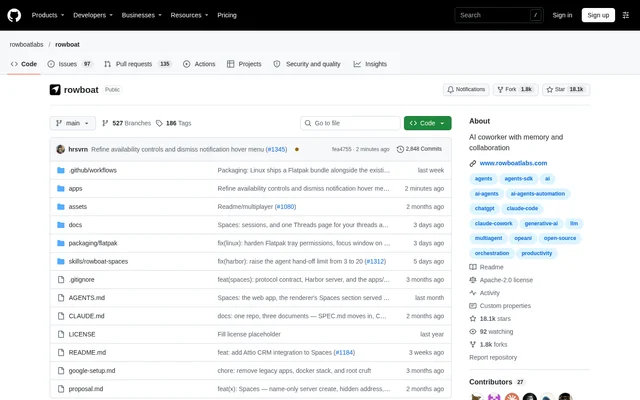
Rowboat is an open-source personal AI assistant that combines persistent work memory with tools for email, meetings, browsing, coding and collaboration. Rowboat is designed for solo work and teams, with desktop downloads for Mac, Windows and Linux. Personal work context lives on the user’s machine rather than in a proprietary document format.
Rowboat builds an Obsidian-style, backlinked knowledge graph from email, meetings, Slack and assistant conversations. The graph preserves relationships and accumulated context over time. Notes remain editable as plain Markdown, so users can inspect and maintain the information that informs their assistant’s work.
What Rowboat can do
Rowboat combines built-in work surfaces with agents that use accumulated work context. Email, meeting notes, browser activity and coding tasks can sit alongside project workspaces. Background agents can respond to events such as incoming email or follow a schedule, connecting to tools and carrying out web or coding work.
- Rowboat sorts email and drafts replies for important messages.
- Rowboat transcribes meetings and saves Markdown summaries.
- Rowboat provides an isolated browser for shared web tasks.
- Rowboat runs parallel coding agents through Claude Code or Codex.
- Rowboat supports custom work surfaces with tool and integration access.
- Rowboat connects external services through MCP.
How Rowboat works
Rowboat runs as a local desktop assistant and supports local models through Ollama or LM Studio, alongside hosted models configured with the user’s own API key or provider. Google services require the documented Google setup. Optional Deepgram, ElevenLabs, Exa and Composio connections use separately configured API keys.
Rowboat connects teammates through Spaces hosted by Harbor. Each participant keeps a local assistant, memory and model keys. Mentioning @rowboat in a Space invokes that participant’s assistant on their machine; the assistant returns selected results to the shared room. Harbor exposes HTTP, WebSocket and MCP interfaces, including access for other agents.
Who Rowboat is for
Rowboat serves individuals who want an assistant grounded in their ongoing work and teams that need shared conversations, documents and agent-assisted execution. Spaces combine channels and shared folders, with threads, direct messages, uploads, markdown documents and whiteboards. Coding work can use shared Space files as context and return changes to a thread for review.
- Rowboat helps individuals draft email responses using work context.
- Rowboat helps meeting participants retain transcripts and summaries.
- Rowboat helps developers delegate implementation work to coding agents.
- Rowboat helps teams collaborate on documents and live whiteboards.
Rowboat access, licensing and deployment
Rowboat is available through downloadable desktop releases and an Apache-2.0-licensed source repository. Rowboat supports local models as well as hosted providers using users’ own credentials. The source does not list subscription plans or hosted-service prices, so model and integration access should be distinguished from the open-source application.
Rowboat offers hosted Spaces through an in-app server creation flow using a Google or Microsoft Rowboat account. Teams can also self-host Harbor from the repository. Team deployment uses Postgres, hostname-based organisation routing and OpenID Connect sign-in, with new members joining through invitations.
Rowboat strengths and limitations
Rowboat keeps personal knowledge in inspectable Markdown and allows model switching without moving the local vault. Rowboat also separates personal assistant context from shared Space content: only selected posts cross into Harbor. Local storage does not mean every connected operation stays local, because external tools can receive queries, URLs and supplied context.
- Rowboat requires separate API keys for optional voice services and Exa search.
- Rowboat requires technical configuration for self-hosted Harbor deployments.
- Rowboat’s Parallel search integration has rate-limited free access.
Rowboat FAQ
What is Rowboat?
Rowboat is an open-source personal AI assistant with local memory, email, meeting notes, browser tools and coding agents. Rowboat builds an editable knowledge graph from work context and supports both individual use and team collaboration through shared Spaces.
Is Rowboat open source?
Rowboat is open source under the Apache-2.0 licence, with desktop downloads and source code available from the repository. Rowboat also includes the open-source Harbor server for self-hosted Spaces. Hosted models use users’ own API keys or providers.
Does Rowboat work with local AI models?
Rowboat supports local models through Ollama or LM Studio and hosted models through users’ own API keys or providers. Rowboat allows model switching while keeping personal data in the same local Markdown vault.
How does Rowboat handle team collaboration?
Rowboat provides Spaces that combine messages, threads, shared files, markdown documents and whiteboards. Each teammate runs a local assistant with separate memory and model keys. Mentioning @rowboat invokes that person’s assistant, which posts selected results back to the shared room.
Does Rowboat support MCP integrations?
Rowboat connects to external tools and services through Model Context Protocol, including search, databases, CRMs, support tools and internal tools. The repository lists examples such as Exa, Slack, Linear/Jira and GitHub. Tool use follows configured MCP permissions.
Is Rowboat data stored locally?
Rowboat stores personal data locally as plain Markdown that users can inspect, edit, back up or delete. Shared Space content resides on Harbor, and external tool calls can transmit information. The Parallel search example explicitly sends queries, requested URLs and supplied context to Parallel.
From the community
No reviews yet
Be the first to review this tool. What you write helps the next person choose.