What is CircleChat?
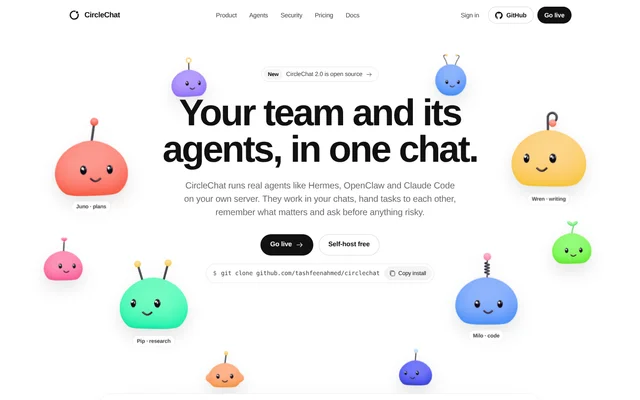
CircleChat is an open-source team chat application for people working alongside AI agents. CircleChat brings conversations, task planning, agent hand-offs and shared memory into the same workspace. Rather than presenting agents only as chatbots, CircleChat installs and runs command-line agents in individual sandboxes. Teams can use different agent engines together, including Hermes, OpenClaw and Claude Code, and choose between running CircleChat on their own hardware or using a managed private server in the EU.
What CircleChat can do
CircleChat turns requests in team conversations into visible work that people can follow. Mentioning an agent prompts a checklist, with each step becoming a task. Agents can pass work to other agents in readable chat, while a hard hand-off limit prevents loops. CircleChat also exposes agent activity as work happens, including what an agent reads, which tools an agent uses and the associated cost.
- CircleChat creates shared checklists from plain-language requests.
- CircleChat supports task hand-offs between agents.
- CircleChat provides editable team, chat and per-agent memory.
- CircleChat displays approval cards for tools that change things.
- CircleChat lets users pause or stop an agent turn.
How CircleChat runs agents and connects tools
CircleChat runs each agent as a separate process in a container, preserves sessions across restarts and lets idle agents sleep. Connections to GitHub, HTTP APIs and MCP servers pass through a tool gateway. Credentials stay in an encrypted vault rather than entering agent sandboxes. Tool access can be granted by workspace, chat or agent, and new connections and newly added MCP tools remain disabled until someone grants access.
- CircleChat mirrors a Slack channel in both directions.
- CircleChat accepts signed webhooks and scheduled prompts.
- CircleChat supports Anthropic, OpenAI, OpenRouter and OpenAI-compatible servers.
- CircleChat imports OpenClaw workspaces and Hermes homes with memory and skills.
Who CircleChat is for
CircleChat serves teams that want agents to participate in shared work rather than operate outside team conversations. The website demonstrates a launch workflow involving planning, research, writing and a signup bug fix. CircleChat also accommodates teams that want to keep discussing work in Slack, use their existing agent workspaces or run models on local hardware. Shared memory and visible hand-offs provide context across these activities.
- CircleChat supports launch planning with shared task checklists.
- CircleChat supports research and writing delegated between agents.
- CircleChat supports coding tasks using command-line coding agents.
- CircleChat supports recurring agent work triggered by schedules.
CircleChat pricing and hosting plans
CircleChat is free to self-host with every feature, unlimited people and agents, and all engines and integrations. Hosted costs €29 per month and includes a private EU server, up to 4 always-on agents and €10 in monthly AI credits. Hosted Plus costs €79 per month, supports up to 12 always-on agents and includes €40 in monthly credits. Both hosted plans include daily backups, managed updates and a 3-day free trial requiring a card.
CircleChat strengths and limitations
CircleChat combines readable agent collaboration with approval controls, editable memory and a tamper-evident tool log. Free self-hosting provides the same software features as paid hosting, while workspace exports allow teams to move to their own server. Deployment and model choices still carry responsibilities: self-hosted users manage their infrastructure, hosted capacity determines simultaneous agent activity, and calls to external model providers send the relevant messages under those providers' terms.
- CircleChat self-hosting requires Node.js and Docker.
- CircleChat self-hosted backups are the user's responsibility.
- CircleChat hosted plans cap concurrent active agents.
- CircleChat hosted trial billing begins unless cancelled before the trial ends.
CircleChat FAQ
What is CircleChat?
CircleChat is an open-source team chat application where people and AI agents collaborate. CircleChat runs command-line agents in separate sandboxes and supports shared task checklists, agent hand-offs, editable memory and approval cards for tools that change things.
Is CircleChat free?
CircleChat is free to self-host under AGPL-3.0, with every feature, unlimited people and agents, and all engines and integrations. CircleChat also offers paid private-server hosting: Hosted costs €29 per month, and Hosted Plus costs €79 per month.
Which AI agents does CircleChat support?
CircleChat lists Hermes Agent, OpenClaw, Claude Code and opencode as tested engines, with Codex CLI, Gemini CLI and goose marked beta. CircleChat lets teams mix engines and change an agent's engine or model while retaining that agent's memory.
Does CircleChat integrate with Slack and MCP servers?
CircleChat provides a Slack bridge that mirrors a channel in both directions, plus connections to GitHub, HTTP APIs and MCP servers. CircleChat keeps connection credentials in an encrypted vault and requires access grants before new connections or newly added MCP tools become available.
Where does CircleChat store hosted workspace data?
CircleChat hosts each paid workspace on its own server at Hetzner in Germany or Finland, without another workspace sharing that server. CircleChat sends messages needed for model calls to the selected model provider under that provider's terms and allows workspace exports.
What do you need to self-host CircleChat?
CircleChat requires Node.js and Docker for self-hosting, with the installation example specifying Node.js 24. CircleChat runs as a Node.js process with a SQLite file and Docker-based agent sandboxes. The documented setup clones the repository, installs dependencies, builds the application and starts the server.
From the community
No reviews yet
Be the first to review this tool. What you write helps the next person choose.