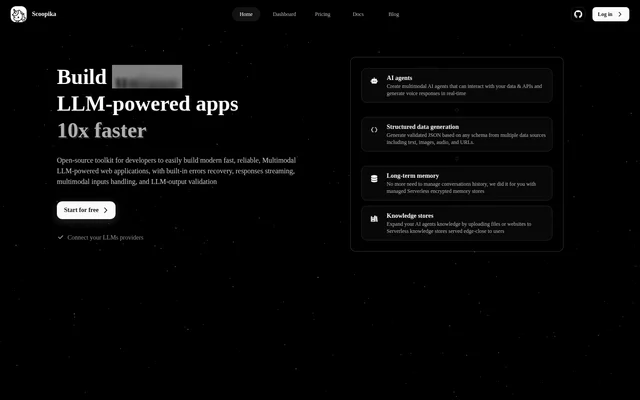
What is Scoopika?
Scoopika is an open-source toolkit for developers creating multimodal AI agents and LLM-powered web applications. Scoopika combines agent execution with streaming, output validation, and error recovery. The toolkit is intended for application development, including conversational interfaces, automation workflows, and data extraction tasks that use a developer's chosen LLM provider.
Scoopika provides SDKs for server-side execution, client-side interaction, and React development. The website describes support for any web framework, including React and NextJS. Scoopika also provides managed services for conversation memory and agent knowledge, while allowing developers to host their own Scoopika endpoint.
What Scoopika can do
Scoopika supports agents that combine multimodal inputs with tools and external data. Agents can fetch information or perform actions through connected APIs and custom functions. Scoopika also handles structured output generation, response streaming, and optional managed storage for conversational history and knowledge retrieved from uploaded content.
- Scoopika accepts text, images, audio, and URLs as agent inputs.
- Scoopika generates validated JSON against a supplied schema.
- Scoopika connects agents to APIs and custom code functions.
- Scoopika streams text and voice responses as they are generated.
- Scoopika stores conversation history in managed encrypted memory.
- Scoopika builds knowledge stores from files, PDFs, and websites.
- Scoopika supports client-side actions through its client SDK.
How Scoopika works
Scoopika follows a workflow of connecting an LLM provider, creating an agent, and using that agent in an application or exposing it through an API endpoint. Provider connections are made from the developer's servers without sharing them with Scoopika servers. The example agent call accepts message, audio, image, and URL inputs.
Scoopika exposes hooks for streamed tokens and tool calls. The server SDK runs agents and deploys streaming HTTP endpoints, while the client SDK supports real-time streaming and client-side actions. The React package supplies building blocks with state management. Developers can host their endpoint on their preferred cloud and use managed memory and knowledge services separately.
Who Scoopika is for
Scoopika is aimed at engineers and developers building LLM-powered applications, from individual side projects to team deployments. The listed use cases focus on adding AI behavior to web products rather than using a standalone chatbot. Scoopika supports conversational interfaces as well as workflows that extract structured data or invoke external tools.
- Scoopika supports custom AI assistants embedded in websites.
- Scoopika supports conversational bots using text and voice.
- Scoopika supports automation applications that call APIs and tools.
- Scoopika supports data extraction into schema-validated JSON.
- Scoopika supports multimodal AI-powered search applications.
Scoopika pricing and plans
Scoopika offers a free Hobby plan with unlimited agent runs, provider connections, agent tools, real-time streaming, output validation, full type-safety, and smart error recovery. Scoopika states that core features can run on a developer's servers for free and that optional features, rather than an added LLM usage surcharge, drive its paid offering.
Scoopika Pro costs $25/month and adds managed long-term memory, knowledge from files and websites, real-time voice responses, higher rate limits, and faster audio processing. Scoopika Scale costs $70/month and lists higher memory storage, requests, knowledge requests, voice response allowances, and direct support. Developers still use their own LLM providers.
Scoopika strengths and limitations
Scoopika combines several application-development capabilities in one toolkit: multimodal input handling, streamed responses, JSON validation, and error recovery. TypeScript SDKs cover server, client, and React use, while deployment remains under the developer's control. The free plan includes core agent functionality, but managed services and voice responses introduce paid-plan requirements.
- Scoopika requires developers to connect an LLM provider.
- Scoopika requires a vision-capable LLM for image inputs.
- Scoopika reserves managed memory, knowledge stores, and voice responses for paid plans.
- Scoopika describes 90% of its components as open source, rather than the entire product.
Scoopika FAQ
What is Scoopika?
Scoopika is an open-source developer toolkit for building multimodal AI agents and LLM-powered web applications. Scoopika includes streaming, JSON output validation, error recovery, API tools, and SDKs for server-side, client-side, and React development.
Is Scoopika free?
Scoopika offers a free Hobby plan with unlimited agent runs, streaming, tools, output validation, and error recovery. Scoopika Pro costs $25/month, while Scale costs $70/month. Paid features include managed memory, knowledge stores, and voice responses; LLM provider costs remain separate.
Which frameworks and SDKs does Scoopika support?
Scoopika provides TypeScript packages for server-side agents and HTTP endpoints, client-side streaming and actions, and React building blocks with state management. Scoopika states that the toolkit works with any web framework and specifically names React and NextJS.
Can Scoopika work with APIs and custom tools?
Scoopika lets developers equip AI agents with APIs, tools, and custom functions from their code. Scoopika agents can use these connections to fetch data or perform actions based on context, supporting automation applications and assistants that interact with external services.
Can Scoopika process images and audio?
Scoopika accepts image and audio inputs alongside text and URLs. Scoopika supports parallel processing of multiple audio files and real-time voice response streaming. Image input requires an LLM that supports vision, while voice responses are included in paid plans.
Can developers host Scoopika themselves?
Scoopika allows developers to host their own endpoint on their preferred cloud and run core features on their servers for free. Scoopika provides server-side agent execution and HTTP endpoint deployment, while managed memory and knowledge stores are supplied as optional services.
From the community
No reviews yet
Be the first to review this tool. What you write helps the next person choose.