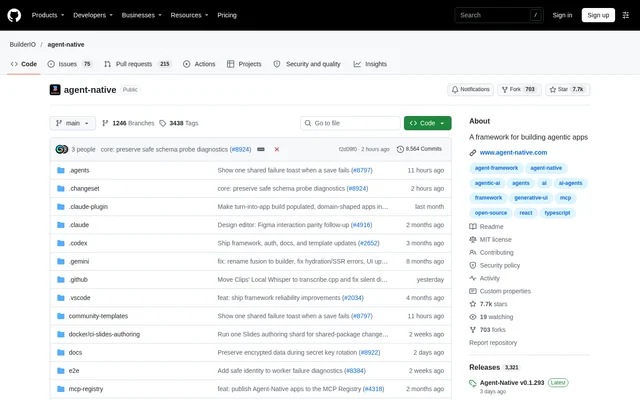
What is Agent-Native?
Agent-Native is an open-source TypeScript framework for building agents with purpose-built user interfaces. Agent-Native serves developers who want autonomous work and interactive application controls to operate together. The framework centers on shared actions, allowing an agent and a UI to invoke the same capability rather than maintaining separate implementations.
Agent-Native describes the UI as a way for people to inspect, edit, approve, and share agent work. The repository includes example agents and documentation alongside the framework source. Agent-Native is distributed under the MIT license, and the documentation states that developers bring their own LLM, SQL database, tools, and infrastructure.
What Agent-Native can do
Agent-Native combines a shared application architecture with built-in features for conversational work, access control, persistent context, and automation. The same action layer connects agent tools to application code and additional interfaces. Agent-Native also provides shared data and relevant UI state so agent work and user edits remain available across both interaction paths.
- Agent-Native exposes actions through agent tools, UI code, HTTP, MCP, A2A, and the CLI.
- Agent-Native includes chat for delegating work, asking questions, and reviewing results.
- Agent-Native provides authentication and permissions for shared work.
- Agent-Native supports reusable skills and persistent memory.
- Agent-Native runs automations on schedules or events.
- Agent-Native delegates work to specialist agents within a workspace or across connected agents.
How Agent-Native works
Agent-Native starts with capabilities defined as actions. The repository example uses defineAction with a schema and execution function; the agent receives that action as a tool, while React invokes the same function through useActionQuery. Both paths use the same validation, permissions, and implementation. Agent-Native agents work through this action layer rather than clicking through the UI.
Agent-Native shares application data and passes relevant interface context to the agent, including the current page, selected record, or active view. Agent-Native uses PostgreSQL for production and PGlite for local development on Nitro-compatible hosts. The quick-start command creates a standalone project from the chat template, with a getting-started guide providing the fuller introduction.
Who Agent-Native is for
Agent-Native is for developers creating agentic applications where users need more than a text box to understand and control work. The repository offers example agents that developers can use as starting points or references. Those examples cover meetings, designs, presentations, analytics, calendars, email, media assets, content, and visual planning.
- Agent-Native provides an analytics example for asking data questions and building dashboards.
- Agent-Native provides a mail example for prioritizing email, drafting replies, and following up.
- Agent-Native provides a slides example for creating and editing on-brand presentations.
- Agent-Native provides a content example for drafting, organizing, and publishing content.
- Agent-Native provides a plans example for diagrams, wireframes, and prototypes.
Agent-Native pricing and access
Agent-Native is an open-source project available under the MIT license. Access is through the public repository and the documented project creation command, rather than a product subscription described in the supplied framework text. Agent-Native asks developers to bring their own LLM, SQL database, tools, and infrastructure; the source does not specify costs for those external components.
Agent-Native strengths and limitations
Agent-Native's shared action design keeps agent and UI behavior tied to the same implementation, validation, and permissions. Agent-Native also exposes those actions through multiple interfaces and includes examples for different knowledge-work applications. The main practical constraints are the code-based development workflow and the requirement to supply external model, database, tooling, and infrastructure choices.
- Agent-Native requires developers to define capabilities in code.
- Agent-Native expects developers to bring their own LLM and supporting infrastructure.
- Agent-Native documents PostgreSQL for production and PGlite for local development.
Agent-Native FAQ
What is Agent-Native?
Agent-Native is an open-source TypeScript framework for building agents that pair autonomous work with purpose-built user interfaces. Agent-Native lets developers define capabilities as shared actions that agents invoke as tools and UI code calls directly.
Is Agent-Native free?
Agent-Native is available as an open-source project under the MIT license. Agent-Native expects developers to bring their own LLM, SQL database, tools, and infrastructure; the supplied framework text does not specify charges for those external components.
Does Agent-Native support MCP and APIs?
Agent-Native exposes shared actions through HTTP, MCP, A2A, and the CLI, in addition to agent tools and UI code. Agent-Native uses the same validation, permissions, and implementation for agent and UI calls.
What can developers build with Agent-Native?
Agent-Native supports applications that combine agent work with interactive interfaces. Agent-Native provides example agents for meeting recordings, interactive designs, presentations, analytics dashboards, calendar management, email, media assets, content publishing, and visual plans.
How do developers get started with Agent-Native?
Agent-Native provides the quick-start command npx --yes @agent-native/core@latest create my-agent --standalone --template chat. Agent-Native also links to a getting-started guide, a framework guide, example agents, and documentation for local development and contributions.
Which databases does Agent-Native use?
Agent-Native documents PostgreSQL for production and PGlite for local development on any Nitro-compatible host. Agent-Native also states that developers bring their own SQL database alongside their chosen LLM, tools, and infrastructure.
From the community
No reviews yet
Be the first to review this tool. What you write helps the next person choose.