What is flue?
flue is an open-source TypeScript framework for building autonomous agents with a programmable harness. flue gives agents the context and execution environment needed to work toward a goal, including sessions, instructions, tools, skills, filesystem access, and a secure sandbox. The framework is intended for developers building agents that can take actions rather than only produce conversational responses.
flue describes an architecture in which developers provide a task, context, and tools rather than a predefined sequence of steps. The repository demonstrates an agent defined as a TypeScript function that selects a model, configures a sandbox, loads skills, registers tools, and returns instructions for the task.
What flue can do
flue combines agent execution, continuity, delegation, and external connections within its harness. Agents can maintain context across conversations and events while working toward a goal. The framework also provides ways to observe agent activity and connect agent actions to application tools, authenticated services, and incoming events.
- flue gives agents secure sandboxes for tool use and file modification.
- flue preserves progress through failures and restarts with durable recovery for accepted work.
- flue lets agents delegate tasks to specialized subagents.
- flue packages reusable expertise and workflows as skills.
- flue connects agents to authenticated tools and services through MCP servers.
- flue receives verified events from Slack, Teams, Discord, and GitHub.
- flue exports telemetry through OpenTelemetry, Braintrust, Sentry, or a custom observer.
How flue works
flue agents are defined in TypeScript using runtime functions to configure models, sandboxes, skills, and tools. The repository example imports a local sandbox, Markdown skill files, and GitHub tool functions. The example then supplies instructions for reproducing a bug, diagnosing its cause, checking intended behavior, and attempting a fix.
flue supports local execution through its CLI and deployment to a hosted runtime of the developer's choice. Listed deployment options include Node.js, Cloudflare Workers, GitHub Actions, GitLab CI/CD, Daytona, and Render. Supporting packages include a Vite plugin, a client SDK for deployed conversations, an OpenTelemetry tracing adapter, and a Postgres persistence adapter.
Who flue is for
flue serves developers who need to define an agent's tools, instructions, skills, and execution environment in code. The repository's bug-triage example illustrates software development work, while the framework's typed actions also cover calling APIs, querying data, and making controlled changes through an application.
- flue supports bug-triage agents that reproduce issues and attempt fixes.
- flue supports task delegation through specialized agent roles.
- flue supports event-driven agents connected to collaboration and development channels.
flue pricing and access
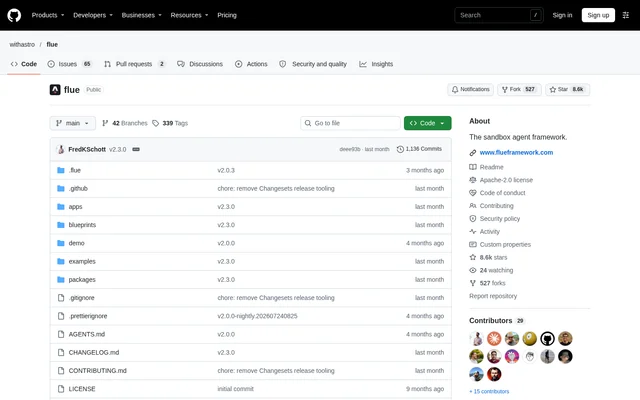
flue is available as an open-source project in a public GitHub repository under the Apache-2.0 license. The repository lists separate packages for the runtime, command-line interface, Vite integration, client SDK, tracing, and persistence. The supplied project text does not describe paid flue plans or hosted-service pricing.
flue strengths and limitations
flue brings sandbox execution, persistent context, reusable skills, and task delegation into a programmable harness. Local execution and multiple deployment targets give developers choices about where agents run. The implementation shown is code-based: developers define TypeScript functions and configure the model, tools, skills, and sandbox rather than use a described no-code workflow.
- flue requires TypeScript development to define the agent harness shown in the repository.
- flue requires developers to configure the tools and context their agents receive.
- flue requires a local or hosted runtime to execute agents.
flue FAQ
What is flue?
flue is an open-source TypeScript agent harness framework for building autonomous agents. flue provides sessions, tools, skills, instructions, filesystem access, and secure sandboxes so agents can work toward goals with developer-provided context and capabilities.
Is flue free?
flue is available as an open-source project under the Apache-2.0 license through its public GitHub repository. The supplied project text does not list paid flue plans or hosted-service prices.
Where can flue agents run?
flue agents can run locally through the CLI or deploy to a hosted runtime of the developer's choice. The repository lists Node.js, Cloudflare Workers, GitHub Actions, GitLab CI/CD, Daytona, and Render as deployment options.
Does flue support MCP and integrations?
flue supports authenticated tools and services through MCP servers and receives verified events from Slack, Teams, Discord, and GitHub. flue also supports telemetry through OpenTelemetry, Braintrust, Sentry, or a custom observer.
Can flue agents recover after failures?
flue provides durable recovery for accepted work so agents can preserve progress through failures and restarts. flue also supports context across conversations and events, allowing agents to maintain continuity while working toward a goal.
What can developers build with flue?
flue supports autonomous agents that use tools, modify files in sandboxes, and delegate work to specialized subagents. The repository demonstrates a bug-triage agent instructed to reproduce a bug, diagnose its cause, verify intended behavior, and attempt a fix.
From the community
No reviews yet
Be the first to review this tool. What you write helps the next person choose.