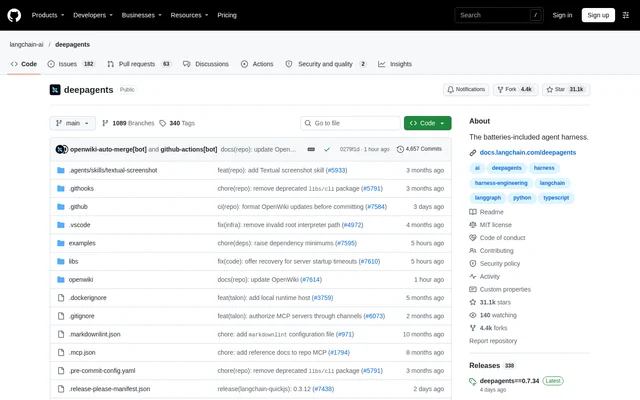
What is Deep Agents?
Deep Agents is an open-source agent harness for developers who need planning, delegation, and context management for long-horizon, multi-step tasks. Deep Agents builds on LangChain’s create_agent and the LangGraph runtime, adding bundled filesystem tools, sub-agents, and skills. The project provides opinionated defaults while allowing developers to extend, override, or replace components without maintaining a fork.
Deep Agents supports any language model that offers tool calling. Supported model paths include frontier APIs, hosted open-weight models, and self-hosted models through Ollama, vLLM, or llama.cpp. This model-agnostic design lets developers choose a compatible model rather than tying the harness to a single provider.
What Deep Agents can do
Deep Agents combines tools for coordinating work, manipulating files, and managing information across longer tasks. Sub-agents receive isolated context windows, while context management summarizes long threads and moves tool outputs to disk. Developers can supply custom functions or MCP servers and configure human review before tool calls execute.
- Deep Agents delegates tasks to sub-agents with isolated context windows.
- Deep Agents reads, writes, edits, and searches files through pluggable backends.
- Deep Agents summarizes long threads and offloads tool outputs to disk.
- Deep Agents runs shell commands in a chosen sandbox.
- Deep Agents supports cross-session recall through pluggable state and store backends.
- Deep Agents loads reusable skills on demand.
- Deep Agents allows people to approve, edit, or reject tool calls.
How Deep Agents works
Deep Agents provides a Python quickstart using uv add deepagents. Developers import create_deep_agent, supply a model and system prompt, and invoke the agent with a message. The example asks a research assistant to research LangGraph and write a summary. Developers can then add tools, change models, customize prompts, and configure sub-agents.
Deep Agents is also available as a JavaScript/TypeScript library through deepagents.js. LangGraph supplies streaming, persistence, and checkpointing, while LangSmith supports tracing, evaluation, monitoring, and deployment workflows. A LangGraph CompiledStateGraph can also be passed in as a sub-agent, allowing custom orchestration to operate alongside the harness defaults.
Who Deep Agents is for
Deep Agents is intended for developers who want a bundled harness rather than assembling planning, context management, and delegation themselves. The repository demonstrates a research assistant and also points to Deep Agents Code, a pre-built terminal coding agent. Developers needing a lighter harness can use LangChain’s create_agent, while custom graph workflows can use LangGraph directly.
- Deep Agents supports research workflows that produce written summaries.
- Deep Agents supports delegated work across agents with separate contexts.
- Deep Agents supports file-based tasks with configurable storage backends.
- Deep Agents supports workflows requiring human review of tool calls.
Deep Agents pricing and access
Deep Agents is an open-source project distributed under the MIT license. Developers can obtain the Python package through the documented installation command or use the JavaScript/TypeScript library. The repository links to documentation, examples, an API reference, and development guides. The supplied product text does not specify commercial plans or model-provider charges.
Deep Agents strengths and limitations
Deep Agents combines replaceable components with bundled capabilities for multi-step agent work. Model flexibility, filesystem backends, and LangGraph infrastructure support different development and deployment choices. Deep Agents follows a trust-the-LLM security model, however: an agent can perform anything its tools permit. Developers must therefore enforce access and execution boundaries through tools and sandboxes.
- Deep Agents requires models with tool-calling support.
- Deep Agents does not rely on the model to enforce security boundaries.
- Deep Agents may require custom LangGraph orchestration when the default agent loop does not fit.
Deep Agents FAQ
What is Deep Agents?
Deep Agents is an open-source agent harness built on LangChain’s create_agent and LangGraph. Deep Agents bundles planning, filesystem tools, sub-agents, context management, and skills for developers building agents that perform long-horizon, multi-step work.
Is Deep Agents free?
Deep Agents is available as an open-source project under the MIT license. Deep Agents provides a Python package and a JavaScript/TypeScript library; the repository does not state commercial subscription plans or model-provider pricing.
Does Deep Agents work with local models?
Deep Agents works with local models that support tool calling. Deep Agents supports self-hosted models through Ollama, vLLM, or llama.cpp, as well as frontier APIs and hosted open-weight models through compatible LangChain chat models.
How is Deep Agents different from LangChain and LangGraph?
Deep Agents is a more opinionated harness built on LangChain’s create_agent, while LangGraph supplies the graph runtime. Deep Agents bundles filesystem access, sub-agents, context management, and skills; LangChain’s create_agent provides a lighter harness, and LangGraph supports custom graph orchestration.
Does Deep Agents support MCP servers?
Deep Agents supports tools supplied through any MCP server, as well as developers’ own functions. Deep Agents also supports human-in-the-loop controls that let people approve, edit, or reject tool calls before execution.
What security limitations does Deep Agents have?
Deep Agents follows a trust-the-LLM model in which the agent can do anything its tools allow. Deep Agents requires developers to enforce boundaries at the tool or sandbox level rather than expecting the model to police its own behavior.
From the community
No reviews yet
Be the first to review this tool. What you write helps the next person choose.