What is Securiti?
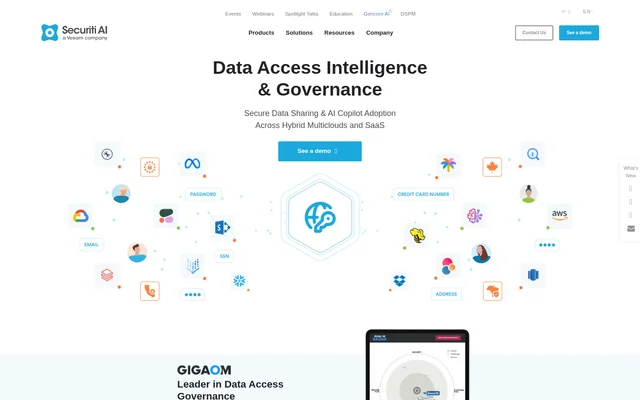
Securiti is an enterprise data access intelligence and governance tool for understanding who can access sensitive data and controlling what those users can see. The product uses the DataAI Command Graph to connect information about assets, users, and groups. It covers structured and unstructured data in public cloud, on-premises, and SaaS stores, and extends access governance to AI copilots and agents that use connected enterprise data.
What Securiti can do
Securiti combines data discovery, entitlement analysis, policy enforcement, and compliance reporting. Security teams can examine permissions at the file or table level and compare those permissions with actual access activity. Instead of relying on a static list of permissions alone, teams can see which users are active and use least-privilege recommendations to guide access changes.
- Securiti classifies sensitive data with AI-powered and customizable classifiers.
- Securiti analyzes file and table privileges through a metadata graph.
- Securiti recommends least-privilege settings based on access activity.
- Securiti filters rows and masks sensitive values at query time.
- Securiti restricts AI responses to data the requesting user can access.
- Securiti reports compliance posture through automated tests and dashboards.
How Securiti works
Securiti uses built-in integrations to discover data assets and collect metadata about files, tables, columns, rows, users, and groups. The DataAI Command Graph correlates that metadata for access investigations and policy decisions. Teams can inspect dashboards for structured and unstructured systems, then use attributes about users and data to define privileges, filter rows, or decide when sensitive values should be masked during a query.
Who Securiti is for
Securiti serves enterprise data security, data governance, privacy, and AI teams. Security teams can use access dashboards to investigate who has permissions and which users are active. Governance and privacy teams can examine entitlements that may violate regulations and investigate cross-border data residency risks. Teams deploying AI copilots can use the same access controls to govern what data those applications can surface.
- Review access to sensitive files and tables.
- Investigate cross-border data residency and access risks.
- Govern data access for SaaS copilots and agents.
- Report access compliance across multiple frameworks.
Securiti pricing and plans
Securiti lists a demo as the way to explore its Data Access Intelligence and Governance product. The page does not publish prices, describe plan tiers, or state whether a free version or trial is available. The demo is the only evaluation option described on the supplied product page.
Securiti strengths and limitations
Securiti brings access visibility and enforcement together: teams can examine entitlement and activity data, then apply controls such as row filters or query-time masking. The product also addresses AI-specific data exposure through entitlement-aware pipelines and context-aware LLM firewalls. The page describes coverage across deployment environments, but does not specify which integrations support each individual enforcement control.
Securiti FAQ
What is Securiti used for?
Securiti is used to discover sensitive enterprise data, analyze who has access to it, and enforce access policies. Teams can examine file and table privileges, monitor access activity, and use dashboards to identify data access and compliance risks.
Does Securiti publish pricing or offer a free plan?
Securiti does not publish pricing or identify a free plan on its Data Access Intelligence and Governance page. The page offers a demo but does not describe plan tiers or say whether a free trial is available.
Who is Securiti for?
Securiti is for enterprise data security, governance, privacy, and AI teams that need to manage access to sensitive data. The product supports teams reviewing user entitlements, applying least-privilege policies, or governing what data connected AI copilots can access.
How does Securiti govern data access for AI copilots?
Securiti governs data access for AI copilots by strengthening access controls across connected SaaS systems. Securiti also supports generative AI pipelines that base responses on data the user is entitled to access and uses context-aware LLM firewall controls to help prevent sensitive data exposure.
What kinds of data stores does Securiti support?
Securiti supports discovery of structured and unstructured data in public cloud, on-premises, and SaaS data stores through built-in integrations. Discovery captures metadata about files, tables, columns, rows, users, and groups, which teams can use to investigate access.
From the community
No reviews yet
Be the first to review this tool. What you write helps the next person choose.