What is StockGPT?
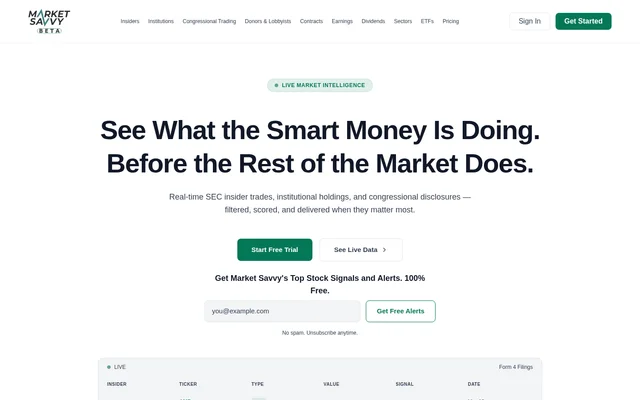
StockGPT is a market intelligence tool for investors who want to research securities filings alongside political and government activity connected to public companies. StockGPT covers insider transactions, institutional holdings, congressional trades, donations and lobbying, and federal contracts. The service combines these records with screening, scoring, and alerts so investors can examine activity relevant to their portfolios.
StockGPT presents institutional positions by portfolio weight, sector, and quarter-over-quarter change. Congressional records add committee context, while lobbying and procurement information connect government activity with public tickers. These capabilities support research into disclosed transactions and spending rather than relying only on individual filing documents.
What StockGPT can do
StockGPT organizes market and government disclosures into connected research modules. StockGPT screens insider trades by transaction characteristics, visualizes institutional holdings, and highlights congressional committee relationships. Additional modules map political donation flows, lobbying expenditure, and government procurement awards to publicly traded companies, giving investors several types of records to examine together.
- StockGPT screens Form 4 trades by transaction type, size, sector, and conviction strength.
- StockGPT tracks institutional holdings through 13-F, 13-D, and 13-G filings.
- StockGPT analyzes House and Senate trades for committee conflicts of interest.
- StockGPT maps donation flows and lobbying spend to public tickers.
- StockGPT tracks federal procurement awards and agency spending.
- StockGPT identifies trading clusters and unusual activity.
- StockGPT delivers alerts through email, SMS, and webhooks.
How StockGPT works
StockGPT ingests new SEC filings and congressional disclosures within minutes, then automatically parses, classifies, and scores transactions. Users set custom screeners based on insider role, transaction size, sector, fund type, or politician committee. StockGPT then supplies alerts alongside conviction scores, cluster signals, and historical context, with real-time access and alert options depending on the selected plan.
Who StockGPT is for
StockGPT serves investors researching the disclosed activity of company insiders, investment funds, and elected officials. StockGPT also supports investors examining links between public companies and government decisions through lobbying records and procurement awards. Screening options let users focus on a sector, insider role, fund type, or committee relevant to their investment strategy.
- Investors can monitor purchases and sales by directors, officers, and executives.
- Investors can examine changes in institutional portfolio holdings.
- Investors can review congressional trades alongside committee responsibilities.
- Investors can research lobbying expenditure and federal contracts connected to public tickers.
StockGPT pricing and plans
StockGPT offers a Free plan at $0 per month and a Pro plan at $29 per month. Free access includes Form 4 trades with a 24h delay, a basic screener with 5 filters, 3 email alerts per day, and congressional trading summaries. Pro adds real-time filings, unlimited email, SMS, and webhook alerts, advanced screeners, conviction scores, congressional conflict analysis, and cluster detection. StockGPT also advertises a free trial with no credit card required and cancellation at any time.
StockGPT strengths and limitations
StockGPT combines several disclosure types with configurable screening and multiple notification channels. StockGPT also places trading activity alongside committee relationships, lobbying records, and federal spending, supporting research across otherwise distinct sources. The main access limitations concern the Free plan: delayed filings, restricted screening, capped email alerts, and summary-only congressional coverage, while more detailed analysis requires Pro.
- StockGPT delays Free plan Form 4 data by 24h.
- StockGPT limits Free plan screening to 5 filters.
- StockGPT caps Free plan email alerts at 3 per day.
- StockGPT reserves congressional conflict analysis and advanced screeners for Pro.
StockGPT FAQ
What is StockGPT?
StockGPT is a market intelligence tool for investors tracking insider trades, institutional holdings, congressional disclosures, lobbying, and federal contracts. StockGPT combines disclosure records with custom screening, transaction scoring, historical context, and alerts.
Is StockGPT free?
StockGPT offers a Free plan at $0 per month with delayed Form 4 data, basic screening, limited email alerts, and congressional summaries. StockGPT also offers Pro at $29 per month and advertises a free trial with no credit card required.
What does StockGPT Pro include?
StockGPT Pro includes real-time Form 4, 13-F, and 13-D/G filings, unlimited email, SMS, and webhook alerts, advanced screeners, and conviction scores. StockGPT Pro also includes congressional conflict analysis, cluster detection, and unusual activity flags.
How does StockGPT track congressional trading?
StockGPT tracks House and Senate disclosures and provides committee conflict-of-interest analysis. StockGPT offers congressional trading summaries on the Free plan, while Pro includes congressional trading access with conflict analysis.
Does StockGPT support webhooks?
StockGPT supports webhook alerts alongside email and SMS notifications. StockGPT includes unlimited alerts across these channels in the Pro plan, while the Free plan is limited to 3 email alerts per day.
What filters does StockGPT offer?
StockGPT supports custom screeners by insider role, transaction size, sector, fund type, and politician committee. StockGPT also describes insider trade screening by transaction type and conviction strength, with advanced screeners available through Pro.
From the community
No reviews yet
Be the first to review this tool. What you write helps the next person choose.