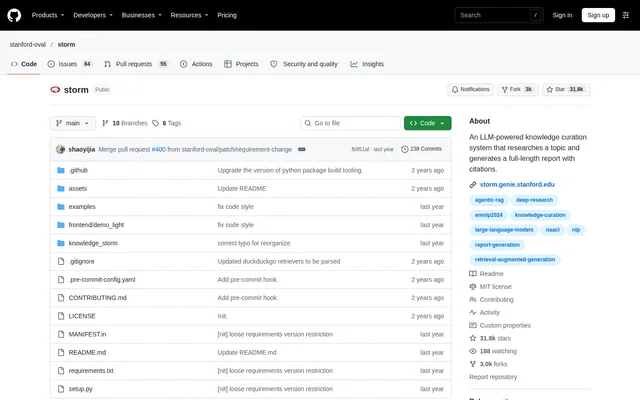
What is STORM?
STORM is an open-source knowledge curation system that researches a topic and generates a full-length, Wikipedia-like article with citations. STORM uses language models and Internet sources to support information gathering, outlining, and drafting. The repository describes experienced Wikipedia editors finding STORM useful during pre-writing, while explicitly warning that generated articles are not publication-ready.
STORM stands for Synthesis of Topic Outlines through Retrieval and Multi-perspective Question Asking. The repository also includes Co-STORM, a collaborative approach to knowledge curation that lets users observe or steer discussions among language model agents. Both implementations use a modular architecture built with dspy.
What STORM can do
STORM connects source collection with structured writing rather than generating an article directly from a topic prompt. STORM develops research questions from different perspectives, gathers references, and uses the resulting material to create an outline and article. The package also provides configurable polishing and supports retrieval from user-provided documents.
- STORM collects references through Internet-based research.
- STORM generates an outline before drafting an article.
- STORM writes full-length articles with citations.
- STORM simulates conversations between a Wikipedia writer and a topic expert.
- STORM supports document grounding through VectorRM.
- STORM can add a summarization section and optionally remove duplicate content.
How STORM works
STORM separates article production into pre-writing and writing stages. During pre-writing, STORM surveys articles on similar topics to discover perspectives and guide question generation. STORM then simulates source-grounded conversations to ask follow-up questions and collect information. During writing, STORM uses the collected references and outline to generate the article.
STORM exposes a Python STORMWikiRunner class for programmatic use. Developers configure language model components and a retrieval module before running research, outline generation, article generation, and polishing. STORM supports language and embedding models through litellm, while retrieval options include YouRM, BingSearch, SerperRM, BraveRM, SearXNG, DuckDuckGoSearchRM, TavilySearchRM, GoogleSearch, and AzureAISearch.
Who STORM is for
STORM serves people exploring topics before writing and developers implementing knowledge curation workflows. The repository specifically identifies experienced Wikipedia editors as finding value in the pre-writing stage. STORM also includes Co-STORM for users who want to observe a research discussion or contribute utterances that redirect the discussion toward their information needs.
- STORM supports reference gathering and outlining before article drafting.
- STORM supports developers customizing model and retrieval components.
- STORM includes Co-STORM for human-guided topic exploration with a shared mind map.
STORM pricing and access
STORM is an open-source project distributed under the MIT license. STORM can be obtained through the knowledge-storm Python package or by cloning the repository and installing its dependencies. The repository also links to a live research preview and provides a minimal Streamlit interface for local development and demo hosting. The supplied page does not list commercial plans or service prices.
STORM strengths and limitations
STORM combines cited article generation with configurable research stages and multiple retrieval options. STORM allows different components to use different language models, and developers can modify the engine through the source code. However, STORM is presented as a pre-writing aid rather than a publication-ready writing system. Programmatic use also requires setting up language model and information retrieval modules.
- STORM articles often require a significant number of edits.
- STORM requires model configuration before developers create a runner.
- STORM requires a configured information retrieval module for programmatic workflows.
STORM FAQ
What is STORM?
STORM is an LLM-powered knowledge curation system that researches topics and generates full-length, Wikipedia-like articles with citations. STORM collects references, creates an outline, and drafts an article to support topic exploration and pre-writing.
Is STORM free and open source?
STORM is available as an open-source project under the MIT license. STORM can be installed through the knowledge-storm Python package or obtained from the source repository. The supplied page does not state pricing for external model or retrieval services.
Does STORM produce publication-ready articles?
STORM does not produce publication-ready articles, according to the repository, and generated drafts often require significant editing. STORM is described as helpful to experienced Wikipedia editors during the pre-writing stage, particularly for research and outlining.
Can STORM research user-provided documents?
STORM supports grounding on user-provided documents through VectorRM, complementing search engine retrieval. STORM also exposes configurable retrieval modules, allowing developers to set up the information sources used by the knowledge curation workflow.
How do you install and configure STORM?
STORM can be installed with pip install knowledge-storm or from the source repository. STORM requires developers to configure language model and information retrieval modules before creating runner instances. The repository also provides a minimal Streamlit interface for local development and demo hosting.
Does STORM support human-AI collaboration?
STORM includes Co-STORM for collaborative knowledge curation. Co-STORM lets users observe discussions among language model agents or inject utterances to steer the conversation. Co-STORM also maintains a dynamically updated mind map that organizes collected information into a hierarchical concept structure.
From the community
No reviews yet
Be the first to review this tool. What you write helps the next person choose.