What is Supapool?
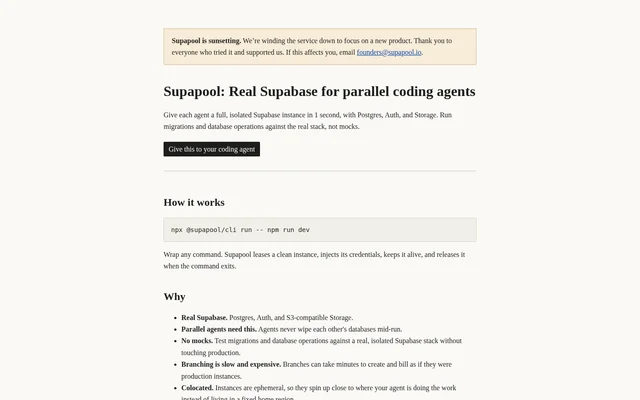
Supapool is a command-line tool that gives coding agents, developers, and CI jobs a clean Supabase instance for the duration of a command. Each lease provides real Postgres, Auth, and S3-compatible Storage rather than mocks. Separate instances let parallel agents work without wiping one another’s databases, and test runs can use the Supabase stack without touching production.
What Supapool can do
Supapool sets up the database environment before the wrapped command starts. SQL migration files run in filename order, and connection values are passed to the command rather than written into repository environment files. The credential aliases cover standard Supabase variables, framework-specific public prefixes, Prisma and Postgres URLs, and standard Postgres connection variables.
- Supapool leases a clean instance for a wrapped command.
- Supapool applies SQL files from supabase/migrations.
- Supapool injects credentials without exposing secret keys through browser-public variables.
- Supapool renews the lease while the command runs.
- Supapool releases the instance when the command exits.
How Supapool works
Supapool accepts a command after the double dash in npx @supapool/cli run --. On first use, the CLI opens GitHub sign-in and saves an API key in ~/.config/supapool/config.json. The wrapped command receives environment variables such as SUPABASE_URL, SUPABASE_ANON_KEY, SUPABASE_SERVICE_ROLE_KEY, and DATABASE_URL, along with SUPAPOOL_INSTANCE_ID to identify the lease.
Supapool leases have a default time to live of 30 minutes. The CLI renews the lease every 5 minutes while the command runs and releases the instance when the command exits. If the process dies and renewals stop, the lease expires and the slot is wiped before returning to the pool.
Who Supapool is for
Supapool is intended for coding agents that need independent databases and developers who want to verify database changes against a real Supabase stack. The CLI can wrap a development server or a test command. The npm library also supports programmatic workflows, such as seeding test data and using the stack inside a callback.
- Give parallel coding agents separate databases.
- Run a development server with temporary Supabase credentials.
- Test migrations and database operations in CI.
- Seed data and exercise the Supabase stack from code.
Supapool pricing and plans
Supapool is free during beta. The page does not state post-beta pricing. Access is through the CLI, which handles GitHub sign-in on first use, or through the npm library for workflows that manage leases from code. Account, usage, and cost information is available through the CLI and API rather than a dashboard.
Strengths and limitations
Supapool lets teams test against Postgres, Auth, and Storage without using a production database or coordinating access to a shared test instance. Automatic migrations and credential injection prepare each run without modifying repository environment files. The instances are disposable, so they suit tests that start from a clean state rather than workflows that need to retain data between runs.
- Stored data does not survive instance release.
- Supapool does not offer a dashboard.
- CI authentication requires an API key stored as a secret.
Getting started with Supapool
Supapool can launch a local development server with npx @supapool/cli run -- npm run dev. The run command handles sign-in on first use, so a separate login command is generally unnecessary. For CI, sign in outside the CI job, save the API key as a CI secret, and set SUPAPOOL_API_KEY so the job can skip browser sign-in.
Supapool also exposes withInstance through the npm package for code that needs a temporary instance. The helper acquires the lease, renews it while the callback runs, and releases it even if the callback throws. Code that needs to control its own lease boundaries can use acquire, renew, release, and startRenewer directly.
Supapool FAQ
What is Supapool?
Supapool is a CLI that leases a clean Supabase instance for a wrapped command. The instance includes real Postgres, Auth, and S3-compatible Storage, and the CLI passes its credentials to the command through environment variables.
Is Supapool free?
Supapool is free during beta. The product page does not state what pricing will be after beta. Users can access the CLI through the npm package and sign in with GitHub on first use.
Does Supapool apply Supabase migrations automatically?
Supapool automatically applies every SQL file in supabase/migrations in filename order. The CLI applies those files to a clean leased instance before starting the wrapped command, so tests can run against the migrated database.
Can Supapool run in CI?
Supapool can run in CI without opening a browser when SUPAPOOL_API_KEY is set. The documented setup is to sign in outside CI, save the API key as a CI secret, and wrap the test command with the Supapool CLI.
Does Supapool keep database data between runs?
Supapool does not retain data after an instance is released. The CLI releases the lease when the command exits. If the process dies and renewals stop, the lease expires and the instance is wiped before the slot returns to the pool.
From the community
No reviews yet
Be the first to review this tool. What you write helps the next person choose.