What is VectorShift?
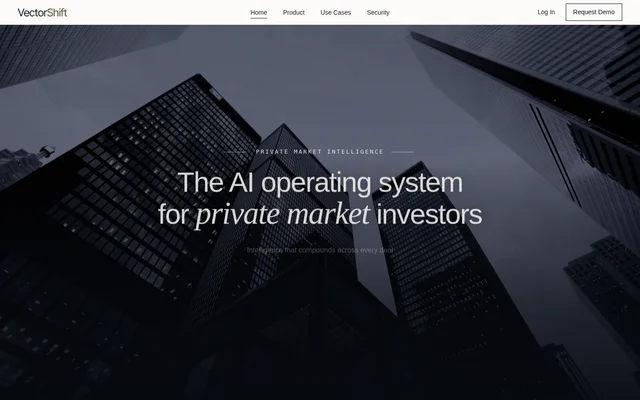
VectorShift is an AI operating system for private market investors, with interfaces for diligence, investment committee work, portfolio monitoring, and limited partner reporting. VectorShift combines document analysis with a record of the firm's previous decisions and outcomes. The stated purpose is to make institutional knowledge available across deals, teams, and investment decisions rather than leave that knowledge dependent on individual experience.
VectorShift captures diligence findings, investment committee decisions, action items, and realized outcomes as a living firm record. Historical operational levers and diligence patterns can surface during underwriting. VectorShift also records the achievement rate and dollar impact of initiatives, connecting investment assumptions with evidence from the firm's own history.
What VectorShift can do
VectorShift provides dedicated interfaces for investment tasks rather than only a general question-and-answer workflow. VectorShift links figures and findings to exact documents and pages, cross-references presentations against data room materials, and tracks evidence as deals progress. The listed capabilities span document review, portfolio oversight, comparative analysis, and meeting capture.
- VectorShift flags inconsistencies between presentations and data room documents.
- VectorShift monitors portfolio deviations from investment theses and surfaces risks.
- VectorShift analyzes companies, deals, or contracts side by side.
- VectorShift flags new filings, tracks changes, and identifies data room gaps.
- VectorShift captures partner calls, expert interviews, and management meetings as searchable records.
- VectorShift scores theses, risks, and initiatives at investment committee review and updates them as evidence arrives.
How VectorShift works
VectorShift organizes files, deals, and firm structure before users ask questions. VectorShift then uses that indexed context to locate relevant information and supplies source references for findings. Workflows and frameworks are captured as teams work, while cross-deal pattern recognition applies deal history across transactions. VectorShift routes tasks to different models and supports switching or tuning models by workflow.
VectorShift supports single-tenant cloud, VPC, and on-premises deployment. VectorShift inherits the firm's existing access controls so that deal data, queries, and outputs remain visible only to authorized participants. Usage and billing are visible at member, deal, and company levels. The website also states that customer data is never used to train models.
Who VectorShift is for
VectorShift serves private market investment firms and the teams conducting diligence, preparing investment decisions, and overseeing portfolio companies. VectorShift also supports the transfer of institutional knowledge from partners to associates by keeping the firm's playbook alongside ongoing deal work. The stated use cases connect individual transaction analysis with longer-term monitoring and reporting.
- VectorShift supports virtual data room analysis during diligence.
- VectorShift supports investment committee memo workflows and presentation review.
- VectorShift supports portfolio monitoring and limited partner reporting.
- VectorShift surfaces historical deal patterns during underwriting.
VectorShift pricing and access
VectorShift directs prospective customers to request a demo to see how the system works for their firm. The supplied page does not list subscription prices, named plans, or a free tier. VectorShift describes deployment choices and usage visibility, but the page does not provide public purchase terms or a self-service registration workflow.
VectorShift strengths and stated safeguards
VectorShift combines traceable answers, private-market workflows, and historical deal knowledge in the same system. VectorShift states SOC 2 Type II certification and GDPR compliance, alongside permission-based access and a no-model-training policy for customer data. Model selection is not tied to a single vendor. The supplied page does not specify feature limits, trial conditions, or deployment prerequisites.
VectorShift FAQ
What is VectorShift?
VectorShift is an AI operating system for private market investors. VectorShift supports data room analysis, investment committee memos, portfolio monitoring, and limited partner reporting while capturing diligence findings, decisions, and outcomes as institutional knowledge.
What can VectorShift do for investment diligence?
VectorShift analyzes data room materials, cross-references presentations against source documents, flags inconsistencies, and tracks new filings, changes, and gaps. VectorShift also provides side-by-side analysis of companies, deals, or contracts and traces findings to exact documents and pages.
Can VectorShift be deployed on-premises?
VectorShift supports on-premises deployment as well as single-tenant cloud and VPC deployment. VectorShift inherits existing firm access controls, restricting deal data, queries, and outputs to authorized participants.
Does VectorShift use customer data to train models?
VectorShift states that customer data is never used to train models. VectorShift also lists SOC 2 Type II certification, GDPR compliance, and permission-based access controls among its security and infrastructure provisions.
How do investment teams access VectorShift?
VectorShift offers a demo request as the website's access path for interested firms. VectorShift does not publish subscription prices, named plans, or free-tier details in the supplied page text.
Does VectorShift support different AI models?
VectorShift describes a model-agnostic design that routes tasks to different models and allows teams to switch or tune models by workflow. VectorShift states that this approach avoids dependence on a single model vendor.
From the community
No reviews yet
Be the first to review this tool. What you write helps the next person choose.