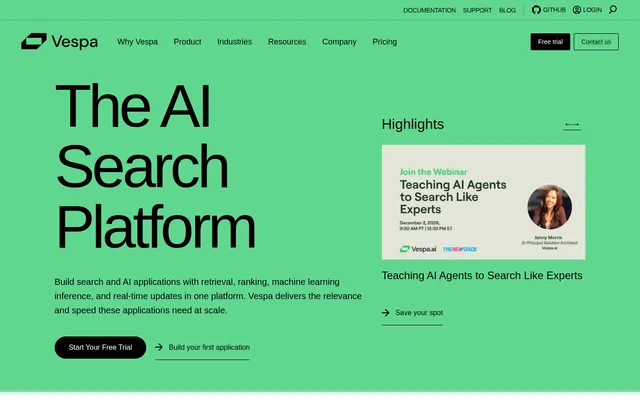
What is Vespa?
Vespa is a search and data-serving engine for applications that query, organize and make inferences over vectors, tensors, text and structured data. Vespa serves developers building search, generative AI, recommendation and personalization systems. Vespa combines retrieval with distributed machine-learned model evaluation, allowing applications to select and rank relevant data within the same engine.
Vespa is available through managed services and self-managed deployment options. Vespa's open-source offering supplies the core engine under Apache 2.0, while commercial offerings add different levels of infrastructure management, operational support and deployment control. The available choices accommodate teams using a managed service, their own cloud environment or their own data center.
What Vespa can do
Vespa combines search, ranking and data updates for applications that need more than vector similarity alone. Vespa supports hybrid search, relevance models and multi-vector representations for generative AI retrieval. Vespa also combines structured navigation with search and recommendation, addressing applications such as e-commerce that work with structured records, text and images.
- Vespa performs vector, lexical and hybrid search.
- Vespa supports filtered vector search and multi-phase ranking.
- Vespa runs tensor computations and machine-learning inference.
- Vespa supports real-time indexing and partial updates.
- Vespa provides grouping, aggregation and faceting.
- Vespa offers streaming search for personal and private data.
How Vespa works
Vespa provides production-ready sample applications and a developer site as starting points for building applications. Vespa documentation can be browsed, searched or accessed through its documentation search interface. Vespa Cloud trial users can build an application, index real data and run real queries before moving to a production-sized deployment.
Vespa Cloud manages infrastructure and operations, including automated deployment, upgrades and scaling. Vespa Enclave keeps data in a customer's cloud environment, with AWS, Azure and GCP named as options. Vespa Enterprise is operated by the customer's team with vendor support and includes a Kubernetes operator. Moving from a trial to production uses an application-package configuration change, a plan change, increased node count and redeployment.
Who Vespa is for
Vespa is designed for developers and engineering teams building data-driven applications. Vespa's stated use cases span search, generative AI, recommendation, personalization, ad targeting and semi-structured navigation. Vespa also addresses personal-data applications in which an individual query accesses only a small fraction of the available dataset, using streaming search rather than relying on indexes.
- Vespa supports search applications that combine keyword and vector retrieval.
- Vespa supplies relevant data for retrieval-augmented generation.
- Vespa retrieves and evaluates content for recommendation and ad targeting.
- Vespa combines e-commerce search with structured navigation.
- Vespa supports personal and private search through streaming mode.
Vespa pricing and plans
Vespa offers an open-source core alongside paid Cloud, Enclave and Enterprise options. Vespa Cloud and Vespa Enclave use resource-based pricing rather than per-query charges, with costs tied to compute, memory, storage and GPUs. Vespa Enterprise uses custom pricing with an annual license sized to the deployment. Basic, Professional and Premium plans provide different support levels.
Vespa Cloud offers $300 in trial credit without requiring a credit card. The trial cluster automatically tears down when the credit runs out. Vespa also offers a Startup option for early-stage companies developing and testing applications. Startup and Open Source receive community support only and are excluded from the commercial support plans.
Vespa strengths and limitations
Vespa brings multiple retrieval methods, machine-learned ranking and structured-data operations into one engine. Vespa's deployment choices let teams select between managed infrastructure and direct operational control. The main trade-offs concern maintenance responsibility and support coverage: self-managed users operate the engine themselves, while managed reliability capabilities and response commitments depend on the selected support plan.
- Vespa Open Source requires customer-managed infrastructure and manually applied monthly snapshots.
- Vespa Open Source has no hardened image or SLA for critical fixes.
- Vespa Startup and Open Source provide community support without an SLA.
- Vespa Cloud and Vespa Enclave require Professional support for backups and disaster recovery.
Vespa FAQ
What is Vespa?
Vespa is a search and data-serving engine that queries vectors, tensors, text and structured data. Vespa combines vector and keyword search with distributed machine-learned ranking for applications including search, retrieval-augmented generation, recommendation and personalization.
Is Vespa free?
Vespa offers an Apache 2.0 open-source core engine for teams that manage their own deployments. Vespa also provides paid managed and enterprise offerings. Vespa Cloud includes $300 in trial credit without a credit card, and the trial cluster shuts down automatically when the credit runs out.
How does Vespa pricing work?
Vespa prices managed services according to the resources an application uses rather than the number of queries. Vespa Cloud and Vespa Enclave use resource-based pricing, while Vespa Enterprise has custom pricing and an annual license sized to the deployment. Support levels vary by plan.
Can Vespa run in a private cloud or on-premises?
Vespa supports customer-controlled deployment through Open Source, Enclave and Enterprise options. Vespa Enclave is managed by Vespa in a customer's AWS, Azure or GCP environment. Vespa Open Source and Vespa Enterprise can run on customer infrastructure in the cloud or on-premises.
What can developers use Vespa for?
Vespa supports search, retrieval-augmented generation, recommendation, personalization, ad targeting and e-commerce navigation. Vespa combines retrieval with machine-learned model evaluation and provides streaming search for personal or private datasets where individual queries access only a small fraction of the total data.
What are the limitations of Vespa Open Source?
Vespa Open Source requires teams to operate their own infrastructure and manually apply monthly snapshot builds. Vespa Open Source includes community support only, has no SLA and does not provide a hardened image. Critical fixes arrive with the next snapshot rather than under an SLA.
From the community
No reviews yet
Be the first to review this tool. What you write helps the next person choose.