What is supermemory?
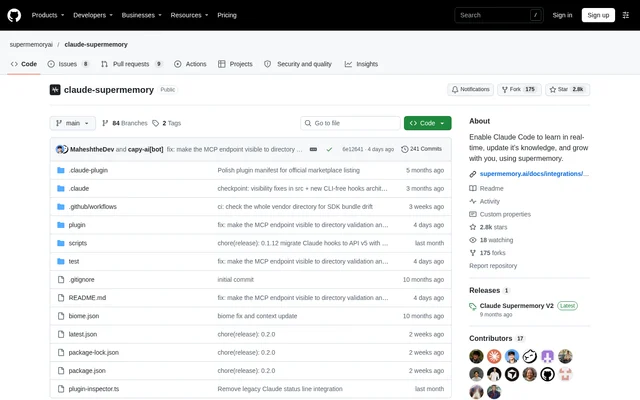
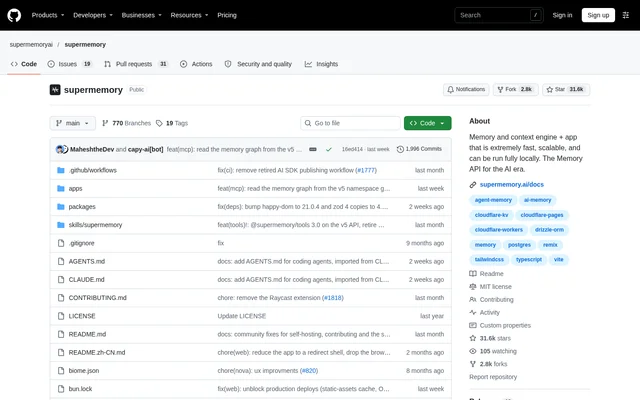
supermemory is an open-source memory and context engine for AI agents, applications, and assistants. supermemory preserves information across conversations by extracting facts, maintaining user profiles, and retrieving relevant context. The repository includes documentation for developers building memory into products and for people adding persistent context to existing AI tools.
supermemory combines conversational memory with retrieval-augmented generation, connectors, and file processing. The project describes a shared memory structure that handles knowledge updates, contradictions, and expired information. Access options include a hosted API, assistant plugins, an MCP server, and a locally running server.
What supermemory can do
supermemory manages both personal context and searchable source material. The API can store conversations, text, URLs, and HTML, while file uploads support several document and media types. Search can combine knowledge-base documents with personalized memories or return memories alone. Profiles distinguish long-term facts from recent activity.
- supermemory extracts facts from conversations and handles changing information.
- supermemory maintains user profiles with stable facts and recent context.
- supermemory searches documents and memories together through hybrid search.
- supermemory synchronizes Google Drive, Gmail, Notion, OneDrive, and GitHub content.
- supermemory processes PDFs, images with OCR, videos with transcription, and code with AST-aware chunking.
- supermemory scopes memories by project using container tags.
How supermemory works
supermemory offers separate entry points for assistant users and developers. Assistant users install a compatible plugin or configure the MCP server, then continue normal conversations while relevant information is extracted and stored. Developers install the JavaScript or Python package, add content through the API, and retrieve profiles or search results for application context.
supermemory supports framework integrations including Vercel AI SDK, LangChain, LangGraph, OpenAI Agents SDK, Mastra, Agno, Claude Memory Tool, and n8n. Local installation initializes an embedded graph engine, embeddings, and credentials. A setup wizard configures the model provider, and developers can point the API client at the local server.
Who supermemory is for
supermemory serves developers building AI agents and applications, users of compatible AI assistants, and people who want to run a memory engine locally. Plugins cover tools including Claude Code, Muse Code, Cursor, Codex, OpenCode, and OpenClaw. Project-based memory scoping supports separating personal context, work, clients, or repositories.
- supermemory helps coding assistants retain project discussions and user preferences.
- supermemory gives application developers profiles and relevant memories for personalized responses.
- supermemory combines synchronized knowledge-base documents with conversational context.
- supermemory supports local experimentation before switching to the hosted API.
supermemory pricing and access
supermemory is published in an MIT-licensed repository with instructions for local installation and self-hosting. The source also links to a hosted dashboard, API documentation, and assistant plugins. Hosted subscription prices, usage allowances, and plan names are not stated in the supplied page, so those terms cannot be compared from this source.
supermemory can be obtained through the documented install script, the local command, or prebuilt Docker images. Local deployments support external model providers or Ollama. The default local embedding model does not require an API key, while local server requests still require the credentials created during setup.
supermemory strengths and limitations
supermemory brings memory extraction, user profiles, retrieval, connectors, and file processing into a common API. Local and hosted deployments share the API interface, and the repository documents switching deployments by changing the client base URL. Local embeddings and Ollama provide an offline text-memory option, subject to the documented setup and ingestion limits.
- supermemory requires an initial embedding-model download before offline use.
- supermemory uses a hosted reader service for URL ingestion.
- supermemory requires an API key for local requests, including requests on localhost.
supermemory FAQ
What is supermemory?
supermemory is an open-source memory and context engine for AI agents, applications, and assistants. supermemory extracts conversational facts, maintains user profiles, handles knowledge changes, and retrieves relevant context through an API, assistant plugins, an MCP server, or a local deployment.
Is supermemory open source?
supermemory is published in a repository marked with an MIT license. supermemory also provides open-source assistant plugins and an open-source MCP server. The supplied page documents local deployment and hosted access but does not state hosted pricing.
Can supermemory run locally and offline?
supermemory can run locally through a standalone installation or Docker. supermemory supports offline text memories with Ollama and local inputs after the initial embedding-model download. URL ingestion still uses a hosted reader service, and local API requests require an API key.
Which AI assistants does supermemory support?
supermemory provides plugins for Claude Code, Muse Code, Cursor, Codex, OpenCode, OpenClaw, and Hermes. supermemory also documents MCP support for compatible clients, with Claude Desktop, Windsurf, and VS Code among the listed supported clients.
Does supermemory have an API and integrations?
supermemory provides an API with JavaScript and Python clients for storing content, retrieving profiles, searching memories and documents, and uploading files. supermemory lists integrations with Vercel AI SDK, LangChain, LangGraph, OpenAI Agents SDK, Mastra, Agno, Claude Memory Tool, and n8n.
What data sources can supermemory connect to?
supermemory lists connectors for Google Drive, Gmail, Notion, OneDrive, GitHub, and a web crawler. supermemory describes automatic synchronization with real-time webhooks and document processing that makes connected content chunked and searchable within the knowledge base.
From the community
No reviews yet
Be the first to review this tool. What you write helps the next person choose.