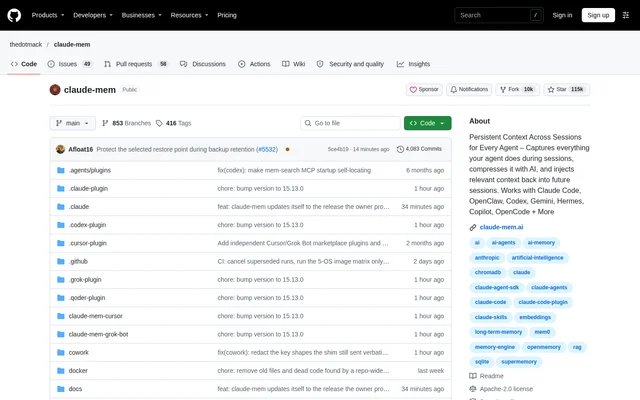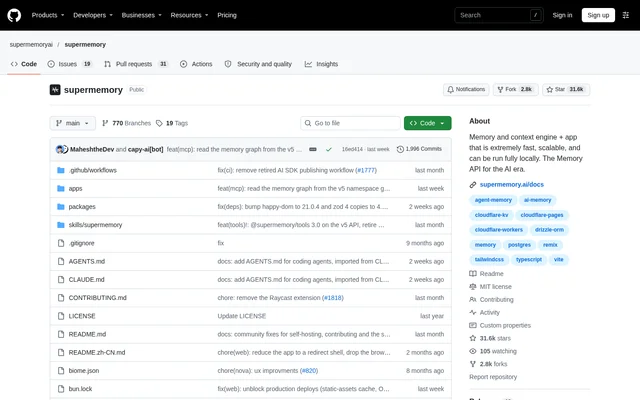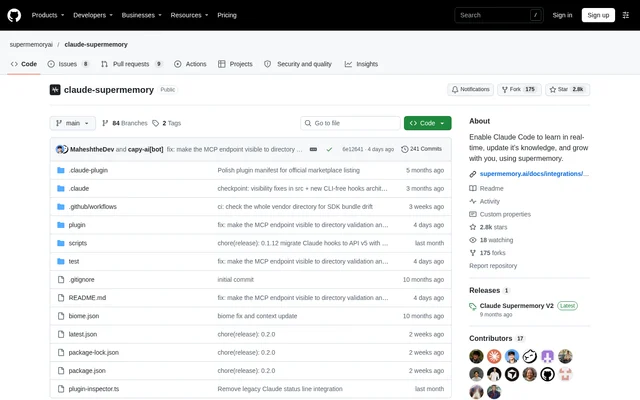
What is claude-supermemory?
claude-supermemory is an open-source project providing a Claude Code plugin for persistent memory through Supermemory. Developers use claude-supermemory to retain context across coding sessions and projects rather than repeatedly supplying the same background. The repository describes memory for previous work, profile facts, repository architecture, and conventions. Although the repository retains its original name, the installed plugin has been renamed to supermemory.
What claude-supermemory can do
claude-supermemory combines automatic lifecycle hooks with hosted MCP tools and repository commands. Authenticated prompt recall searches for relevant memories before Claude sees a substantive prompt, while background capture saves new conversation content when a session ends. Deeper retrieval is available through a context-gatherer subagent that searches project containers and produces a synthesized brief.
- claude-supermemory injects fresh memory matches and deduplicates recall within a session.
- claude-supermemory loads profile facts when a session starts.
- claude-supermemory exposes hosted tools including search_memory, listSpaces, and whoAmI.
- claude-supermemory indexes repository architecture, conventions, and run instructions.
- claude-supermemory shares repository memory with Codex and OpenCode.
- claude-supermemory supports per-repository API keys and container overrides.
How claude-supermemory works
claude-supermemory registers lifecycle hooks for session startup, prompt submission, tool use, and session completion. Startup initializes authentication and loads profile context. Prompt submission triggers direct memory search by default, and session completion saves the new conversation delta. The tool-use hook displays read-only memory activity without approving calls or modifying their inputs. MCP calls remain subject to Claude Code permission rules.
claude-supermemory derives the default repository container from the normalized Git remote, allowing clones to share memory while separating repositories with identical names. Repositories without a remote use local path identity. Configuration can isolate worktrees or override the container. Automatic captures carry personal-scope metadata, and the plugin uses the unified repository identity rather than reading older per-tool legacy containers.
Who claude-supermemory is for
claude-supermemory serves developers who use Claude Code for work that continues across sessions or spans multiple projects. The documented capabilities support retaining repository knowledge, retrieving past context, and sharing memory with other supported coding agents. Project-level settings also let developers specify credentials, backend URLs, and memory namespaces for individual repositories.
- claude-supermemory helps returning developers recover context from earlier coding sessions.
- claude-supermemory preserves architecture and conventions through repository indexing.
- claude-supermemory supports shared repository context across Claude Code, Codex, and OpenCode.
- claude-supermemory enables deeper historical searches through MCP tools or the context-gatherer agent.
claude-supermemory strengths and limitations
claude-supermemory provides automatic recall without requiring Claude to initiate a search tool call, alongside explicit MCP tools for additional retrieval. Memory hooks exit cleanly when authentication is missing, Supermemory is unreachable, or another failure occurs, so the coding session can continue. Failed capture is reported at the next session start. Custom REST, MCP, and browser-auth endpoints remain separately configurable.
- claude-supermemory requires Node.js 18+ on the system PATH.
- claude-supermemory sends new conversation content to Supermemory through automatic capture.
- claude-supermemory does not read older per-tool legacy containers.
- claude-supermemory provides the terminal recall strip on Claude Code 2.1.287+, but not on the documented 2.1.250 version.
Getting started with claude-supermemory
claude-supermemory installation starts by adding supermemoryai/claude-supermemory to the Claude Code plugin marketplace and installing the supermemory plugin. Authentication can proceed through browser login when a session starts or through the SUPERMEMORY_CC_API_KEY environment variable. The /supermemory:status command checks authentication, API and MCP reachability, and the active project container. The /supermemory:index command saves repository structure, conventions, and run instructions.
claude-supermemory FAQ
What is claude-supermemory?
claude-supermemory is a Claude Code plugin that provides persistent memory through Supermemory. claude-supermemory recalls relevant context before substantive prompts, saves new conversation content at session end, and retains project knowledge across sessions and repositories.
How do you install claude-supermemory?
claude-supermemory is installed by adding supermemoryai/claude-supermemory to the Claude Code plugin marketplace and installing the supermemory plugin. claude-supermemory requires Node.js 18+ on the system PATH and supports authentication through browser login or a Supermemory API key.
Does claude-supermemory share memory with Codex and OpenCode?
claude-supermemory shares new repository memories with Codex and OpenCode through a common container identity derived from the normalized Git remote. Clones share memory, while same-named repositories remain separate. claude-supermemory does not read older per-tool legacy containers.
Does claude-supermemory support MCP tools?
claude-supermemory provides hosted MCP tools including search_memory, listSpaces, and whoAmI using the same credentials as the memory hooks. MCP tool calls follow Claude Code permission rules, and the bundled proxy supplies the current repository's default container.
What happens if Supermemory is unavailable?
claude-supermemory allows the Claude Code session to continue when Supermemory is unreachable, an API key is missing, or a memory hook encounters another failure. claude-supermemory reports a failed capture the next time a session starts.
What does claude-supermemory automatically save?
claude-supermemory saves new conversation content in the background when a session ends. The capture hook asks Supermemory to retain durable context rather than transient Git state, and automatic captures use the shared repository container with personal-scope metadata.
From the community
No reviews yet
Be the first to review this tool. What you write helps the next person choose.