What is VModel?
VModel is an AI model integration and deployment service for developers building applications that use AI. VModel provides a community library of pre-trained models that can be called through an API, and the service also supports custom model deployment. The site emphasizes image and video workflows, while describing the API as a common way to access models of different types and styles. VModel handles the infrastructure behind those model calls.
What VModel can do
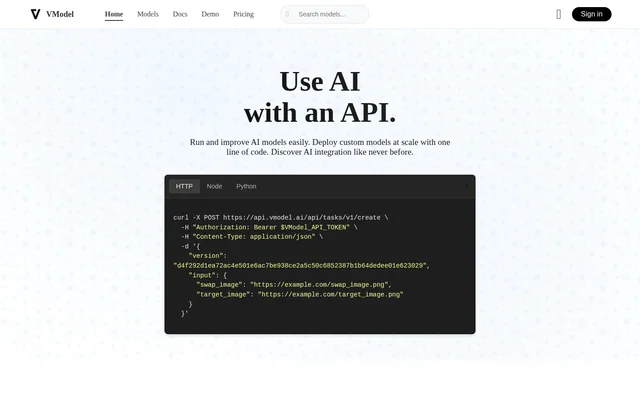
VModel offers pre-trained models for tasks such as image generation, image editing, and video processing. The image-swapping example shows how an application can submit a source image and a target image to a specific model version. The model library also includes pre-trained style models for adding different visual styles to an application. For developers who want to run their own models rather than select a pre-trained option, VModel offers custom model deployment.
- VModel runs pre-trained style models.
- VModel supports image generation and editing.
- VModel supports video generation and processing.
- VModel lets developers deploy custom models.
How the VModel API works
VModel accepts task requests through a REST API. In the quick-start example, the developer sends an authenticated HTTP POST request with an API token, a model version, and the inputs for that model. The image-swap request supplies URLs for the source and target images. VModel shows the same task creation workflow using HTTP, Node.js, and Python, and the documentation offers guides, examples, and API references for each model.
Who VModel is for
VModel is intended for developers and teams at organizations ranging from startups to enterprises. The site presents product image generation and virtual try-ons as examples for e-commerce teams, while creators and marketing teams are shown using image editing and video processing for content production. For enterprise applications, VModel lists document processing, customer service automation, and business intelligence as use cases. These examples describe how teams can incorporate model calls into their own applications.
- Generate product images for e-commerce listings.
- Build virtual try-ons into shopping applications.
- Edit images or process video for content production.
- Process documents in enterprise applications.
- Automate customer service tasks.
VModel pricing and plans
VModel uses pay-as-you-go pricing with prepaid credits rather than a subscription. Credits are purchased as a one-time payment, can be used across the model library, and do not expire. Each model has its own rate: the pricing page lists bytedance/seedance-1-lite at $0.02 per second of output video. VModel advertises $10 in free API calls to get started. If an account runs out of credits, the site says more can be purchased as needed.
VModel strengths and limitations
VModel uses a common REST API and credit balance across its model library, so developers can call different models through the same interface and pay for them from the same balance. The lack of a monthly commitment and the absence of credit expiration can suit applications with variable usage. Costs still depend on the models selected, and there are separate constraints on refunds and API usage that teams should account for when choosing models and purchasing credits.
- VModel does not refund unused credits.
- VModel applies API rate limits and asks users to contact the service for higher limits.
- VModel charges according to each model's pricing rather than a flat rate for the library.
VModel FAQ
What is VModel?
VModel is an AI model integration and deployment service with a unified REST API. Developers can run pre-trained models from its community library, including models for image and video tasks, or deploy custom models for use in their own applications.
Is VModel free?
VModel is a paid, pay-as-you-go service that advertises $10 in free API calls to get started. There is no subscription or monthly commitment. Each model has its own usage rate, and purchased credits can be used across the library without expiring.
How do VModel credits work?
VModel uses prepaid credits that can be spent across its model library, with each model charging its own rate. Purchased credits never expire but are non-refundable. Users can purchase more credits as needed if their balance runs out.
What can developers build with VModel?
VModel can be used to build features such as product image generation, virtual try-ons, image editing, and video processing into applications. VModel also lists document processing, customer service automation, and business intelligence as enterprise use cases.
How do developers call the VModel API?
VModel accepts authenticated REST requests that include a model version and the inputs required by that model. The quick-start example shows how to create a task with an API token, and the site provides examples for HTTP, Node.js, and Python.
From the community
No reviews yet
Be the first to review this tool. What you write helps the next person choose.