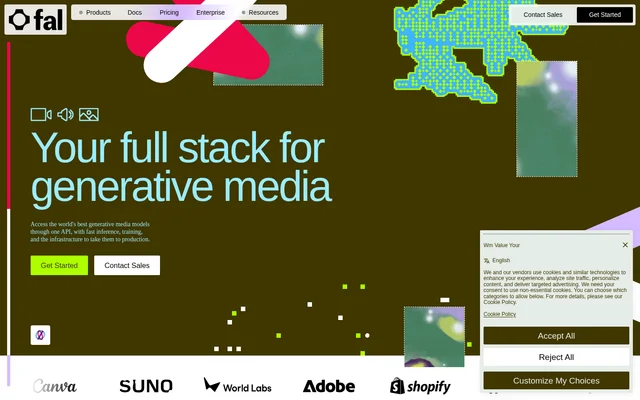
What is fal?
fal is a generative media platform for developers and enterprises that need model APIs, production inference, and training infrastructure. fal brings image, video, audio, 3D, and world models together through a unified API. The service also supports custom model deployment and GPU compute, covering both access to existing models and infrastructure for developing or serving custom workloads.
fal separates these capabilities into Model APIs, Serverless Inference, and Compute. Model APIs provide access to available generative media models, while Serverless Inference runs custom models with autoscaling and observability. Compute supplies interconnected GPU clusters for training and other compute-intensive AI jobs, including multi-node training and fine-tuning.
What fal can do
fal supports generative media workflows across model access, editing, deployment, and training. Available model categories include image and video generation, audio and voice, 3D, world models, and editing and transformation. Custom deployment capabilities extend beyond the shared catalog, allowing developers to bring their own weights or serve private and fine-tuned models.
- fal exposes generative media models through a unified API.
- fal supports image generation, video generation, and media editing.
- fal provides access to audio, voice, and 3D models.
- fal deploys custom models with GPU autoscaling.
- fal supports training and fine-tuning on multi-node GPU clusters.
- fal provides observability and inference performance controls.
How fal works
fal provides a model catalog, documentation, a unified API, and SDKs for developers integrating generation into applications. The website includes a JavaScript example using the fal client to submit a prompt to a model endpoint and receive queue updates and logs. Developers can call available models or their own LoRAs without managing separate model providers.
fal also supports workloads that require custom infrastructure. Private or fine-tuned models can use serverless deployment, while training jobs can run on interconnected GPU clusters. Production inference includes controls for latency, throughput, and variable demand. Enterprise deployments can add private model endpoints, single sign-on, usage analytics, and collaboration with Applied Machine Learning Engineers.
Who fal is for
fal serves developers integrating generative media into applications and enterprises running production AI workloads. The combination of a model catalog and custom infrastructure supports teams that need access to existing models as well as teams developing their own. Enterprise options address private deployment, procurement, capacity planning, and customized generative media solutions.
- Application developers can integrate image, video, and audio generation.
- Model teams can train and fine-tune models on GPU clusters.
- Production teams can scale inference as demand changes.
- Enterprises can serve custom models through private endpoints.
fal pricing and plans
fal uses usage-based pricing rather than a single flat price for every workload. Model APIs have model-specific billing units: video can be billed by seconds or videos, images by image count or megapixels, and audio by characters or seconds. Some models use GPU-based pricing depending on their architecture. Compute uses hourly GPU pricing.
fal offers on-demand usage and reserved enterprise pricing with guaranteed capacity. The pricing page lists GPU-specific rates and model-specific output prices. Image pricing increases proportionally with resolution, and the page notes that approximate output comparisons can change with the model, resolution, and prompt complexity. Cost assessment therefore depends on the selected model and workload.
fal strengths and limitations
fal combines model access, serverless deployment, and training compute within the same service. A unified API reduces the need to manage separate providers, while private endpoints, observability, and enterprise controls support production use. Pricing comparisons require care because models use different billing units and output assumptions, rather than a uniform charge across the catalog.
- fal charges depend on the selected model and billing unit.
- fal prices higher-resolution images proportionally.
- fal output estimates vary with model, resolution, and prompt complexity.
fal FAQ
What is fal?
fal is a generative media platform for developers and enterprises. fal provides a unified API for image, video, audio, 3D, and world models, alongside serverless custom model deployment and GPU clusters for training and fine-tuning.
Is fal free?
fal charges for model APIs and compute through usage-based pricing. Model API charges depend on the model and output unit, while Compute uses hourly GPU pricing. fal also lists free tools, including a background remover, image upscaler, image extender, and image resizer.
Does fal have an API and SDKs?
fal provides a unified API and SDKs for accessing generative media models and custom LoRAs. The website includes a JavaScript client example that submits a generation request to a model endpoint and receives queue updates and logs.
Can fal deploy custom AI models?
fal supports custom AI model deployment through serverless inference, including private and fine-tuned models and user-supplied weights. fal provides autoscaling, built-in observability, and performance controls for latency, throughput, and variable demand, alongside private model endpoints.
Can fal train and fine-tune AI models?
fal provides interconnected GPU clusters for training and fine-tuning AI models. fal supports multi-node training and compute-intensive jobs, with infrastructure designed to scale workloads across hundreds or thousands of GPUs.
What enterprise features does fal offer?
fal offers SOC 2 compliance, single sign-on, private deployments, usage analytics, and priority support. fal also provides reserved pricing with guaranteed capacity, private model endpoints, and collaboration with Applied Machine Learning Engineers for customized solutions.
From the community
No reviews yet
Be the first to review this tool. What you write helps the next person choose.