What is Amazon SageMaker?
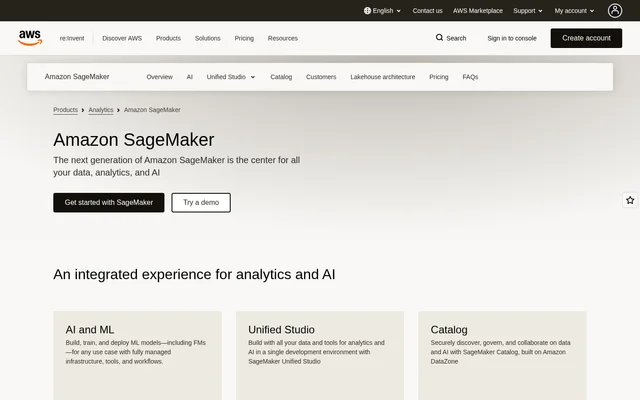
Amazon SageMaker is an AWS cloud platform that combines data management, analytics, and AI development. It gives data engineers, analysts, and data scientists a shared environment for discovering data, running queries, and developing models. The current Amazon SageMaker includes SageMaker AI, the model development service that previously used the Amazon SageMaker name, as well as Unified Studio, Lakehouse, and Catalog.
What Amazon SageMaker can do
Amazon SageMaker supports model development from training through deployment, alongside the data preparation and analytics work that can feed those models. SageMaker AI includes tools for distributed training, inference, and monitoring. Unified Studio brings model development together with SQL analytics and generative AI application development, so teams can work with shared data and tools.
- SageMaker AI trains, customizes, and deploys machine learning and foundation models.
- Unified Studio provides a managed serverless notebook with a built-in AI agent.
- Unified Studio provides a SQL editor for querying multiple data sources.
- Unified Studio uses Amazon Bedrock to build generative AI applications.
- SageMaker Catalog lets teams discover and securely share data and AI artifacts.
How Amazon SageMaker works
Amazon SageMaker brings its analytics and AI tools together in Unified Studio. Teams can discover data, explore it in a notebook or SQL editor, and prepare it for analytics or model development. Unified Studio brings in Amazon Redshift for SQL analytics and Amazon Athena, Amazon EMR, and AWS Glue for data processing.
Amazon SageMaker Lakehouse connects access to Amazon S3 data lakes, Amazon Redshift warehouses, and third-party data sources. Apache Iceberg-compatible tools can query a shared copy of analytics data. Federated queries can access supported data in place, while zero-ETL integrations can bring data from operational databases and applications into the lakehouse in near real time.
Who Amazon SageMaker is for
Amazon SageMaker is intended for teams working across data engineering, analytics, machine learning, and generative AI. Data engineers can connect and prepare data, analysts can query it with SQL, and data scientists can train and deploy models. The shared environment also supports teams that need to publish and govern data, models, or generative AI applications for use elsewhere in the organization.
- Data engineers can connect sources and prepare data for downstream work.
- Analysts can query data across lakes, warehouses, and supported external sources.
- Data scientists can train and deploy models on managed infrastructure.
- AI developers can build generative AI applications using proprietary data.
Amazon SageMaker pricing and plans
Amazon SageMaker is available through the AWS console. The supplied AWS pricing overview describes pay-as-you-go billing for most cloud services, with charges based on the services consumed. The overview also describes Savings Plans for eligible AWS machine learning usage in exchange for a spending commitment, but does not specify SageMaker rates, plan eligibility, or product-specific free allowances.
Amazon SageMaker strengths and limitations
Amazon SageMaker combines a shared development environment with governance for data, models, and development artifacts. SageMaker Catalog uses a common permission model for fine-grained access, and the service describes monitoring for data quality and lineage. Compatibility matters when choosing query tools: the page specifically describes shared-copy access for Apache Iceberg-compatible tools and engines.
Amazon SageMaker FAQ
What is Amazon SageMaker?
Amazon SageMaker is an AWS cloud platform for data management, analytics, and AI development. It combines a shared workspace, managed infrastructure for training and deploying models, a lakehouse for querying data across sources, and a catalog for discovering and governing data and AI assets.
How is Amazon SageMaker priced?
Amazon SageMaker is available through the AWS console, and the supplied AWS pricing overview describes pay-as-you-go billing for most AWS cloud services. The overview does not list SageMaker-specific rates or confirm a free allowance for SageMaker.
Who uses Amazon SageMaker?
Amazon SageMaker is designed for data engineers, analysts, data scientists, and AI developers working with data and models. Teams can use Unified Studio to prepare data, write SQL queries, develop machine learning models, and build generative AI applications in a shared environment.
Can Amazon SageMaker train and deploy foundation models?
Amazon SageMaker supports training, customization, and deployment of foundation models through SageMaker AI. The managed infrastructure and tools cover distributed training, inference, and monitoring, and also support development and deployment of other machine learning models.
What data sources can Amazon SageMaker query?
Amazon SageMaker can query data in Amazon S3 data lakes, Amazon Redshift data warehouses, and supported third-party sources. SageMaker Lakehouse supports federated queries that let teams access data in place and shared-copy access through Apache Iceberg-compatible tools.
From the community
No reviews yet
Be the first to review this tool. What you write helps the next person choose.