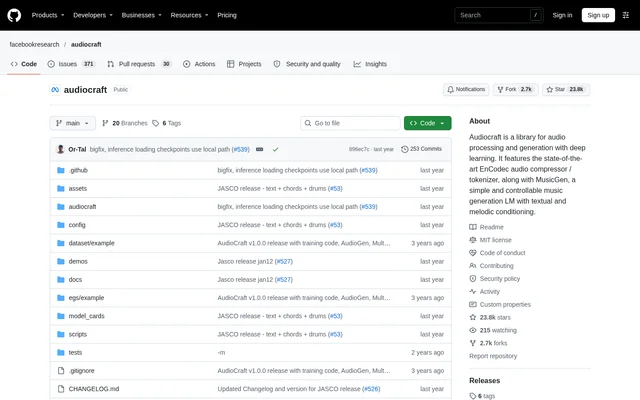
What is AudioCraft?
AudioCraft is an open-source PyTorch library for researchers and developers studying audio generation with deep learning. AudioCraft combines generative audio models with inference code, training components and training pipelines. The project is hosted in the facebookresearch GitHub repository and includes documentation for using individual models and developing research workflows.
AudioCraft covers more than text-prompted music generation. The repository also includes sound generation, neural audio compression, diffusion decoding and audio watermarking models. These components support research involving both generated audio and audio representations, with model-specific documentation providing configuration details, example grids and task-specific guidance.
What AudioCraft can do
AudioCraft brings several audio models into a shared research library. Different models address different tasks, from generating music or sound from text to compressing audio and training watermarking models. AudioCraft also includes music generation approaches that accept melodic, stylistic or musical-structure conditioning rather than relying only on text.
- AudioCraft includes MusicGen for music generation with textual and melodic conditioning.
- AudioCraft includes AudioGen for text-to-sound generation.
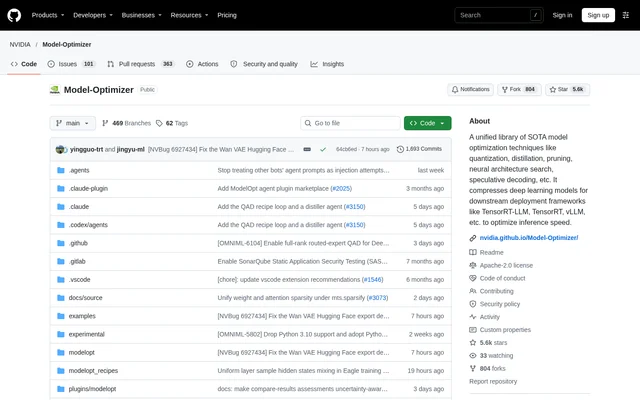
- AudioCraft includes EnCodec for neural audio compression and tokenization.
- AudioCraft includes Multi Band Diffusion for EnCodec-compatible decoding.
- AudioCraft includes MAGNeT for non-autoregressive text-to-music and text-to-sound generation.
- AudioCraft includes AudioSeal for audio watermarking.
- AudioCraft includes MusicGen Style for text-and-style-to-music generation.
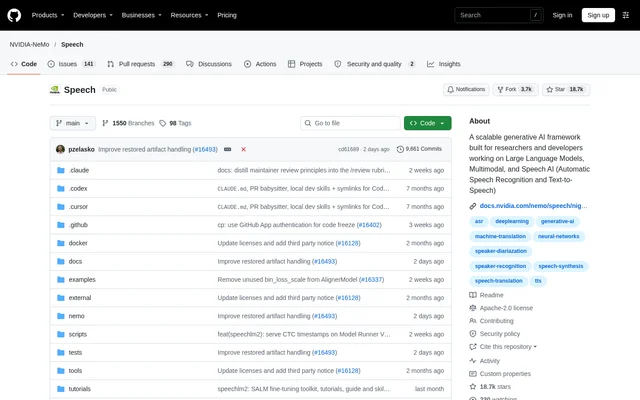
- AudioCraft includes JASCO for music conditioned on chords, melodies and drum tracks.
How AudioCraft works
AudioCraft is installed in a Python environment with Python 3.9 and PyTorch 2.1.0. The repository provides installation commands for the stable package, the development version from GitHub and an editable local checkout. A local repository installation is mandatory for training, and the installation instructions recommend installing PyTorch before xformers.
AudioCraft recommends having ffmpeg installed and links to API documentation and model-specific training instructions. AudioCraft model storage can be redirected with the AUDIOCRAFT_CACHE_DIR environment variable. Other Hugging Face model caches and Demucs downloads have separate configuration guidance, with the repository directing users to the relevant external documentation.
Who AudioCraft is for
AudioCraft is aimed at deep learning research on audio rather than being presented as a standalone consumer music editor. AudioCraft provides PyTorch components for developers building training pipelines and documentation for researchers reproducing existing work. The available models support experiments spanning music, sound, audio codecs and watermarking.
- AudioCraft supports researchers reproducing existing audio generation work.
- AudioCraft supports developers building custom audio training pipelines.
- AudioCraft supports experiments with text-conditioned music and sound generation.
- AudioCraft supports research involving neural audio codecs and watermarking.
AudioCraft pricing and licenses
AudioCraft is available as an open-source project through its repository and Python package installation paths. AudioCraft code is released under the MIT license, while model weights are released under CC-BY-NC 4.0. These are separate licensing terms, so access to the code does not make the model weights available under the same permissions.
AudioCraft strengths and limitations
AudioCraft combines a range of audio research tasks with both inference and training resources. AudioCraft documentation covers general design principles, custom training pipelines and model-specific configurations. The main constraints are the technical environment required to run the library and the distinction between permissive code licensing and noncommercial model-weight licensing.
- AudioCraft requires the documented Python and PyTorch versions.
- AudioCraft requires an editable local repository installation for training.
- AudioCraft model weights carry noncommercial licensing restrictions.
AudioCraft FAQ
What is AudioCraft?
AudioCraft is an open-source PyTorch library for deep learning research on audio generation. AudioCraft includes inference and training resources for models that generate music and sound, compress audio, decode audio representations and support audio watermarking.
Is AudioCraft free?
AudioCraft is available as an open-source project with code released under the MIT license. AudioCraft model weights are released separately under CC-BY-NC 4.0, so the weights have noncommercial restrictions that do not apply in the same way to the MIT-licensed code.
Can AudioCraft generate music and sound from text?
AudioCraft includes MusicGen for text-to-music generation and AudioGen for text-to-sound generation. AudioCraft also includes MAGNeT for non-autoregressive music and sound generation, plus models that condition music on style, chords, melodies or drum tracks.
What does AudioCraft require to install?
AudioCraft requires Python 3.9 and PyTorch 2.1.0, and the repository recommends installing ffmpeg. AudioCraft supports installation from the stable Python package, GitHub development code or a local repository checkout; the local installation is mandatory for training.
Does AudioCraft include training code?
AudioCraft provides training code for EnCodec, MusicGen, Multi Band Diffusion and JASCO, along with PyTorch components and training pipelines. AudioCraft documentation explains general training design principles and links to model-specific configurations, example grids and task guidance.
Where does AudioCraft store downloaded models?
AudioCraft model storage uses a Hugging Face location that can be overridden with the AUDIOCRAFT_CACHE_DIR environment variable. AudioCraft documentation points to separate Hugging Face cache guidance for other models and Torch Hub documentation for Demucs download locations.
From the community
No reviews yet
Be the first to review this tool. What you write helps the next person choose.