What is Auphonic?
Auphonic is an AI audio processing service for podcasts, education, videos, audiobooks, radio and broadcasts. Auphonic combines audio algorithms with encoding, metadata and publishing workflows. The website accepts audio or video files for processing, while API and CLI access provide additional ways to use the service. Access includes a free monthly allowance and paid credit options.
What Auphonic can do
Auphonic covers sound processing and production tasks within the same service. Core audio algorithms are included in the free plan, alongside encoding and publishing capabilities. Paid plans extend the workflow with speech recognition, generated shownotes and chapters, watch folders and batch productions. Feature availability depends on the selected plan.
- Auphonic provides intelligent leveling and loudness specifications.
- Auphonic reduces noise and reverb and offers filtering and enhancement.
- Auphonic supports multitrack productions and filler and silence cutting.
- Auphonic supports encoding, metadata, chapters, video and audiograms.
- Auphonic offers multilingual speech recognition and automatic shownotes on paid plans.
- Auphonic connects to external services and supports automatic publishing.
How Auphonic works
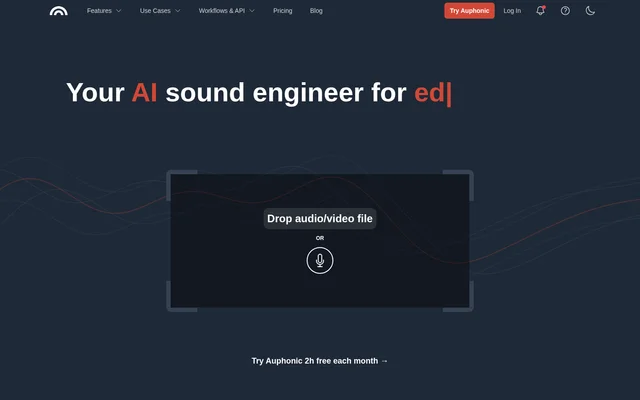
Auphonic lets users select or drop an audio or video file on its website and start processing. Auphonic also lists API access and a CLI across all plan groups. Paid plans add watch folders and batch productions for additional workflow options. The supplied page confirms external service connections but does not identify individual services.
Auphonic bills processing according to audio duration, with a minimum charge of 3 minutes per production. Multiple output formats or input tracks do not independently increase the charged duration. Auphonic permits changes to settings and repeat processing without additional charges when the same input files remain in the same production. Changing an input file or creating a new production incurs another charge.
Who Auphonic is for
Auphonic serves people producing podcasts, educational recordings, videos, audiobooks, radio and broadcasts. The listed capabilities address both audio processing and distribution-related work, including loudness specifications, metadata, chapters and automatic publishing. Auphonic also provides paid workflow features for users who need speech recognition, batch productions or watch folders rather than only individual file processing.
- Auphonic supports podcast processing with leveling, noise reduction and silence cutting.
- Auphonic supports educational recordings and audiobook production.
- Auphonic supports video workflows with video processing and audiograms.
- Auphonic supports radio and broadcast audio with loudness specifications.
Auphonic pricing and plans
Auphonic includes 2 hours of free processed audio each month, and free productions include an Auphonic jingle. Additional usage is available through recurring credits or one-time purchases. Recurring plans include monthly allowances of 9, 21, 45, 100 or 250 hours. The pricing page offers monthly and yearly billing, with a stated 20% saving for yearly payment.
Auphonic recurring credits reset monthly, and unused free or recurring credits do not accumulate. One-time credits never expire and can supplement recurring allowances. Recurring credits are used before one-time credits, followed by free credits. Auphonic lists priority processing, priority support and team accounts for Yearly and Business plans, while manual invoicing and custom contracts are Business-only features.
Auphonic strengths and limitations
Auphonic includes core audio processing, API access, CLI access and automatic publishing in its free offering. Flexible credit purchases allow occasional additional usage without relying only on a recurring allowance. Auphonic charges only for successful productions and provides a refund request link on the production page when users are dissatisfied with a result.
- Auphonic free productions include a jingle.
- Auphonic requires paid access for multilingual speech recognition and automatic shownotes.
- Auphonic does not carry unused recurring or free credits into later months.
- Auphonic applies a minimum billable duration of 3 minutes.
Auphonic FAQ
What is Auphonic?
Auphonic is an AI audio processing service for podcasts, education, videos, audiobooks, radio and broadcasts. Auphonic provides intelligent leveling, noise and reverb reduction, filtering, loudness specifications, encoding and publishing workflows.
Is Auphonic free?
Auphonic offers 2 hours of free processed audio each month, including its core AI audio algorithms. Free productions include an Auphonic jingle, and unused free credits do not accumulate. Additional processing is available through paid recurring or one-time credits.
Does Auphonic have an API or CLI?
Auphonic includes API access and a CLI across its Free, Monthly and One-Time, and Yearly and Business plan groups. Auphonic also supports external service connections and automatic publishing, while watch folders and batch productions require paid access.
Do Auphonic credits expire?
Auphonic one-time credits never expire, while recurring credits reset monthly and unused free credits do not accumulate. Auphonic uses recurring credits first, then one-time credits, then free credits. One-time purchases can supplement a recurring plan.
Can you reprocess audio in Auphonic without paying again?
Auphonic allows production edits and repeat processing without additional costs when the same input files remain in the same production. Changing an input file or creating a new production triggers another charge. Credits are charged only for successful processing.
Does Auphonic generate transcripts and shownotes?
Auphonic offers multilingual speech recognition and automatic shownotes and chapters on paid plans. These capabilities are not included in the free plan, although encoding, metadata and chapters are listed among the free workflow features.
From the community
No reviews yet
Be the first to review this tool. What you write helps the next person choose.