What is Basedash?
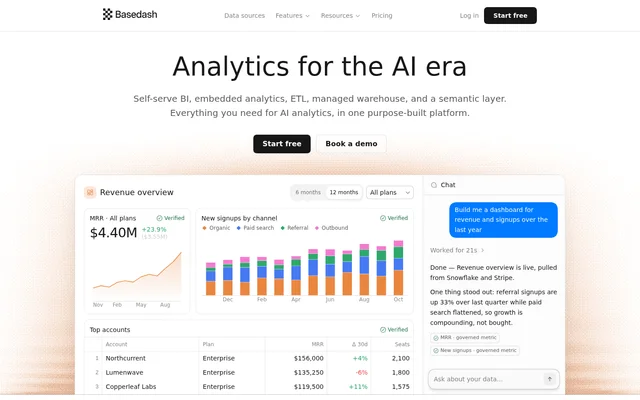
Basedash is an AI analytics platform that combines self-serve business intelligence, embedded analytics, data ingestion, a managed warehouse, and a semantic layer. Basedash serves teams that need to ask questions about company data, share dashboards, and provide analytics to customers. Users can request a chart, dashboard, or direct answer in plain English.
Basedash builds answers on governed business definitions rather than treating every question as an isolated query. Basedash shows the SQL behind results and lists supporting tables and definitions. This makes the product relevant to teams that want broader access to analytics while retaining visibility into how answers were produced.
What Basedash can do
Basedash covers data preparation, analysis, reporting, and customer-facing delivery within the same product. Basedash supports interactive questions as well as agents that monitor metrics and report changes. Shared models and permissions apply across the interface, supported external assistants, API access, and Slack.
- Basedash generates charts, dashboards, and answers from plain-English questions.
- Basedash detects metric anomalies and sends briefs to Slack or email.
- Basedash schedules recurring reports or triggers reports when data changes.
- Basedash embeds white-label dashboards and AI chat through React.
- Basedash connects Claude, ChatGPT, and Cursor through MCP.
- Basedash ingests data from 750+ sources, including Salesforce, HubSpot, Stripe, and Shopify.
- Basedash reuses metric definitions, segments, and business logic through semantic models.
How Basedash works
Basedash starts with connected data sources or an existing database or warehouse. Basedash can provision a managed DuckDB warehouse that keeps tables synchronized, with scalable storage and point-in-time recovery. Teams already using Snowflake, BigQuery, or Databricks can connect those warehouses instead of adopting the managed warehouse.
Basedash lets teams define reusable models or bring existing dbt projects into the semantic layer. Team context and skills add business-specific instructions, and Basedash retains knowledge learned from conversations. Users then ask questions through Basedash, Slack, connected assistants, or the REST API. For embedded analytics, developers add React components and use JWT SSO to scope customers to their own rows.
Who Basedash is for
Basedash addresses operators, analysts, executives, viewers, and teams that need shared access to business reporting. Basedash also supports product teams building customer-facing analytics and developers connecting company data to AI assistants. The source describes sales and operations teams using dashboards, AI answers, and recurring reports across multiple stakeholders.
- Sales teams can review revenue, signups, and conversion trends.
- Operations teams can distribute dashboards and recurring reports.
- Product teams can add customer-specific analytics and chat to applications.
- Analysts can maintain shared metric definitions and inspect generated SQL.
- Developers can query governed data through MCP or the REST API.
Basedash pricing and plans
Basedash charges a flat-rate team subscription plus AI usage rather than separate per-seat licences. The Startup plan costs $1,000/month, supports up to 25 users, and includes $1,000/month in AI credits. The pricing page also lists Slack support, automations, insights, the MCP server, and the Basedash Warehouse for the Startup plan.
Basedash offers custom Enterprise pricing for larger deployments and requirements such as embedding, self-hosting, SSO, SCIM, audit logs, and custom AI models. Basedash provides a 14-day free trial with no credit card required. Teams can start the trial or book a demo, and migration assistance for data and dashboards is offered.
Basedash strengths and limitations
Basedash combines analytics with ingestion and warehouse capabilities while allowing teams to retain existing warehouses. Basedash also provides governance controls, including row-level security, audit logs, and explicit approval before AI-run write queries execute. Deployment options include self-hosting in a customer VPC, with air-gapped operation and customer-provided model keys.
- Basedash limits Startup access to 25 users before a custom Enterprise plan is needed.
- Basedash pricing includes AI usage in addition to the subscription.
- Basedash embedded analytics requires developers to integrate React components.
Basedash FAQ
What is Basedash?
Basedash is an AI analytics and business intelligence platform that combines self-serve reporting, embedded analytics, data ingestion, a managed warehouse, and a semantic layer. Basedash answers plain-English questions with charts, dashboards, or direct answers supported by governed definitions and visible SQL.
Is Basedash free?
Basedash offers a 14-day free trial with no credit card required, rather than a stated ongoing free plan. Basedash Startup costs $1,000/month plus AI usage for up to 25 users and includes $1,000/month in AI credits. Enterprise pricing is custom.
Does Basedash have an API or MCP server?
Basedash provides a REST API and an MCP server for accessing analytics from other applications and assistants. Basedash names Claude, ChatGPT, and Cursor as supported MCP connections, and also supports questions through Slack. These access methods use the same models and permissions.
Can Basedash connect to an existing data warehouse?
Basedash can connect to existing Snowflake, BigQuery, and Databricks warehouses, as well as directly connected databases. Basedash also offers a managed DuckDB warehouse that synchronizes connected tables and includes scalable storage and point-in-time recovery.
Can Basedash embed analytics in a product?
Basedash supports embedded dashboards and AI chat through React components. Basedash allows white-label branding and uses JWT SSO to scope each customer to their own rows. The pricing page identifies embedding among the requirements addressed by custom Enterprise plans.
Can Basedash be self-hosted?
Basedash supports self-hosting in a customer VPC, including air-gapped deployment when needed and the use of customer-provided model keys. Basedash lists self-hosting as an Enterprise requirement alongside controls such as SSO, SCIM, audit logs, and custom AI models.
From the community
No reviews yet
Be the first to review this tool. What you write helps the next person choose.