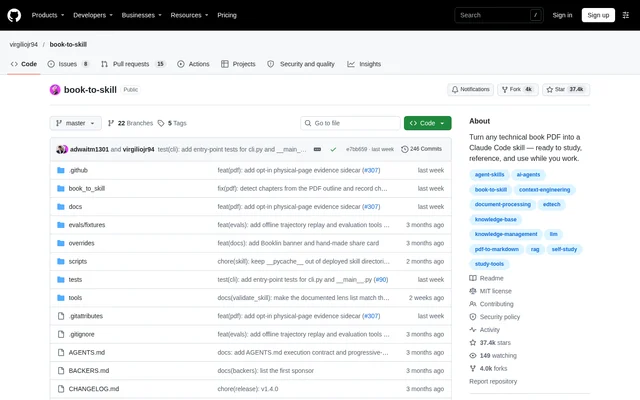
What is book-to-skill?
book-to-skill is an open-source project that turns technical books and other structured prose into reusable agent skills. Developers, technical learners, and teams can use the generated material to study concepts or consult source documents while working. Rather than producing only a summary, book-to-skill organizes frameworks, decision rules, anti-patterns, and chapter-level references.
book-to-skill generates the SKILL.md format used by hosts supporting the open Agent Skills standard. The repository names GitHub Copilot CLI, Amp, Claude Code, Codex, Hermes Agent, OpenCode, and OpenClaw as compatible hosts. Generated chapter files are loaded on demand, keeping unrelated source material outside the active context until a relevant topic is requested.
What book-to-skill can do
book-to-skill accepts individual files, folders, globs, or lists of sources and distills their contents into a unified skill. The generated structure separates core concepts from detailed chapter material and reference aids. Beyond initial conversion, the documented usage includes analysis-only workflows, generation from existing analysis, and updating a skill with additional material.
- book-to-skill creates a core SKILL.md file containing mental models and a chapter index.
- book-to-skill generates chapter files that agents load on demand.
- book-to-skill builds an alphabetized glossary with chapter references.
- book-to-skill collects techniques, algorithms, and design patterns.
- book-to-skill produces a cheatsheet with decision tables and reference rules.
- book-to-skill can publish generated skills to GitHub, privately by default.
How book-to-skill works
book-to-skill combines a deterministic Python extractor with a spec-driven generator. The extractor converts documents into clean text and metadata; the user's agent follows the repository's SKILL.md instructions to produce the structured skill. A conversion begins by pointing the /book-to-skill command at a file, folder, or glob, with an optional skill name.
book-to-skill generally writes generated output to the cross-agent skills directory, while some hosts use different discovery paths. Claude Code conversion attempts a verified symlink, and Hermes Agent uses a category-based personal skills location. For PDFs, book-to-skill asks whether the source is technical or text-heavy and selects an available extraction tool accordingly.
Who book-to-skill is for
book-to-skill serves people who repeatedly consult technical books, internal documents, research collections, and standards. The source describes workflows for coding, self-study, team documentation, and brand references. A folder of related documents can become a unified skill, allowing an agent to consult organized material rather than requiring repeated manual searches through separate sources.
- Developers can reference architecture decisions, runbooks, and onboarding guides while coding.
- Technical learners can ask topic-specific questions about converted books.
- Research workflows can combine papers and personal notes into a unified skill.
- Teams can query brand voice guidelines and design principles.
- Readers can consult RFCs, API contracts, and compliance documents.
book-to-skill pricing and installation
book-to-skill is free and MIT-licensed, with source code available in the public GitHub repository. The documented installation command is npx skills add virgiliojr94/book-to-skill. Manual installation is also available by cloning the repository into the appropriate skills folder. Users supply their own books or documents; the project does not include book content.
Strengths and limitations of book-to-skill
book-to-skill combines cross-agent compatibility with structured, on-demand reference files. Extraction and analysis run on the user's machine, and the converter does not upload source files. That local-processing distinction does not extend to every agent deployment: when an agent uses a cloud model, text supplied to that model follows the provider's normal data terms.
- Scanned PDFs need OCR before book-to-skill can extract their text.
- Some input formats require optional libraries or external extraction applications.
- Cloud-model use remains subject to the model provider's data terms.
- Generated skills from copyrighted books should remain private because redistribution can infringe rights.
book-to-skill FAQ
What is book-to-skill?
book-to-skill is an open-source converter that turns technical books, document folders, and collections of sources into structured agent skills. Generated outputs include core mental models, chapter files, a glossary, patterns, and a cheatsheet for studying and referencing source material through compatible agents.
Is book-to-skill free?
book-to-skill is free and MIT-licensed. The project is available from its public GitHub repository and can be installed through the cross-agent skills CLI or by manually cloning the repository into a supported host's skills directory.
Which agents work with book-to-skill?
book-to-skill works with hosts supporting the open Agent Skills standard, including GitHub Copilot CLI, Amp, Claude Code, Codex, Hermes Agent, OpenCode, and OpenClaw. Skill discovery paths vary by host, with separate handling documented for Claude Code, Hermes Agent, and managed installation locations.
Can book-to-skill process scanned PDFs?
book-to-skill requires scanned PDFs to undergo OCR before conversion. The extractor checks the opening pages for a text layer and stops with an explanation when the PDF contains only page images, rather than continuing toward an empty generated skill.
Does book-to-skill upload documents?
book-to-skill runs extraction and analysis locally and states that source files are not uploaded by the tool. When the user's agent runs a cloud model, however, any text supplied to that model follows the provider's normal data terms.
Can book-to-skill convert documents other than books?
book-to-skill accepts structured prose beyond books, including internal documentation, brand guidelines, research papers, notes, specifications, and standards. Inputs can be individual files, folders, globs, or collections of sources, and update/fold-in modes support adding material to an existing skill.
From the community
No reviews yet
Be the first to review this tool. What you write helps the next person choose.