What is CEBRA?
CEBRA is a machine-learning method for transforming high-dimensional time-series recordings into interpretable latent embeddings. CEBRA helps researchers investigate relationships between behavioural actions and neural activity, revealing structures in data variability. The method is presented through the EPFL Mathis Laboratory website and a Nature publication describing joint behavioural and neural analysis.
CEBRA supports supervised, hypothesis-driven analysis and self-supervised, discovery-driven analysis. The website describes consistency as a metric for identifying meaningful differences, while the resulting latent representations can also support decoding. Demonstrations span sensory and motor tasks, different species, and both simple and complex behaviours.
What CEBRA can do
CEBRA creates lower-dimensional representations that researchers can use to examine neural dynamics and their relationship to behaviour. The website demonstrates applications involving navigation, movement and visual processing, rather than presenting a general-purpose consumer tool. A published extension adds attribution maps for time-series data through regularized contrastive learning.
- CEBRA compresses high-dimensional time series into interpretable embeddings.
- CEBRA jointly analyses behavioural and neural recordings.
- CEBRA supports label-free analysis and hypothesis testing.
- CEBRA uses single-session and multi-session datasets.
- CEBRA supports decoding position, movement trajectories and viewed video.
- CEBRA has been demonstrated on calcium and electrophysiology recordings.
How CEBRA works
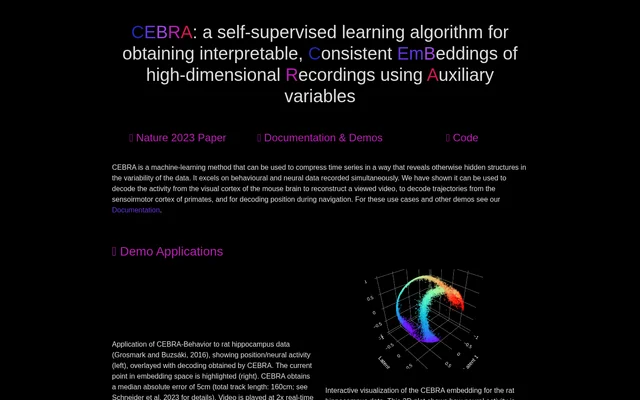
CEBRA uses behavioural and neural data to learn latent representations, with either supervised guidance or self-supervised discovery. In the rat hippocampus demonstration, neural activity maps into a lower-dimensional space that correlates with position and movement direction. An interactive visualisation lets readers explore the relationship between the embedding and the recorded behaviour.
CEBRA's visual cortex demonstration embeds recordings using DINO frame features as labels, then uses a kNN decoder on the test-set embedding to decode video frames. The website links to the official GitHub implementation, documentation and demos, and offers a Colaboratory example for exploring an embedding.
Who CEBRA is for
CEBRA is aimed at researchers investigating neural representations and behavioural dynamics. The examples are relevant to neuroscience, computational neuroscience and machine-learning research involving time-series data. The website demonstrates the method across species and recording techniques, including primary visual cortex, hippocampus, primary motor cortex and somatosensory cortex recordings.
- CEBRA helps researchers study position encoding during navigation.
- CEBRA supports analysis of movement trajectories from sensorimotor recordings.
- CEBRA supports reconstruction of viewed video from visual cortex activity.
- CEBRA enables hypothesis testing with recordings from single or multiple sessions.
CEBRA pricing and access
CEBRA is available through an official implementation on GitHub, with documentation and demonstrations linked from the website. The page does not list subscription plans, purchase prices or a free-tier offer. Access information centres on the research software, published papers and examples rather than a hosted service or commercial plan comparison.
CEBRA strengths and limitations
CEBRA combines flexible analysis modes with demonstrations across calcium and electrophysiology datasets. The website reports consistent latent spaces across different recording methods and provides concrete examples of decoding from neural activity. Documentation, research papers and interactive demonstrations give researchers several ways to examine the method and its reported applications.
CEBRA also carries a patent-related consideration for non-academic applications. EPFL has filed a patent covering dimensionality reduction of time-series data and systems or devices using the resulting embeddings. The website asks users to contact EPFL's Tech Transfer Office if this does not work for their non-academic use case; the page does not provide detailed commercial terms.
CEBRA FAQ
What is CEBRA?
CEBRA is a machine-learning method that compresses high-dimensional time series into interpretable embeddings. CEBRA supports joint behavioural and neural analysis, helping researchers investigate neural representations and use learned latent spaces for decoding.
Who is CEBRA for?
CEBRA is for researchers analysing behavioural and neural time-series recordings, particularly in neuroscience. CEBRA has been demonstrated across species, sensory and motor tasks, and calcium and electrophysiology datasets, with applications involving navigation, movement and visual processing.
What can CEBRA decode from neural activity?
CEBRA has been used to decode position during navigation, movement trajectories from primate sensorimotor cortex, and viewed video from mouse visual cortex activity. CEBRA's website includes demonstrations connecting learned embeddings with behaviour and reconstructed video frames.
Can CEBRA work without labels?
CEBRA can be used label-free, according to the website. CEBRA also supports supervised, hypothesis-driven analysis and self-supervised, discovery-driven analysis, and can leverage both single-session and multi-session datasets for investigating neural dynamics.
Where can researchers get CEBRA?
CEBRA provides an official implementation on GitHub, along with documentation, demos and a Colaboratory example linked from the website. CEBRA's website also links to research papers explaining the method and its time-series attribution extension.
Does CEBRA have restrictions for non-academic use?
CEBRA's website states that EPFL has filed a patent concerning time-series dimensionality reduction and systems or devices using the resulting embeddings. CEBRA's page directs users to EPFL's Tech Transfer Office if this presents a problem for their non-academic use case.
From the community
No reviews yet
Be the first to review this tool. What you write helps the next person choose.