What is DocsGPT?
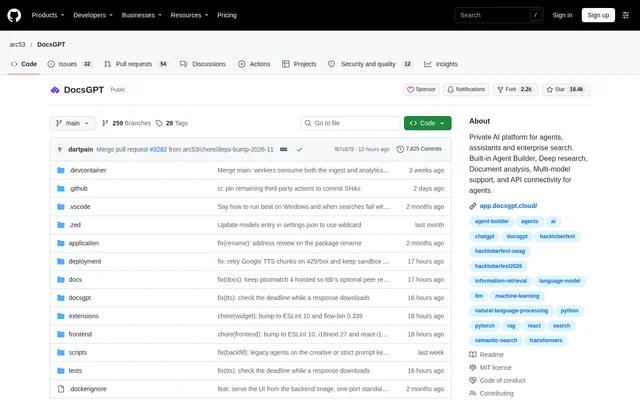
DocsGPT is an open-source project for building AI agents, assistants and enterprise search using organizational knowledge. DocsGPT turns documents, websites and connected applications into agents that answer with sources. The project serves developers and teams that want to combine document retrieval, configurable models and agent tools within a deployment they control.
DocsGPT includes an agent builder, document analysis and a research mode for multi-step answers. DocsGPT can run entirely inside an organization's environment, with either cloud model providers or local models. The repository states that the software is MIT licensed, including team capabilities such as single sign-on, teams and usage quotas.
What DocsGPT can do
DocsGPT combines knowledge retrieval with agent configuration and workflow automation. Agents can have their own prompt, knowledge, tools and model, while a visual builder connects agents with conditions, state and sandboxed code. DocsGPT also supports actions beyond document search, including external API requests, scheduled runs and webhook-triggered execution.
- DocsGPT ingests PDFs, Office files, web pages and audio.
- DocsGPT synchronizes knowledge from Google Drive, SharePoint, Confluence, GitHub and S3.
- DocsGPT cites the documents used to produce answers.
- DocsGPT connects agents to web search, REST APIs and MCP servers.
- DocsGPT flags, redacts or blocks sensitive data and ungrounded answers.
- DocsGPT runs agents on schedules or through HTTP-triggered webhooks.
How DocsGPT works
DocsGPT provides an installer for macOS, Linux and Windows PowerShell. The installer checks for Docker, installs the docsgpt command and starts a setup flow that asks who should reach the service and which model to use. Alternative deployment paths include Docker Compose, pip, Kubernetes, an air-gapped installation and a repository setup script.
DocsGPT exposes chat, agents, knowledge and settings through a browser application. Developers can embed chat and search widgets using a script tag or React package, connect an OpenAI SDK to the compatible API, or use the Agent API and webhooks. An MCP server allows Claude, Cursor and other MCP clients to search agent knowledge.
Who DocsGPT is for
DocsGPT serves developers integrating document-grounded assistants into products and teams organizing access to internal knowledge. DocsGPT also supports organizations that need local deployment, shared agents and controlled access to tools or documents. Team capabilities include OIDC single sign-on, SCIM provisioning, roles, sharing, audit logs and token or spend limits.
- Developers can embed a knowledge assistant in a website.
- Teams can search connected documents and inspect cited sources.
- Researchers can use agents for multi-step answers.
- Organizations can automate agent workflows through schedules and webhooks.
DocsGPT pricing and access
DocsGPT is available as an MIT-licensed open-source project for self-hosting. The repository explicitly includes single sign-on, teams and quotas within that licence rather than describing separate paid feature tiers. DocsGPT Cloud is offered for people who want to try the service without following the self-hosting path, but cloud prices are not stated.
DocsGPT strengths and deployment considerations
DocsGPT combines source-cited retrieval, visual agent workflows and several integration interfaces in an MIT-licensed project. DocsGPT supports OpenAI, Anthropic, Google, Groq and OpenRouter, plus local models through Ollama, vLLM and other compatible servers. Self-hosting gives organizations control of the API, worker, databases, vector store and files, while also making deployment management part of adoption.
- DocsGPT self-hosting involves operating the application and its supporting services.
- DocsGPT advises reviewing the architecture guide before exposing a deployment beyond the local machine.
- DocsGPT advises reviewing the security checklist before external exposure.
DocsGPT FAQ
What is DocsGPT?
DocsGPT is an MIT-licensed open-source AI platform for agents, assistants and enterprise search. DocsGPT turns documents, websites and connected applications into knowledge-backed agents, with source citations, visual workflows, multi-step research and support for cloud or local models.
Is DocsGPT free?
DocsGPT is available as MIT-licensed open-source software for self-hosting, including single sign-on, teams and quotas. DocsGPT also offers a cloud option, but the supplied product text does not state cloud pricing or describe cloud subscription plans.
Can DocsGPT run locally or air-gapped?
DocsGPT supports self-hosted and air-gapped deployments, with models and embeddings running locally. DocsGPT lists Ollama, vLLM and other OpenAI-compatible servers as local model options, alongside deployment paths including Docker Compose, pip and Kubernetes.
What documents and data sources does DocsGPT support?
DocsGPT supports PDFs, Office files, web pages, audio and other knowledge inputs. DocsGPT can keep connected knowledge synchronized from Google Drive, SharePoint, Confluence, GitHub and S3, and provides answers that cite their source documents.
Does DocsGPT have an API and MCP support?
DocsGPT provides an OpenAI-compatible API, an Agent API, webhooks and an MCP server. DocsGPT allows Claude, Cursor and other MCP clients to search agent knowledge, while website integrations can use a script tag or React widget package.
From the community
No reviews yet
Be the first to review this tool. What you write helps the next person choose.