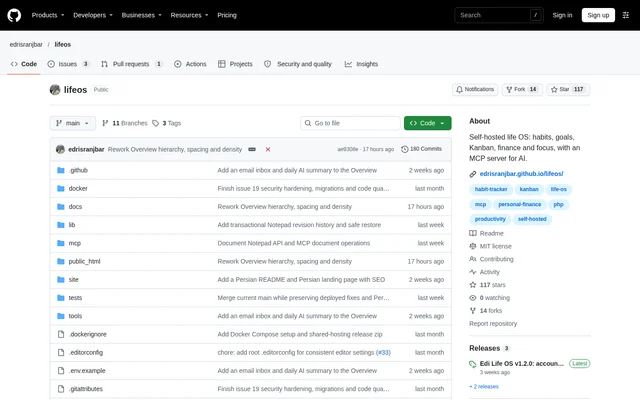
What is Edi Life OS?
Edi Life OS is an open-source, self-hosted dashboard for personal productivity and finance management. Edi Life OS brings habits, goals, projects, focus sessions, money and notes into connected workspaces with a shared sign-in and database. The project is built with PHP, MySQL and vanilla JavaScript, without a frontend framework or build step.
Edi Life OS connects daily activity to longer-term planning rather than keeping each workspace separate. Habits can contribute to goal progress, Kanban cards appear in the calendar, and the Overview combines focus, habits, goals and work into a daily score. Growth also links life dimensions to goals, habits, tasks and recurring reviews.
What Edi Life OS can do
Edi Life OS provides workspaces for planning, tracking and reviewing personal activity. The task and project tools include due dates, priorities and checklists, while finance records cover both everyday transactions and obligations. Notes support different formats, and the optional AI connection exposes supported dashboard functions through an authenticated API.
- Edi Life OS tracks habit completions, streaks and monthly progress.
- Edi Life OS manages SMART goals with measures, deadlines and editable checklists.
- Edi Life OS organizes Kanban cards with labels, comments and attachments.
- Edi Life OS records expenses, income, budgets, debts and credits.
- Edi Life OS runs timed focus sessions with breaks and a soundtrack.
- Edi Life OS supports Markdown and HTML notes with previews and matching exports.
- Edi Life OS displays a read-only IMAP inbox and AI summaries using a personal provider key.
How Edi Life OS works
Edi Life OS can run through Docker, on PHP and MySQL shared hosting, or with a local PHP server. The Docker workflow involves obtaining the repository or published image, copying the environment template, setting sign-in details and passwords, and starting the containers. Shared-hosting installations place the public web root separately from backend files.
Edi Life OS offers an optional Node.js MCP server for Claude Desktop, Claude Code and other MCP clients. The server runs over stdio and communicates only through the token-protected HTTP API, without touching the database or credentials directly. Configuration requires the application base URL and API token; there is no hosted MCP endpoint.
Who Edi Life OS is for
Edi Life OS suits individuals who want to manage personal routines, projects and finances in a self-hosted application. Edi Life OS also supports people who want an AI assistant to read dashboard information or update supported records in plain language. Users need to be comfortable configuring hosting or running the application locally.
- Edi Life OS connects habit completion with progress toward personal goals.
- Edi Life OS combines project cards and financial dues in calendar views.
- Edi Life OS lets connected AI assistants log expenses and mark habits complete.
- Edi Life OS supports weekly, monthly and quarterly growth reviews.
Edi Life OS pricing and access
Edi Life OS is distributed as an open-source project under the MIT license, and the repository states that there is no subscription. Edi Life OS can be obtained from the repository, a release archive or a published Docker image. Users provide the environment that runs the application and retain the data in their own MySQL database.
Edi Life OS strengths and limitations
Edi Life OS combines connected workspaces with direct control over deployment and stored data. Revision checks prevent stale browser tabs from silently overwriting newer changes, and API writes use transactions and row locks. Edi Life OS nevertheless leaves operational responsibilities with the user, including backing up the database, attachment files and configuration together.
- Edi Life OS does not implement per-user API token issuance or token scopes.
- Edi Life OS requires hosting-layer request limits because API rate limiting is not implemented.
- Edi Life OS administrators can reset other users' passwords, so accounts require trusted administrators.
- Edi Life OS secret-note flags control visibility rather than providing separate encryption.
Edi Life OS FAQ
What is Edi Life OS?
Edi Life OS is an open-source, self-hosted personal productivity dashboard for habits, goals, tasks, finances, focus sessions and notes. Edi Life OS connects these workspaces through a shared database and offers optional AI assistant access through an MCP server.
Is Edi Life OS free?
Edi Life OS is available under the MIT license without a subscription. Edi Life OS is self-hosted, so users provide the hosting environment and configure the application, database and credentials rather than accessing a hosted subscription service.
Does Edi Life OS work with Claude?
Edi Life OS includes an optional MCP server that connects to Claude Desktop, Claude Code and other MCP clients. Edi Life OS lets connected assistants read dashboard information, plan goals, log habits and track expenses through its token-protected HTTP API.
How do you install Edi Life OS?
Edi Life OS supports Docker, PHP and MySQL shared hosting, and a local PHP server. Edi Life OS documents repository-based Docker installation, a published Docker image, release archives for shared hosting, and local configuration through a database connection and sign-in credentials.
Does Edi Life OS have an API?
Edi Life OS provides a private HTTP API covering the dashboard, goals, tasks, habits, finances and sticky notes. Edi Life OS uses a bearer token separate from browser sign-in, but per-user token issuance, token scopes and API rate limiting are not implemented.
Where does Edi Life OS store data?
Edi Life OS stores application data in the user's MySQL database, with dedicated tables for habits and JSON documents for other workspaces. Edi Life OS recommends backing up the database, attachment files and configuration together.
From the community
No reviews yet
Be the first to review this tool. What you write helps the next person choose.