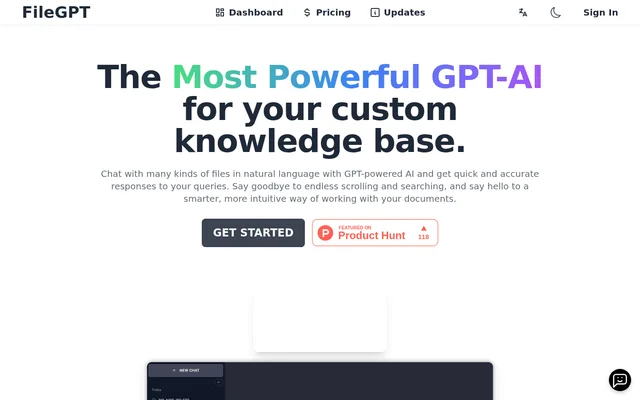
What is FileGPT?
FileGPT is an LLM-based application for interacting with documents and other source content through natural-language questions. FileGPT is presented as a tool for a custom knowledge base, with support for files, audio, video, YouTube, and webpages. The stated audiences include students, researchers, individuals, and businesses.
FileGPT focuses on asking questions about content rather than manually scrolling through documents. FileGPT can combine information from multiple files into a single answer, making cross-source questioning a central capability. The website also states that users retain unlimited access to their collections of content.
What FileGPT can do
FileGPT brings document, web, and multimedia questioning into a shared workflow. FileGPT lists broad format support on the main page, while the pricing page assigns some parsing and media capabilities to specific paid plans. Users therefore need to distinguish general product capabilities from the features included in a particular account.
- FileGPT answers natural-language questions about selected sources.
- FileGPT supports PDF, DOC, and TXT documents.
- FileGPT accepts YouTube and webpage queries.
- FileGPT combines information from multiple files in a single answer.
- FileGPT supports large files and long texts.
- FileGPT provides handwritten text and unstructured PDF support on ProYearly and higher plans.
- FileGPT supports audio, video, image, and Bilibili queries on ProYearly and higher plans.
How FileGPT works
FileGPT describes a workflow in which users select sources, ask questions, and receive answers. FileGPT can query all selected files together instead of limiting each question to an individual document. The website provides Get Started and Sign In entry points, alongside a separate pricing page for comparing account options.
FileGPT also offers website embedding through GrowthYearly, EliteYearly, and EnterpriseYearly. FileGPT adds usage and engagement tracking through Basic Analytics on EliteYearly, while EnterpriseYearly includes enhanced analytics for growth, engagement, and conversion. These business-facing capabilities sit alongside the document and media questioning features.
Who FileGPT is for
FileGPT explicitly lists students and researchers among the audiences for BasicYearly, and describes ProYearly as intended for individuals with larger needs. FileGPT also presents pricing for businesses. The supported formats make the product relevant to work involving written documents, online material, and multimedia sources.
- FileGPT lets students ask questions about reading materials.
- FileGPT lets researchers query multiple source files together.
- FileGPT lets individuals ask questions about webpages and YouTube content.
- FileGPT lets businesses embed document and content chat on their own websites through eligible plans.
FileGPT strengths and limitations
FileGPT combines multiple source types with cross-file answers, giving users a way to question collections rather than individual documents alone. FileGPT also extends into website embedding and analytics for business use. Access to these capabilities depends on the selected plan, so broad format support does not mean every feature is available during the free trial.
- FileGPT requires a paid upgrade for increased usage.
- FileGPT limits file size, files per collection, and monthly tokens by plan.
- FileGPT places handwritten text and unstructured PDF support on ProYearly and higher plans.
- FileGPT places website embedding on GrowthYearly and higher plans.
- FileGPT places analytics on EliteYearly and EnterpriseYearly.
FileGPT FAQ
What is FileGPT?
FileGPT is an LLM-based application for asking natural-language questions about documents and other content. FileGPT supports multiple formats and can combine information from several files into a single answer.
What file types does FileGPT support?
FileGPT supports PDF, DOC, TXT, audio, YouTube, and webpages. FileGPT also lists audio, video, image, and Bilibili queries, unstructured PDF support, and handwritten text support under ProYearly and higher plans.
Can FileGPT answer questions across multiple files?
FileGPT can query multiple files and integrate information into a single answer. FileGPT describes the workflow as selecting sources, asking questions, and receiving answers across the selected content.
Can FileGPT be embedded on a website?
FileGPT supports embedding on a user's own website through GrowthYearly, EliteYearly, and EnterpriseYearly. FileGPT also offers basic usage and engagement analytics on EliteYearly, with enhanced analytics and branding removal on EnterpriseYearly.
Who is FileGPT for?
FileGPT is intended for students, researchers, individuals, and businesses working with documents and other content. FileGPT labels BasicYearly for students and researchers, while ProYearly targets individuals with larger needs.
From the community
No reviews yet
Be the first to review this tool. What you write helps the next person choose.