What is KServe?
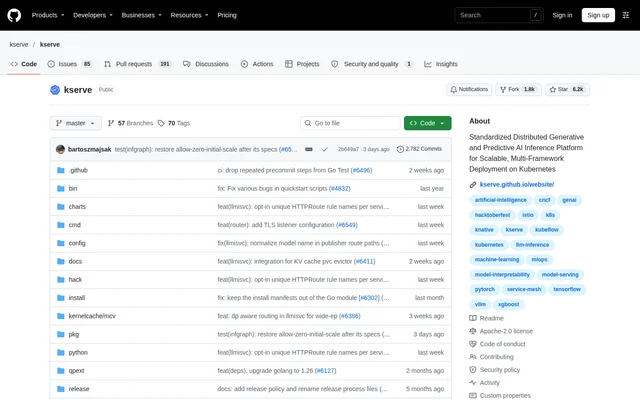
KServe is an open-source inference platform for deploying generative and predictive AI models on Kubernetes. KServe brings language model serving and traditional machine learning inference into a common deployment system. The project supports multi-framework workloads and is a Cloud Native Computing Foundation incubating project.
KServe addresses both quick deployments and enterprise-scale AI workloads. KServe combines serving backends, request routing, autoscaling, and model operations features rather than focusing on a single model framework. The repository links to documentation, presentations, demonstrations, and community resources for learning about supported features.
What KServe can do
KServe provides separate capabilities for generative and predictive inference within the same Kubernetes-based project. KServe supports language model performance features alongside predictive model routing, deployment controls, and explanations. Specific capabilities depend on the workload and installation choice, particularly where serverless deployment features are involved.
- KServe supports vLLM and llm-d backends for language model inference.
- KServe provides an OpenAI-compatible inference protocol and native Hugging Face model support.
- KServe supports GPU acceleration, model caching, and KV cache offloading to CPU or disk.
- KServe serves TensorFlow, PyTorch, scikit-learn, XGBoost, and ONNX models.
- KServe routes requests between predictor, transformer, and explainer components.
- KServe supports canary rollouts, inference pipelines, and ensembles with InferenceGraph.
- KServe provides model explanations, feature attribution, and detection features for monitoring.
How KServe works
KServe offers several installation paths. The standard Kubernetes installation is described as lighter than the serverless installation. The Knative installation provides serverless deployment for InferenceService. KServe also offers a quick installation path for a local machine and documentation for creating an initial InferenceService.
KServe can optionally use ModelMesh for high-scale, high-density, and frequently changing model serving workloads. KServe is also an addon component of Kubeflow. The repository directs users to Kubeflow documentation and guides for running KServe on AWS or OpenShift Container Platform.
Who KServe is for
KServe is for teams deploying and operating AI inference workloads on Kubernetes. KServe supports both language model serving and predictive applications, including deployments that combine models with transformation or explanation components. The available installation choices address local setup, serverless inference, and dense model serving needs.
- KServe supports language model deployments using Hugging Face models and optimized serving backends.
- KServe supports predictive applications built with multiple machine learning frameworks.
- KServe supports inference pipelines and ensembles that connect model serving components.
- KServe supports high-density model serving through optional ModelMesh installation.
KServe pricing and access
KServe is available as an open-source project through its public repository under the Apache-2.0 license. The supplied project text does not list commercial KServe plans or subscription prices. KServe documentation provides installation guidance, an InferenceService API reference, and developer and contributor guides.
KServe strengths and deployment limitations
KServe combines generative and predictive inference, multiple framework choices, and several deployment options within a Kubernetes-based project. KServe supports request-based autoscaling for generative workloads and scale-to-zero for predictive workloads. Installation choice matters: the lighter standard Kubernetes option omits capabilities available through the serverless installation.
- KServe requires a Kubernetes-based deployment environment.
- KServe standard Kubernetes installation does not support canary deployment.
- KServe standard Kubernetes installation does not support request-based autoscaling with scale-to-zero.
KServe FAQ
What is KServe?
KServe is an open-source platform for generative and predictive AI inference on Kubernetes. KServe supports multi-framework model deployment, language model serving, autoscaling, request routing, and model explainability, and is a Cloud Native Computing Foundation incubating project.
Is KServe free?
KServe is available as an open-source project under the Apache-2.0 license through its public repository. KServe's project page does not list subscription plans or commercial pricing and instead directs users to installation documentation.
Which model frameworks does KServe support?
KServe supports TensorFlow, PyTorch, scikit-learn, XGBoost, and ONNX for predictive AI workloads. KServe also supports vLLM and llm-d backends for language model serving, with native support for Hugging Face models.
How can KServe be installed?
KServe offers standard Kubernetes, Knative, optional ModelMesh, and local quick installation paths. KServe is also a Kubeflow addon, and the repository links to guides for AWS and OpenShift Container Platform deployments.
Does KServe support scale-to-zero?
KServe supports request-based autoscaling with scale-to-zero for predictive workloads, but the standard Kubernetes installation does not include this capability. KServe's standard installation also excludes canary deployment, making installation choice important when selecting deployment features.
Does KServe support an OpenAI-compatible API?
KServe provides an OpenAI-compatible inference protocol for integration with language models. KServe pairs this protocol with generative AI capabilities including vLLM and llm-d backends, GPU support, model caching, and native Hugging Face model support.
From the community
No reviews yet
Be the first to review this tool. What you write helps the next person choose.