What is Landing AI?
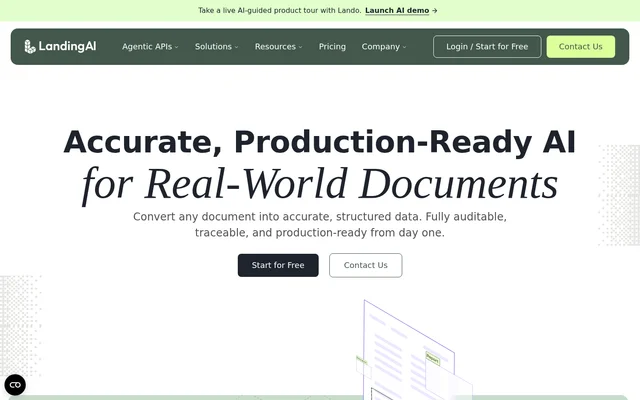
Landing AI is an AI document processing tool that turns documents into structured data through Agentic Document Extraction (ADE). Landing AI serves teams working with variable layouts, complex tables, and multi-page files, particularly where extracted information needs to remain traceable to its original source.
Landing AI uses a vision-first approach to preserve document structure, including tables, forms, and headings. The service produces grounded outputs rather than extracted text alone. Supported inputs include PDFs, images, scanned documents, spreadsheets, invoices, receipts, contracts, and medical records, making document variability a central part of the product's stated scope.
What Landing AI can do
Landing AI organizes document processing around parsing, splitting, and extraction. These capabilities let teams preserve source structure, separate mixed document batches, and request specific fields using their own schemas. Outputs carry citations so teams can inspect where content came from, while confidence scoring highlights results that may need human review.
- Landing AI converts documents into layout-aware Markdown and structured content blocks.
- Landing AI preserves text, tables, figures, and content hierarchy.
- Landing AI splits mixed files into classified sub-documents.
- Landing AI detects document instances using repeated identifiers.
- Landing AI extracts fields with flat or nested schemas and arrays.
- Landing AI extracts large tables spanning multiple pages.
- Landing AI supplies page coordinates and bounding-box citations.
How Landing AI works
Landing AI provides modular REST APIs and Python or TypeScript libraries for connecting document extraction to existing workflows. A workflow can parse source documents, split combined files when needed, and extract selected fields against a defined schema. Structured outputs can then feed retrieval systems, automation, search, or analytics.
Landing AI describes agentic orchestration that plans, decides, and verifies until quality thresholds are met. Semantic chunking supports retrieval-augmented generation, while page references and precise coordinates support verification. Deployment choices include cloud, on-premises, and virtual private environments, with a zero data retention option for organizations with specific privacy requirements.
Who Landing AI is for
Landing AI targets teams processing documents across financial services, insurance, healthcare, energy and utilities, legal, and logistics. The page emphasizes regulated, high-variance documents where governance and source attribution matter. Developers can use the APIs to build document pipelines, while business workflows can use the resulting structured data for checks, reporting, and decisions.
- Landing AI supports loan and credit underwriting workflows.
- Landing AI supports know your customer checks and regulatory reporting.
- Landing AI turns document archives into queryable datasets.
- Landing AI supplies structured content for retrieval-augmented generation.
- Landing AI supports reconciliation, compliance checks, reporting, and approvals.
Landing AI pricing and plans
Landing AI advertises free starting access and describes pricing based on document volume and the features a team needs. Plans are presented for organizations ranging from startups to enterprises. The supplied page does not give monetary prices, included processing allowances, or free access limits, and also offers a contact route for inquiries.
Landing AI strengths and limitations
Landing AI combines structured extraction with source-level evidence, making auditability a central strength of the offering. Layout preservation, schema-defined fields, and multiple deployment options address different document processing requirements. The page also states SOC 2 Type II certification and GDPR and HIPAA compliance, alongside an optional zero data retention configuration.
- Landing AI confidence scores can flag results that still need human review.
- Landing AI does not publish exact plan prices in the supplied text.
- Landing AI does not specify free usage allowances in the supplied text.
Landing AI FAQ
What is Landing AI?
Landing AI is an AI document processing tool that uses Agentic Document Extraction to convert documents into structured data. Landing AI provides parsing, document splitting, and schema-defined extraction, with source citations and confidence scores to support verification.
Is Landing AI free?
Landing AI advertises free starting access and offers plans priced according to document volume and required features. Landing AI does not list exact prices or free usage allowances in the supplied page text.
What document types does Landing AI support?
Landing AI supports PDFs, JPEG, PNG, and TIFF images, scanned documents, spreadsheets, invoices, receipts, contracts, and medical records. Landing AI also describes support for complex layouts, multi-column documents, mixed content, and tables spanning multiple pages.
Does Landing AI have an API?
Landing AI provides modular REST APIs and Python or TypeScript libraries for parsing, splitting, and extracting document data. Landing AI outputs can support retrieval-augmented generation, workflow automation, search, and analytics.
Can Landing AI run on-premises?
Landing AI offers on-premises deployment alongside cloud and virtual private deployment options. Landing AI also offers a zero data retention option and states SOC 2 Type II certification and GDPR and HIPAA compliance.
How does Landing AI make extracted data traceable?
Landing AI links parsed content to page numbers and precise coordinates, with table-cell grounding and bounding-box citations for extracted values. Landing AI also supplies confidence scores that surface results which may need human review.
From the community
No reviews yet
Be the first to review this tool. What you write helps the next person choose.