What is MotionAgent?
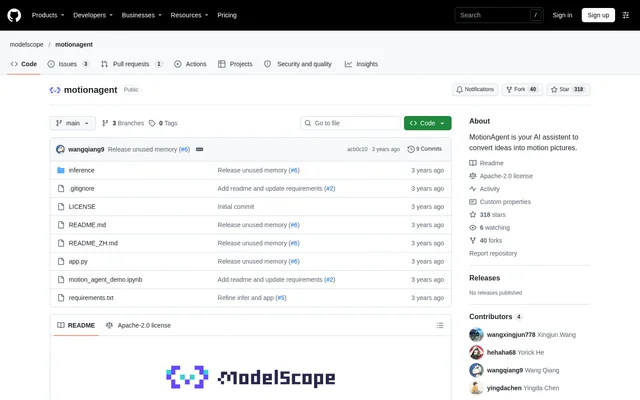
MotionAgent is an open-source deep learning tool for generating videos from user-created scripts. MotionAgent brings script writing, movie still generation, image-to-video generation, and background music composition into a provided toolset. The project is powered by models from the ModelScope open-source model community and is published as a GitHub repository.
MotionAgent is intended for people who want to turn story ideas into scripts and generated visual material. The repository includes application code, dependency requirements, a demonstration notebook, and installation instructions. MotionAgent is distributed under the Apache-2.0 license rather than presented as a subscription-based video service.
What MotionAgent can do
MotionAgent covers several parts of a script-based video workflow. Users specify a story theme and background for script generation, then use the toolset to create scene images, generate video from images, and compose background music. The README explicitly lists support for different script styles and high-resolution video generation.
- MotionAgent generates scripts from a specified story theme and background.
- MotionAgent supports scripts in various styles using an LLM-based model.
- MotionAgent generates corresponding movie still scene images.
- MotionAgent generates videos from images.
- MotionAgent supports high-resolution video generation.
- MotionAgent generates background music in custom styles.
How MotionAgent works
MotionAgent runs through a Python application installed from the repository. The documented workflow creates and activates a conda environment, clones the project, installs dependencies from requirements.txt, and runs app.py. Users then open the URL printed in the application log to access the page.
MotionAgent lists Qwen-7B-Chat, SDXL 1.0, I2VGen-XL, and MusicGen among its models. The verified environment uses python3.8, torch2.0.1, CUDA11.7, Ubuntu 20.04, and an Nvidia-A100 40G. MotionAgent currently supports a single GPU; the instructions explain how to select a GPU when multiple cards are available.
Who MotionAgent is for
MotionAgent serves users creating scripts, visual scenes, generated videos, and musical accompaniment. The documented installation also makes MotionAgent relevant to users comfortable managing Python dependencies and GPU resources. The stated use cases focus on generating media from story inputs rather than editing an existing video timeline.
- MotionAgent helps users develop scripts from story themes and backgrounds.
- MotionAgent helps users create still images corresponding to movie scenes.
- MotionAgent helps users animate images through video generation.
- MotionAgent helps users compose background music in a chosen style.
MotionAgent pricing and access
MotionAgent is available as an open-source project under the Apache-2.0 license, with source code accessible through GitHub. The README provides installation and launch instructions rather than product subscription plans. Access involves obtaining the repository, installing its dependencies, and running the application in an environment that meets the documented resource requirements.
MotionAgent strengths and limitations
MotionAgent combines multiple media-generation capabilities in a single documented toolset and identifies the models used by the project. MotionAgent also provides explicit compatibility and resource information. These details help users assess a local installation, but the GPU memory requirement, storage recommendation, and single-card support constrain where the application can run.
- MotionAgent requires 36GB of GPU memory.
- MotionAgent recommends reserving more than 50GB of storage space.
- MotionAgent currently supports only a single GPU.
- MotionAgent recommends clear_cache for ModelScope community Notebooks or disks below 100GB.
- MotionAgent re-downloads models on each run with clear_cache enabled, significantly reducing speed.
MotionAgent FAQ
What is MotionAgent?
MotionAgent is an open-source deep learning tool that generates videos from user-created scripts. MotionAgent provides script generation, movie still generation, image-to-video generation, and custom-style background music generation using models from the ModelScope community.
Is MotionAgent free or paid?
MotionAgent is available as an open-source GitHub project under the Apache-2.0 license. MotionAgent does not list product subscription plans in the README; the documented access method is installing the repository and running the Python application.
What hardware does MotionAgent require?
MotionAgent requires 36GB of GPU memory and recommends more than 50GB of storage space. MotionAgent currently supports a single GPU, and the verified setup lists an Nvidia-A100 40G running with Ubuntu 20.04, python3.8, torch2.0.1, and CUDA11.7.
How do you install and run MotionAgent?
MotionAgent is installed by creating a conda environment, cloning the GitHub repository, and installing dependencies from requirements.txt. MotionAgent starts with python3 app.py, after which users open the URL generated in the log to access the application page.
Which models does MotionAgent use?
MotionAgent lists Qwen-7B-Chat, SDXL 1.0, I2VGen-XL, and MusicGen in its model list. MotionAgent describes script generation as LLM-based, with Qwen-7B-Chat given as an example, and states that its models are powered by the ModelScope open-source model community.
What does MotionAgent's clear_cache option do?
MotionAgent recommends enabling clear_cache when using the ModelScope community Notebook or when disk space is less than 100GB. MotionAgent warns that this option causes models to be downloaded again on each run, significantly decreasing speed.
From the community
No reviews yet
Be the first to review this tool. What you write helps the next person choose.