What is Rome?
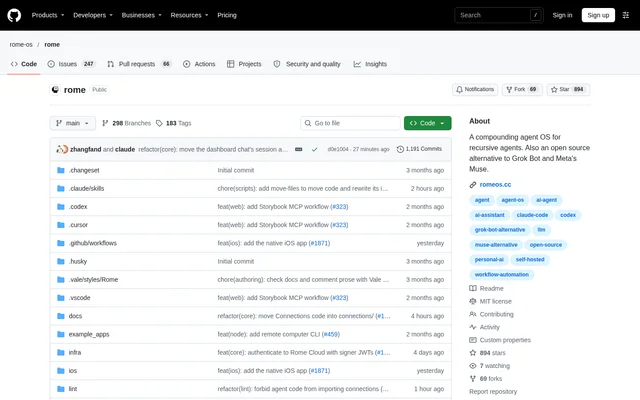
Rome is an open-source agent operating environment for persistent agents, workflow automation, and personal software. Rome brings tools, memory, interfaces, and reusable capabilities into an environment where people guide agents. The project presents Rome as an alternative to Grok Bot and Meta's Muse for persistent agents, scheduled tasks, and custom apps.
Rome focuses on retaining useful work beyond an individual conversation. Agents can build harnesses, design procedures, and orchestrate workflows under human guidance. Actions, skills, and apps remain as git-tracked code, while memory and app-private data provide continuity for later tasks and repeated work.
What Rome can do
Rome combines agent reasoning with executable actions, persistent data, and interfaces designed around specific jobs. A Rome App can include backend operations, app-owned agents, procedures, lifecycle hooks, web interfaces, and storage. These components form capabilities that Rome can discover and reuse in later work.
- Rome handles one-off tasks, scheduled work, and long-running follow-through.
- Rome scaffolds apps and workflows from plain-language requests.
- Rome stores app-private data across runs.
- Rome lets actions pause for approval.
- Rome records every action run.
- Rome supports chat channels including Telegram, Discord, and WhatsApp.
How Rome works
Rome can turn a plain-language request into a short specification, scaffold an app or workflow, build the result into the user's instance, and continue refining it in the same conversation. The resulting source code is git-tracked. Users can keep an app private, modify it, or publish it through the App Store.
Rome supports Docker-based self-hosting through a quickstart script that checks for Docker, pulls the published image, and starts the environment. The dashboard is bound to loopback by default. Named Docker volumes retain state when the script upgrades the container, and telemetry export remains disabled unless explicitly configured.
Who Rome is for
Rome serves people who need agents to continue working beyond a chat session, as well as developers building reusable agent capabilities and apps. The documented examples span software development, personal administration, monitoring, and customer research. Purpose-built apps provide a persistent interface when work involves editable data, multiple actions, or ongoing agent activity.
- Rome can follow through on code review comments until merge blockers are resolved.
- Rome can sort an inbox, flag urgent messages, and draft replies.
- Rome can watch a game's price and notify the user about a drop.
- Rome can interview customers and summarize suggested onboarding improvements.
- Rome can deliver a morning brief on a schedule.
Rome pricing and access
Rome is distributed as an MIT-licensed open-source project, with Docker instructions for running an instance on a user's own machine. Rome Cloud provisions a private environment for each guardian and is currently available as a preview. The repository links to the preview, documentation, and App Store, but does not state cloud pricing.
Rome strengths and limitations
Rome combines reusable software capabilities with persistent app data and interfaces, rather than keeping all interaction inside a chat thread. Self-hosting, editable source code, and a choice of model provider give users deployment and customization options. Setup still involves operational considerations, and the cloud and desktop access paths have specific constraints.
- Rome Cloud is currently a preview.
- Rome's Mac app connects to Rome Cloud rather than running Rome itself.
- Rome requires Docker for the documented local self-hosting path.
- Rome's first-run onboarding is available to whoever reaches the dashboard first.
Rome FAQ
What is Rome?
Rome is an open-source agent operating environment for persistent agents, scheduled tasks, and custom apps. Rome combines tools, workflows, memory, and interfaces so that capabilities created during earlier work can be reused in later tasks.
Is Rome open source, and what does access cost?
Rome is an MIT-licensed open-source project available for Docker self-hosting. Rome Cloud also offers private environments through a preview, but the repository does not state cloud pricing or describe paid plans.
Can Rome run on your own machine?
Rome can run on a user's own machine through Docker. Rome provides a quickstart script that checks for Docker, pulls the published image, and starts the environment, with persistent state stored in named Docker volumes.
What can you use Rome for?
Rome supports code review follow-through, inbox organization, price monitoring, customer interviews, and scheduled briefs. Rome can handle individual tasks, recurring workflows, and long-running work, or build purpose-specific apps with interfaces and persistent data.
Does the Rome Mac app run Rome locally?
Rome does not run locally inside the Mac app. Rome's Mac app signs in to Rome Cloud, displays the user's environment, and connects the Mac as a device on which Rome can run programs. Local hosting uses Docker instead.
Can Rome build custom apps?
Rome can turn a plain-language request into a specification, scaffold an app or workflow, and refine the result through conversation. Rome produces ordinary git-tracked source code that users can keep private, modify, or publish through the App Store.
From the community
No reviews yet
Be the first to review this tool. What you write helps the next person choose.