What is SkillSpector?
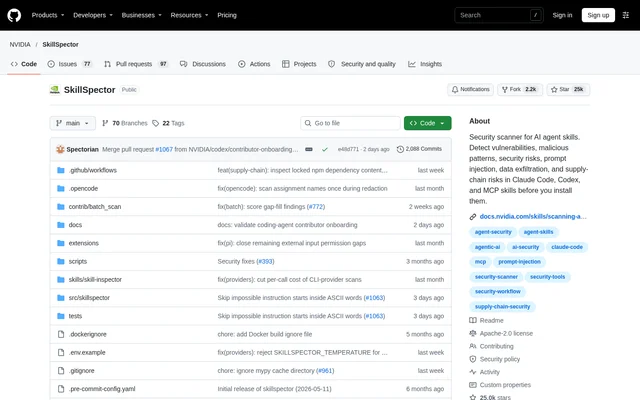
SkillSpector is an open-source security scanner that checks AI agent skills before installation. SkillSpector targets vulnerabilities, malicious patterns, and security risks in skills used by tools such as Claude Code, Codex CLI, and Gemini CLI. The project helps developers and security reviewers assess whether a skill is safe to install.
SkillSpector is part of the NVIDIA Verified Skills pipeline, which scans, evaluates, and signs agent skills before publication. Skills that pass that pipeline are published to the NVIDIA skills catalog. The repository also links to documentation for interpreting scan reports, gating installations, extending analyzers, and reporting suspected vulnerabilities.
What SkillSpector can do
SkillSpector combines fast static analysis with optional LLM semantic evaluation to inspect agent skills. SkillSpector covers 71 vulnerability patterns across 17 categories, including prompt injection, data exfiltration, privilege escalation, memory poisoning, tool misuse, and MCP tool poisoning. Findings include risk scores, severity labels, and recommendations.
- SkillSpector scans Git repositories, URLs, zip archives, directories, and individual files.
- SkillSpector queries OSV.dev for live CVE data with automatic offline fallback.
- SkillSpector produces terminal, JSON, Markdown, and SARIF reports.
- SkillSpector accepts known findings through glob-rule or fingerprint baselines.
- SkillSpector scans skill collections recursively or through a parallel batch scanner.
- SkillSpector compares normalized MCP Registry snapshots without fetching or executing listed server endpoints.
How SkillSpector works
SkillSpector runs through a command-line workflow: users install the tool, select a skill input, and run a scan. The repository documents installation with uv and installation from source inside an activated virtual environment. A locally built Docker image provides an alternative that does not require Python to be installed on the host.
SkillSpector supports static-only scanning through the no-LLM option, while documented LLM workflows pass provider credentials through environment variables or a local environment file. Users can select a report format and save results to a file. Pi and OpenCode extensions support scanning from agent sessions, and the MCP command requires installation of the MCP extra.
Who SkillSpector is for
SkillSpector serves developers and security reviewers who work with AI agent skills and need checks before installation. SkillSpector also supports workflows involving collections of skills, automated security reporting, and MCP Registry comparisons. SARIF output is intended for CI/CD integration and IDE tooling, while JSON output provides machine-readable findings.
- Developers can inspect a skill directory or SKILL.md file before installation.
- Security reviewers can examine repositories and archives for malicious patterns.
- CI maintainers can export SARIF reports and fail on incomplete recursive coverage.
- Agent users can scan skills inside Pi and OpenCode sessions.
SkillSpector licensing and access
SkillSpector is available as an open-source GitHub project under the Apache-2.0 license. The documented access paths are command-line installation, installation from source, and a locally built Docker image. The installation notice states that additional third-party open-source projects will be downloaded and installed, and asks users to review their license terms before use.
SkillSpector strengths and limitations
SkillSpector provides several input and report formats, optional LLM evaluation, and baseline suppression for accepted findings. These capabilities support both individual skill reviews and repeated automated scans. SkillSpector also applies resource bounds to ingestion and analysis, so a completed command should be interpreted alongside the report's coverage information rather than assumed to cover every possible input.
- SkillSpector enforces download, archive-entry, and individual-file analysis limits.
- SkillSpector can omit skills when recursive collection limits or other resource budgets are reached.
- SkillSpector reports incomplete recursive coverage and offers a fail-on-incomplete option for CI.
- SkillSpector requires a locally generated registry-mode report for MCP Registry comparisons.
SkillSpector FAQ
What is SkillSpector?
SkillSpector is an open-source security scanner for AI agent skills. SkillSpector detects vulnerabilities, malicious patterns, prompt injection, data exfiltration, and supply-chain risks before installation, using static analysis and optional LLM semantic evaluation.
Is SkillSpector open source?
SkillSpector is an open-source project distributed under the Apache-2.0 license. SkillSpector is available through its GitHub repository, with documented installation using uv, installation from source, and a Docker image that users build locally.
Can SkillSpector run without an LLM?
SkillSpector can run static scans without LLM analysis using the no-LLM option. SkillSpector also offers optional LLM semantic evaluation, with documented Docker examples passing provider credentials through a local environment file or shell environment variables.
What files and repositories can SkillSpector scan?
SkillSpector accepts Git repositories, URLs, zip archives, directories, and individual files, including SKILL.md files. SkillSpector also supports recursive collection scanning and parallel batch scanning, subject to ingestion limits, collection limits, and other resource budgets.
Does SkillSpector integrate with agent tools and CI workflows?
SkillSpector provides Pi and OpenCode extensions for scanning skills inside agent sessions, plus an MCP command that requires the MCP installation extra. SkillSpector also exports SARIF reports for CI/CD integration and IDE tooling, alongside JSON, Markdown, and terminal output.
From the community
No reviews yet
Be the first to review this tool. What you write helps the next person choose.