What is Taste-Skill?
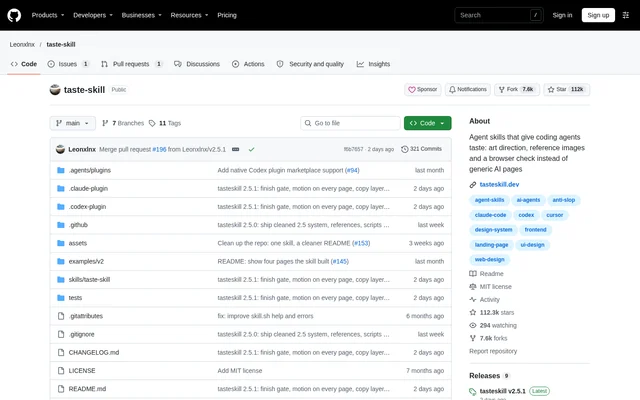
Taste-Skill is an open-source Agent Skill for building and redesigning company websites with coding agents. Taste-Skill supplies design guidance, assets and checking scripts rather than operating as a standalone website editor. The repository contains the design-taste-frontend skill and provides installation paths for Claude Code, Codex and the npx skills CLI.
Taste-Skill organizes each build around the client's business type and a consistent visual system. The supplied rules cover plain copy, aligned content edges, screen-sized sections, photographs, brand icons and product interface visuals. A browser checker and finish gate evaluate the rendered result before the agent hands over the page.
What Taste-Skill can do
Taste-Skill combines design selection, asset preparation and rendered-page inspection in the same skill. The included tools select visual directions, resolve image and icon assets, and check whether a built page follows the prescribed layout and content rules. Effects depend on the business category rather than appearing on every website.
- Taste-Skill selects palettes and Google Fonts pairings by page kind.
- Taste-Skill supplies hero layouts and a shared starter design system.
- Taste-Skill selects vetted photographs and writes source credits.
- Taste-Skill resolves brand and interface icons into local SVG files.
- Taste-Skill checks layouts, contrast, placeholder text and image loading in headless Chrome.
- Taste-Skill measures page weight and speed and captures screenshots.
How Taste-Skill works
Taste-Skill starts when a user asks a coding agent to build or redesign a company site. The agent loads the skill, classifies the business, plans the page screen by screen and copies the supplied assets into the project. An empty folder starts with a static page; an existing supported project uses its own stack.
Taste-Skill runs checks against the served or built page in a real browser over HTTP. The checker reports passes, warnings and failures across desktop and mobile widths. The finish gate holds completion until no fixable failure remains, with a maximum of three rounds. Local execution requires Node 22 or newer and Chrome, Edge or Chromium.
Who Taste-Skill is for
Taste-Skill serves developers who use coding agents for company website work, including new builds and redesigns. The documented business categories include software, gaming, tech, product, service and place. Taste-Skill differentiates technical pages from hospitality, retail and service pages through its choice of photographs, interface visuals, typography and effects.
- Developers can build software websites with product UI fragments and diagrams.
- Developers can create photograph-led pages for cafes, hotels, shops and studios.
- Developers can audit existing pages in a browser before redesigning them.
- Developers can work within existing React, Vue, Svelte, Astro or Tailwind projects.
Taste-Skill pricing and access
Taste-Skill is available as an open-source project under the MIT License, with no paid skill plans described in the repository. Installation options include the npx skills CLI, Claude Code and Codex plugins, or a linked local clone. Taste-Skill requires no API keys, and bundled Wikimedia Commons photographs are stored locally for offline use.
Taste-Skill strengths and limitations
Taste-Skill brings concrete design assets and browser verification into an agent-driven website workflow. Local photographs, source credits, responsive checks and reduced-motion fallbacks are documented strengths. Taste-Skill also has explicit operational boundaries: execution depends on a local runtime and browser, remote assets need network access, and some visual effects are intentionally restricted by business type.
- Taste-Skill requires Node 22 or newer and Chrome, Edge or Chromium.
- Taste-Skill needs network access for additional photographs, Google Fonts and brand icons.
- Taste-Skill builds Next.js briefs as static exports.
- Taste-Skill limits shaders to software, technical hardware and gaming pages.
Taste-Skill FAQ
What is Taste-Skill?
Taste-Skill is an open-source Agent Skill that guides coding agents through company website builds and redesigns. Taste-Skill combines art direction, photographs, product interface assets, layout rules and browser checks, with installation options for Claude Code and Codex.
Is Taste-Skill free?
Taste-Skill is available as an open-source project under the MIT License, and the repository describes no paid skill plans. Taste-Skill requires no API keys and includes locally stored Wikimedia Commons photographs that work offline.
What does Taste-Skill need to run?
Taste-Skill requires Node 22 or newer and an installed Chrome, Edge or Chromium browser. Taste-Skill optionally uses ffmpeg for WebP output and hero photograph phone crops. Additional photographs, Google Fonts and brand icons require network access.
Does Taste-Skill work with React and other frontend frameworks?
Taste-Skill supports existing React, Vue, Svelte, Astro and Tailwind projects in their own stack, with the kit served from the public folder. Taste-Skill creates a static page in an empty folder and builds a Next.js brief as a static export.
How does Taste-Skill check a website?
Taste-Skill renders the built page in headless Chrome over HTTP at multiple viewport widths. Taste-Skill checks for empty visuals, broken shaders, contrast drops, misaligned columns, section-height drift, placeholder text and image-loading gaps, then uses a finish gate to require fixes for fixable failures.
Where does Taste-Skill get its photographs?
Taste-Skill uses a vetted photograph library that includes bundled Wikimedia Commons sets and Unsplash photographs. Taste-Skill credits sources in an expandable footer line and marks draft stand-ins when clients lack photographs, rather than presenting library images as the client's own staff, rooms or products.
From the community
No reviews yet
Be the first to review this tool. What you write helps the next person choose.