What is WrenAI?
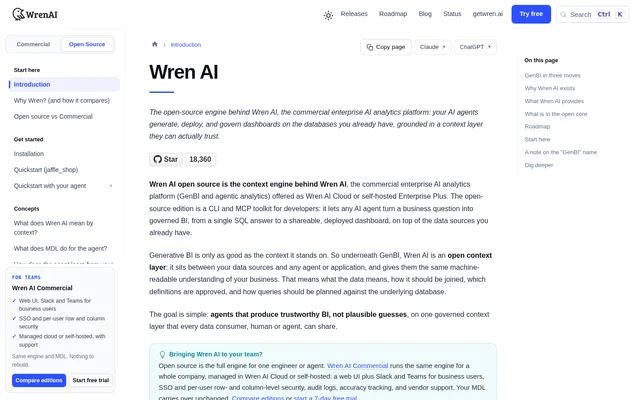
WrenAI is an open-source context engine for developers building business intelligence with AI agents. WrenAI sits between existing data sources and the agents or applications that query them. A database schema can tell an agent which columns exist, but the context layer can also tell the agent what a refund status means, which table is canonical, and how the business defines an active customer.
What WrenAI can do
WrenAI supports the workflow from answering a business question to publishing a dashboard. The same semantic models and business definitions inform both the initial SQL query and the deployed result. Business logic can live in files that a team can inspect, version, and share rather than being inferred separately each time an agent answers a question.
- WrenAI defines data models, relationships, calculated fields, and views in MDL.
- WrenAI helps agents generate governed SQL and charts from business questions.
- WrenAI validates query plans before execution.
- WrenAI builds browser-side dashboards that can be deployed to Vercel or Cloudflare Pages.
How WrenAI works
WrenAI uses Modeling Definition Language files to map business-facing models to physical tables. When an agent queries a modeled table, the engine resolves the table reference, leaves undeclared columns out of the model, and applies project rules such as default filters. The Rust engine uses Apache DataFusion to plan and execute modeled SQL across supported sources, including PostgreSQL, BigQuery, Snowflake, and DuckDB.
Who WrenAI is for
WrenAI is designed for developers who want an agent to query company data using explicit business definitions. An engineer can use the CLI directly or attach a project to an agent framework through the LangChain or Pydantic AI integrations. The commercial edition adds a web interface and Slack and Teams access for business users.
- Define revenue, churn, or active customers for repeated use.
- Answer a business question with governed SQL.
- Publish a query result as a shareable dashboard.
WrenAI pricing and plans
WrenAI is available as a free, open-source edition that includes the semantic engine, CLI, and MCP toolkit for an engineer or agent. The separate commercial offering is available as Wren AI Cloud or self-hosted Enterprise Plus. The commercial edition uses the same engine and adds company-wide features such as single sign-on, per-user row- and column-level security, and audit logs. Existing MDL files carry over unchanged.
WrenAI strengths and limitations
WrenAI keeps business definitions in files that developers can review and version. The source identifies structural, semantic, and business context as available today, while operational and behavioral context are still in active development. The maintained open-source engine is distinct from GenBI Classic, the earlier Docker-based, chat-first BI app, which has been sunset.
- Operational context, including governance rules and sanctioned queries, is still in development.
- Behavioral context, including memory of past questions and feedback, is still in development.
- GenBI Classic no longer receives security fixes.
Getting started with WrenAI
WrenAI provides an installation guide and a quickstart that uses the jaffle_shop sample data. Developers can follow the quickstart to try a modeled query before connecting their own database. The documentation also covers building and deploying a GenBI app, which turns a query result into a browser-side dashboard powered by the WebAssembly version of the semantic engine.
WrenAI FAQ
What is WrenAI?
WrenAI is an open-source context engine and developer toolkit for generative business intelligence. WrenAI gives AI agents access to business definitions, data relationships, and modeled tables so they can generate governed SQL, charts, and dashboards on existing data sources.
Is WrenAI free?
WrenAI has a free, open-source edition that includes the semantic engine, CLI, and MCP toolkit. The separate commercial offering is available as Wren AI Cloud or self-hosted Enterprise Plus and adds features such as a web interface, single sign-on, and audit logs.
Which databases does WrenAI support?
WrenAI supports data sources including PostgreSQL, MySQL, BigQuery, Snowflake, DuckDB, ClickHouse, Trino, SQL Server, Databricks, and Redshift. WrenAI uses a Rust semantic engine powered by Apache DataFusion to plan and execute modeled SQL across supported sources.
Can WrenAI build and deploy dashboards?
WrenAI lets AI agents build shareable, browser-side dashboards from governed query results and deploy them to Vercel or Cloudflare Pages. These GenBI apps use the WebAssembly build of the semantic engine to run SQL with the project's data models.
Does WrenAI integrate with AI agent frameworks?
WrenAI provides LangChain and Pydantic AI integrations for attaching a WrenAI project to an agent framework. The open-source edition also includes a CLI and MCP toolkit that agents can use to work with the project's data context.
From the community
No reviews yet
Be the first to review this tool. What you write helps the next person choose.