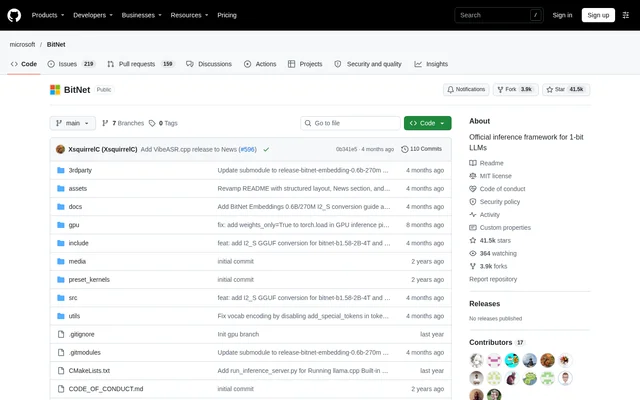
What is BitNet?
BitNet is an open-source project providing an official inference framework for compatible 1-bit language models through bitnet.cpp. Hosted in Microsoft's GitHub repository, BitNet focuses on optimized kernels for fast, lossless inference of 1.58-bit models. The project is relevant to developers and researchers who want to run language models locally, study inference performance, or evaluate deployment on resource-constrained hardware.
BitNet includes support for official language and embedding models alongside selected community language models. The repository links model downloads, technical reports, an online demo, and local installation instructions. CPU and GPU inference are available, while NPU support is described as forthcoming. The source code is distributed under the MIT license.
What BitNet can do
BitNet combines model execution, setup utilities, and performance testing in a source-based workflow. The available capabilities cover text generation, interactive conversations, and supported embedding model inference. Model compatibility is documented by processor architecture and kernel type, so users can check whether a particular model has an appropriate execution path before building.
- BitNet runs compatible language models using optimized CPU and GPU kernels.
- BitNet enables conversational mode for supported instruct models.
- BitNet exposes controls for threads, context size, generated tokens, and temperature.
- BitNet supports optimized I2_S conversion for the listed x86 embedding models.
- BitNet provides scripts for inference benchmarking with configurable workloads.
- BitNet provides dummy-model generation for benchmarking model layouts without a supported public model.
How BitNet works
BitNet local setup begins by cloning the repository recursively, installing dependencies, and building the project. The instructions recommend a conda environment and specify Python, CMake, and Clang requirements. Windows users need the listed Visual Studio development components and must run the build commands from a Developer Command Prompt or PowerShell environment.
BitNet uses downloaded model files with setup and inference scripts. The documented workflow downloads a compatible model from Hugging Face, runs setup_env.py with the model directory and quantization choice, and then launches run_inference.py with a model path and prompt. Conversational mode uses the supplied prompt as the system prompt for supported instruct models.
Who BitNet is for
BitNet is suited to technical users who can install build tools, manage model files, and run command-line scripts. The documented workflows support local model deployment and inference research rather than only a hosted chat experience. Developers evaluating CPU execution can use the compatibility table and benchmark scripts to select models and test performance on their own hardware.
- BitNet supports developers running compatible language models on local devices.
- BitNet supports researchers comparing inference workloads and thread settings.
- BitNet supports interactive conversations with compatible instruct models.
- BitNet supports embedding inference on the documented x86 kernel path.
BitNet pricing and access
BitNet is available as an open-source project under the MIT license, with source code accessible from the public GitHub repository. The page provides build instructions rather than paid subscription plans. Users can access the linked online demo or obtain compatible model files through the listed Hugging Face resources for local execution.
BitNet strengths and limitations
BitNet combines local execution, configurable inference, and benchmarking within a documented repository. The project reports CPU speed and energy improvements and provides a technical report for further detail. Those results should be read alongside the model and kernel compatibility table: available execution paths differ between models and architectures, and local deployment requires a development environment.
- BitNet requires dependency installation and a source build for the documented local workflow.
- BitNet kernel support varies across model and processor combinations.
- BitNet lists no ARM kernel support for the official embedding models.
- BitNet describes NPU support as a future addition.
BitNet FAQ
What is BitNet?
BitNet is an open-source project providing the official inference framework for compatible 1-bit language models through bitnet.cpp. BitNet includes optimized CPU and GPU kernels, local inference scripts, model setup utilities, and benchmarking tools.
Is BitNet free?
BitNet is available as open-source code under the MIT license. The repository provides local build instructions and links an online demo, but does not list paid subscription plans or hosted service pricing.
Can BitNet run language models locally on a CPU?
BitNet supports local CPU inference for compatible language models on x86 and ARM architectures. Available kernels depend on the selected model, and the documented workflow requires downloading model files, installing dependencies, and building the project.
Does BitNet support GPU and NPU inference?
BitNet provides an official GPU inference kernel as well as CPU inference support. The repository describes NPU support as coming next, so NPU execution is not presented as an available deployment option.
How do you use BitNet for chat?
BitNet supports conversational mode for instruct models through the command-line inference script. Users provide a compatible model file and enable the conversation option; the supplied prompt then acts as the system prompt.
Does BitNet support embedding models?
BitNet supports the official embedding models listed in the repository through optimized I2_S kernels on x86 CPUs. The compatibility table lists no ARM kernel support for those embedding models, and the repository links a conversion and inference optimization guide.
From the community
No reviews yet
Be the first to review this tool. What you write helps the next person choose.