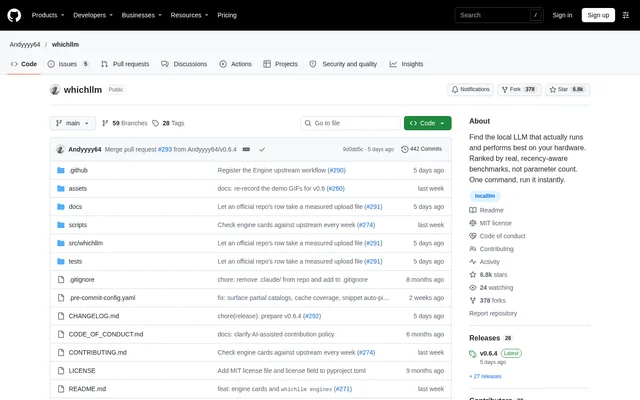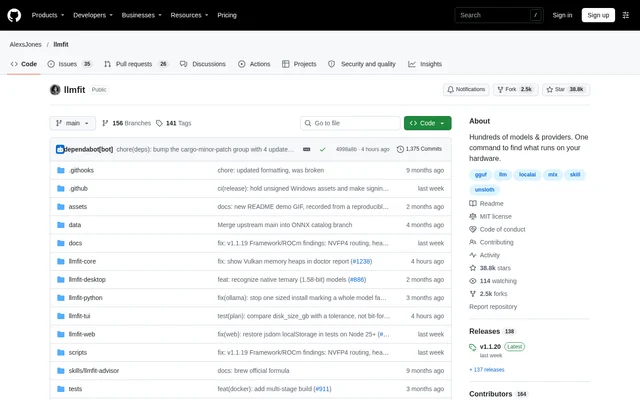
What is llmfit?
llmfit is an open-source hardware compatibility and model recommendation tool for running large language models locally. llmfit inspects CPU resources, system memory, GPUs, VRAM, and accelerator configuration to identify suitable models. The project helps local LLM users and developers compare model requirements with the resources available on a particular machine.
llmfit ranks models across memory fit, estimated speed, quality, and context rather than presenting model size alone. The catalog covers hundreds of models and providers, with support for popular quantizations. Hardware detection includes NVIDIA CUDA, Apple Silicon, AMD ROCm, and Intel OneAPI configurations.
What llmfit can do
llmfit combines hardware inspection, compatibility analysis, and benchmarking in terminal and web interfaces. The compatibility engine considers model parameter counts, context lengths, and quantization formats when projecting memory requirements and performance. Supported formats include GGUF, AWQ, GPTQ, and EXL2, alongside analysis for multi-GPU setups and mixture-of-experts architectures.
- llmfit detects CPU cores, system RAM, GPUs, VRAM, and unified memory.
- llmfit ranks models by fit, speed, quality, and context.
- llmfit provides an interactive terminal browser and a web dashboard.
- llmfit exposes system and model information through HTTP JSON endpoints.
- llmfit measures inference performance against a running provider.
- llmfit estimates storage capacity for keeping runnable models.
How llmfit works
llmfit starts its interactive terminal browser when launched without flags. The interface displays detected hardware specifications alongside ranked models, with filtering by model name, family, or quantization. Command-line users can request recommendations, export raw JSON, inspect an individual model’s analysis, or start the web interface and API server.
llmfit derives speed estimates from a memory-bandwidth model informed by runtime sampling and community measurements. The model information command exposes estimate inputs and verification commands. Benchmark runs are saved locally first, and a user's own measurements replace estimates in the fit table. Benchmark results can also be contributed to the project.
Who llmfit is for
llmfit serves people selecting local models and developers connecting hardware-aware recommendations to scripts, agents, dashboards, or deployment pipelines. Supported runtime providers include Ollama, llama.cpp, MLX, Docker Model Runner, and LM Studio. The project also offers preview cluster analysis for users assessing model fit across multiple machines.
- llmfit helps local users choose models suited to their available memory and compute.
- llmfit helps developers consume model recommendations as JSON.
- llmfit helps hardware evaluators compare estimates with measured inference performance.
- llmfit helps cluster operators inspect model fit before launching a distributed runtime.
llmfit pricing and installation options
llmfit is distributed as an open-source project under the MIT license, with source code and release downloads available on GitHub. Installation routes include Homebrew, MacPorts, WinGet, Scoop, Python package tooling, and a shell installer. Users can also build the project from source with Cargo.
llmfit provides prebuilt binaries for Linux, macOS, and Windows, plus a multi-architecture Docker image. Container deployment supports interactive CLI and terminal interface use, as well as a headless web interface and API server. Python tooling also provides a way to run llmfit without installing it.
llmfit strengths and limitations
llmfit combines cross-platform hardware detection with inspectable estimates, local benchmarks, and automation interfaces. These capabilities support both interactive model selection and scripted workflows. Recommendations should still be read in context: projected speed is an estimate unless replaced by measurements, and some deployment features carry explicit maturity or release constraints.
- llmfit speed projections can differ from measurements on a particular machine.
- llmfit cluster mode is a preview tested only against a mock Ray Dashboard.
- llmfit reads Ray discovery information but does not launch or schedule workloads.
- llmfit withholds Windows release assets if signing is skipped or fails.
llmfit FAQ
What is llmfit?
llmfit is an open-source tool that recommends local large language models based on detected hardware. llmfit evaluates CPU resources, RAM, GPUs, VRAM, and accelerator configuration, then ranks models by memory fit, estimated speed, quality, and context.
Is llmfit open source?
llmfit is an open-source project distributed under the MIT license. llmfit is available through its public GitHub repository, prebuilt release binaries, package managers, Python tooling, and a Docker image, with a source build option using Cargo.
Which operating systems does llmfit support?
llmfit supports macOS on Apple Silicon and Intel, Linux on x86_64 and ARM64, and Windows on x86_64. llmfit offers several installation methods, including platform-specific package managers, prebuilt binaries, Python tooling, and container deployment.
Does llmfit have an API or runtime integrations?
llmfit provides an HTTP JSON API for system information and model recommendations, alongside command-line JSON output. llmfit supports local runtime providers including Ollama, llama.cpp, MLX, Docker Model Runner, and LM Studio for local model workflows.
Does llmfit measure performance or only estimate it?
llmfit provides both performance estimates and local benchmarking. llmfit estimates speed using a memory-bandwidth model informed by runtime sampling and community measurements, while benchmark commands measure performance against a running provider. Local measurements can replace estimates in the fit table.
Can llmfit check models across multiple machines?
llmfit offers preview cluster mode to assess model fit across multiple machines using Ray discovery or a manually written cluster configuration file. llmfit reads the Ray dashboard without launching or scheduling workloads; the source states that testing has only covered a mock Ray Dashboard.
From the community
No reviews yet
Be the first to review this tool. What you write helps the next person choose.