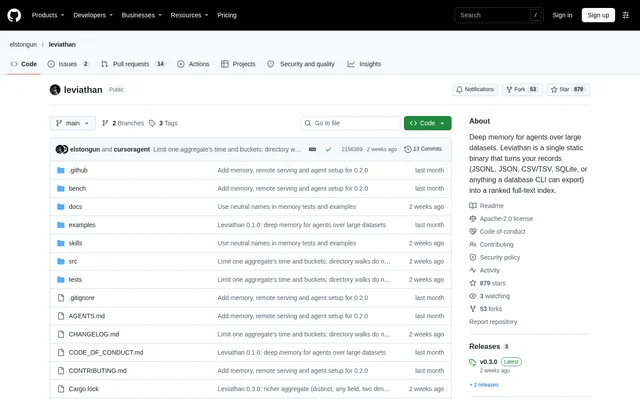
What is Leviathan?
Leviathan is an open-source full-text search and memory project for agents working over large datasets. Leviathan turns tables, exports and logs into a ranked index so an agent can retrieve relevant records rather than read entire files. Search responses contain short result cards with citations, while a separate optional memory system retains claims across agent sessions.
Leviathan is distributed as a single static binary and stores the search index in a SQLite file. The project supports local command-line use as well as optional agent-facing services. Developers can obtain prebuilt binaries from the repository’s Releases page or install the project with Cargo.
What Leviathan can do
Leviathan combines record retrieval, exact aggregation and optional persistent memory. Field mappings control record identifiers, searchable text, group names, dates and displayed fields. A folder containing different datasets can become one index, with dataset kinds available as filters and related records sharing a customer group.
- Leviathan indexes JSONL, JSON, CSV/TSV, SQLite and database CLI output.
- Leviathan returns ranked search cards with record citations.
- Leviathan supports group selection, field filters, date ranges, phrases and exclusions.
- Leviathan calculates exact counts, sums, averages, minimums and maximums.
- Leviathan updates indexed records through upsert and delete commands.
- Leviathan stores keyed memory claims and recalls them within a token budget.
- Leviathan exposes search tools through CLI, MCP and HTTP interfaces.
How Leviathan works
Leviathan streams records into a SQLite file containing an FTS5 index. Search resolves the requested group, matches indexed text and filter values, ranks results using BM25 with boosts, and decodes only the top results into capped cards. Responses report how many matches are shown so agents can distinguish missing matches from missing data.
Leviathan accepts mappings through command-line flags or configuration files, and the init command can infer a commented configuration. Only the identifier field is required. Database exports can be piped into indexing commands through tools such as psql or duckdb, keeping database credentials outside Leviathan.
Who Leviathan is for
Leviathan is for developers giving agents access to records, operational histories and persistent context. Any agent with a shell can call the CLI, and supplied skills support agent instructions. Optional MCP configuration supports agents including Claude Code, Codex, Cursor and Gemini CLI, while HTTP access supports remote clients and agent frameworks.
- Leviathan can retrieve customer-specific support tickets using scoped search.
- Leviathan can search maintenance logs and exported database records.
- Leviathan can connect tickets and orders through shared customer groups.
- Leviathan can preserve preferences and changing facts across agent sessions.
Leviathan licensing and access
Leviathan is an open-source project licensed under Apache-2.0. The repository provides source code, Cargo installation commands and prebuilt release binaries rather than listing commercial subscription plans. Leviathan has no runtime dependencies, and developers can use the local CLI without enabling an HTTP service or remote agent connection.
Leviathan strengths and limitations
Leviathan combines local storage, cited retrieval and several agent access methods in a single binary. Leviathan handles wrapped JSON, alternate CSV delimiters, byte-order marks, Latin-1 and blank headers. Atomic builds and unchanged-input detection support index maintenance, while explicit memory writes and queryable history make memory changes inspectable.
- Leviathan requires command-line setup and dataset mapping.
- Leviathan relies on external database CLIs to export data from other databases.
- Leviathan memory requires explicit writes rather than running a model internally.
- Leviathan benchmarks use a synthetic maintenance log, with methodology and caveats documented separately.
Leviathan FAQ
What is Leviathan?
Leviathan is an open-source search and memory tool for agents working with large datasets. Leviathan turns records into a ranked full-text index and returns short, cited result cards through a CLI or optional MCP and HTTP interfaces.
Is Leviathan open source?
Leviathan is open source under the Apache-2.0 license. Leviathan is available as source code, prebuilt release binaries or a Cargo installation, and the repository does not list commercial subscription plans.
What data formats does Leviathan support?
Leviathan supports JSONL, JSON, CSV/TSV, SQLite and output exported by database CLIs. Leviathan can index folders containing multiple formats and SQLite tables, and supports messy exports including wrapped JSON, alternate delimiters, byte-order marks and Latin-1.
Does Leviathan support MCP and APIs?
Leviathan supports an optional read-only stdio MCP server and an HTTP service exposing Streamable HTTP MCP, REST and OpenAPI. Leviathan also provides agent configuration commands and supports remote authentication through bearer tokens or OAuth 2.1.
How does Leviathan agent memory work?
Leviathan stores optional read/write agent memory in a separate SQLite file. Leviathan records individual claims, replaces changing values by key, provides session-start briefings and limits recall to a token budget. Memory writes are explicit, secrets are refused and history remains queryable.
Does Leviathan run locally?
Leviathan runs as a single static binary with no runtime dependencies and stores its index in a SQLite file. Leviathan remains offline unless configured to serve or connect over HTTP, and external database exports use their own CLIs without Leviathan holding database credentials.
From the community
No reviews yet
Be the first to review this tool. What you write helps the next person choose.