What is Rise?
Rise was a workplace calendar that helped teams schedule meetings around the time they needed for focused work. Rise addressed a common problem: a meeting can split a morning or afternoon into blocks too short for a larger task. The calendar combined everyday scheduling with tools to spot those gaps, test alternative meeting times, and protect longer stretches of uninterrupted work. The company began working on Rise in December 2020 and closed the service on March 31st, 2025.
What Rise could do
Rise combined schedule analysis with tools that could act on a shared calendar. The reporting workflow measured how a team spent its time and estimated how much uninterrupted time it might recover by rearranging meetings. Rise kept simulations separate from live calendar changes, while FocusGuard and Flexible events were designed to improve schedules without requiring users to review every suggestion.
- Rise analyzed team calendars for fragmented work time.
- Rise compared focus time before and after simulated meeting moves.
- Rise used Find a time to help identify a meeting slot.
- Rise used FocusGuard to block off time automatically when schedules became overloaded.
- Rise used event priorities to help resolve conflicts and showed previews of suggested moves.
How Rise worked with team calendars
Rise used a scheduling engine to identify meetings that could move and draft an alternative team schedule. For reports, Rise compared the original and proposed schedules without moving any actual events. Flexible events gave the engine room to optimize eligible events without asking for approval each time. As the team refined the feature, Rise clarified which changes it had made and reduced moves that did not produce a significant improvement.
Rise was designed to serve as the main calendar rather than a separate scheduling interface. The team worked on synchronizing calendars with Google, Outlook, and iCloud, developing Windows and macOS integrations, and rolling out iOS and Android apps. Rise also built calendar functions such as working locations, out-of-office events, alerts, and attachments.
Who Rise was for
Rise was built for workplace teams that wanted to coordinate meetings while preserving time for larger tasks. The company described a pattern in which founders and managers had back-to-back meetings, while colleagues with fewer meetings still lost usable work time when appointments split the day. Rise also added support for meeting rooms and accommodated teams distributed across time zones.
- Teams could find a meeting time that worked across schedules.
- Managers could see where meeting patterns broke up focus time.
- Distributed teams could coordinate meetings across time zones.
- Teams returning to the office could account for meeting rooms.
Rise pricing, refunds, and shutdown
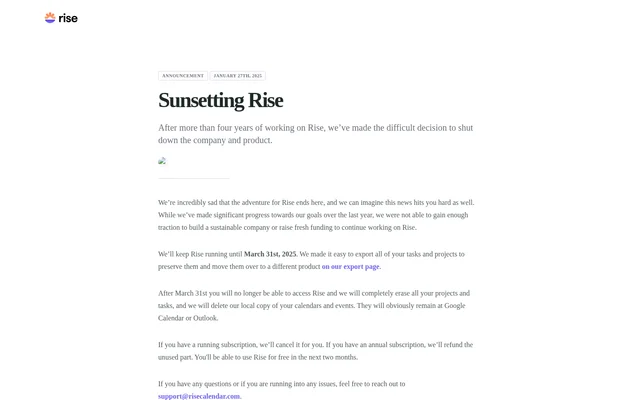
Rise offered paid subscriptions before winding down the product and made access free for its final two months. The shutdown announcement said the company would cancel active subscriptions and refund the unused portion of annual subscriptions. Access ended on March 31st, 2025. Before the closure, Rise provided an export page so users could preserve tasks and projects and move them to another product.
Rise strengths and limitations
Rise let teams see the potential effect of moving meetings without committing to those changes. That distinction made the reports useful for evaluating scheduling options before anything changed on a live calendar. The company said schedule optimization was harder when Rise could see only one person's calendar, because moving a meeting often depended on finding room in several people's schedules.
- Rise is no longer accessible following the shutdown.
- Scheduling improvements depended on access to team members’ calendars.
- Rise said it would erase tasks and projects after shutdown.
- Rise said it would delete its local calendar copies, while events would remain in Google Calendar or Outlook.
What you can do
- Schedule fragmentation reports
- Before-and-after focus time comparisons
- Find a time meeting scheduling
- FocusGuard automatic time blocking
- Flexible events and conflict priorities
- Previews of suggested meeting moves
- Task and project exports before shutdown
Who Rise is for
Workplace teams, managers, and founders
- Finding meeting times that work for a team
- Protecting uninterrupted work time
- Identifying fragmented schedules
- Previewing the effect of moving meetings
- Resolving calendar conflicts by priority
Rise FAQ
What is Rise Calendar?
Rise is a discontinued workplace calendar that helped teams schedule meetings and protect focus time. Rise analyzed how meetings split up the workday and generated reports showing how much uninterrupted time teams might recover by moving meetings.
Was Rise free?
Rise offered paid subscriptions and made the service free for its final two months before shutting down on March 31st, 2025. Rise said it would cancel active subscriptions and refund the unused portion of annual subscriptions.
How did Rise protect focus time?
Rise protected focus time with FocusGuard, which automatically blocked off time when schedules became overloaded. Rise also used Flexible events to optimize meetings that had room to move, and its reports compared uninterrupted focus time before and after simulated scheduling changes.
Which calendars did Rise support?
Rise worked on calendar synchronization with Google, Outlook, and iCloud. The shutdown announcement said Rise would delete its local copies of calendars and events after closure, while events stored in Google Calendar or Outlook would remain there.
Can I still access Rise or export my tasks?
Rise shut down on March 31st, 2025, and said users would no longer be able to access the service after that date. Rise provided a task and project export page before the shutdown and said it would erase those tasks and projects afterward.
From the community
No reviews yet
Be the first to review this tool. What you write helps the next person choose.